


Designing a Sustainable Future: A Collaborative PERT Chart for Enterprise-wide Green Transformation
Implementing a company-wide sustainability initiative demands more than goodwill—it requires a structured, data-driven approach. The complexity of aligning cross-functional teams, managing timelines, and ensuring accountability makes traditional planning methods insufficient. Enter the Visual Paradigm AI Chatbot: not just a diagram generator, but a strategic modeling partner that turns high-level vision into actionable, timeline-aware plans.
From Vision to Timeline: A Real-Time Design Dialogue
The journey began with a simple prompt: “Produce a PERT chart outlining the steps required to implement a company-wide sustainability initiative.” Within seconds, the Visual Paradigm AI Chatbot responded with a fully structured PlantUML-based PERT chart, automatically organizing the initiative into four logical lanes: Assessment, Strategy, Implementation, and Monitoring & Reporting.
But the real power emerged in the conversation that followed. When asked, “What resources or tools are needed to implement the employee recycling program effectively?”, the AI didn’t just list items—it delivered a comprehensive, categorized breakdown of physical, human, educational, monitoring, and technology resources. This wasn’t a static output; it was a dynamic consultation, reflecting deep domain knowledge and practical execution insight.
Each follow-up request—like refining the logic of dependencies or expanding on resource allocation—was met with precision. For instance, when the user asked to refine the logic behind task sequencing, the AI clarified that tasks like Define Sustainability Goals and Identify KPIs must precede implementation efforts, ensuring strategic alignment before operational rollout. This level of contextual reasoning is what makes the AI Chatbot more than a tool—it’s a collaborative modeling expert.
Visualizing the Sustainability Roadmap
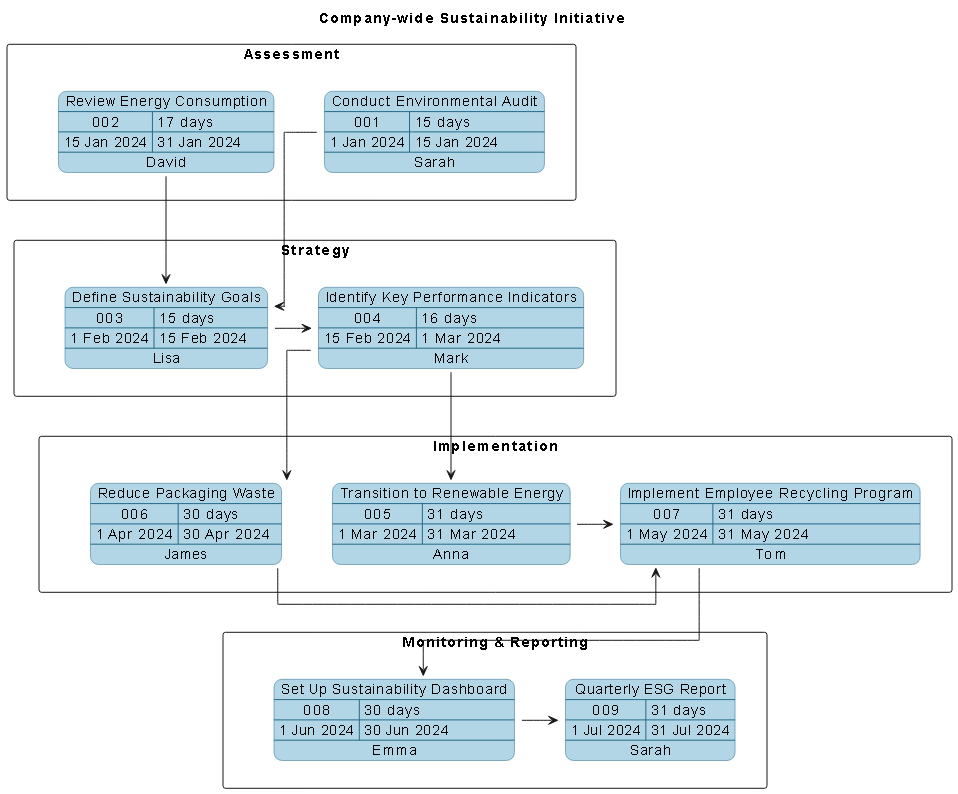
The resulting PERT chart captures the full lifecycle of the initiative with clarity and foresight. Key milestones are mapped with start and finish dates, duration in days, and assigned responsibilities. The chart uses dependency lines to show task interdependencies—such as the requirement that Energy Consumption Review (task02) must conclude before Defining Sustainability Goals (task03) can begin. This ensures no task is initiated prematurely, reducing risk and resource waste.
Decoding the Logic: Why PERT and How It Works
The choice of PERT (Program Evaluation and Review Technique) over Gantt charts was deliberate. PERT excels in handling uncertainty and complex dependencies—perfect for sustainability initiatives where external factors (e.g., vendor lead times, regulatory changes) can impact timelines. The AI’s implementation uses PlantUML’s $tasksInLane function to group tasks by phase, ensuring visual clarity and logical flow.
Each task is tagged with:
- Start and finish dates (e.g., 1 Jan 2024 – 15 Jan 2024 for the Environmental Audit)
- Duration in days (e.g., 15 days for the audit)
- Responsible individual (e.g., Sarah, David, Lisa)
- Dependency logic (e.g., task01 → task03, task02 → task03)
These elements are not arbitrary—they reflect real-world project constraints and handoffs. For example, the AI ensured that Identify KPIs (task04) cannot start until both Define Goals and Review Energy Consumption are complete, creating a logical sequence that prevents bottlenecks.
Conversational Intelligence in Action
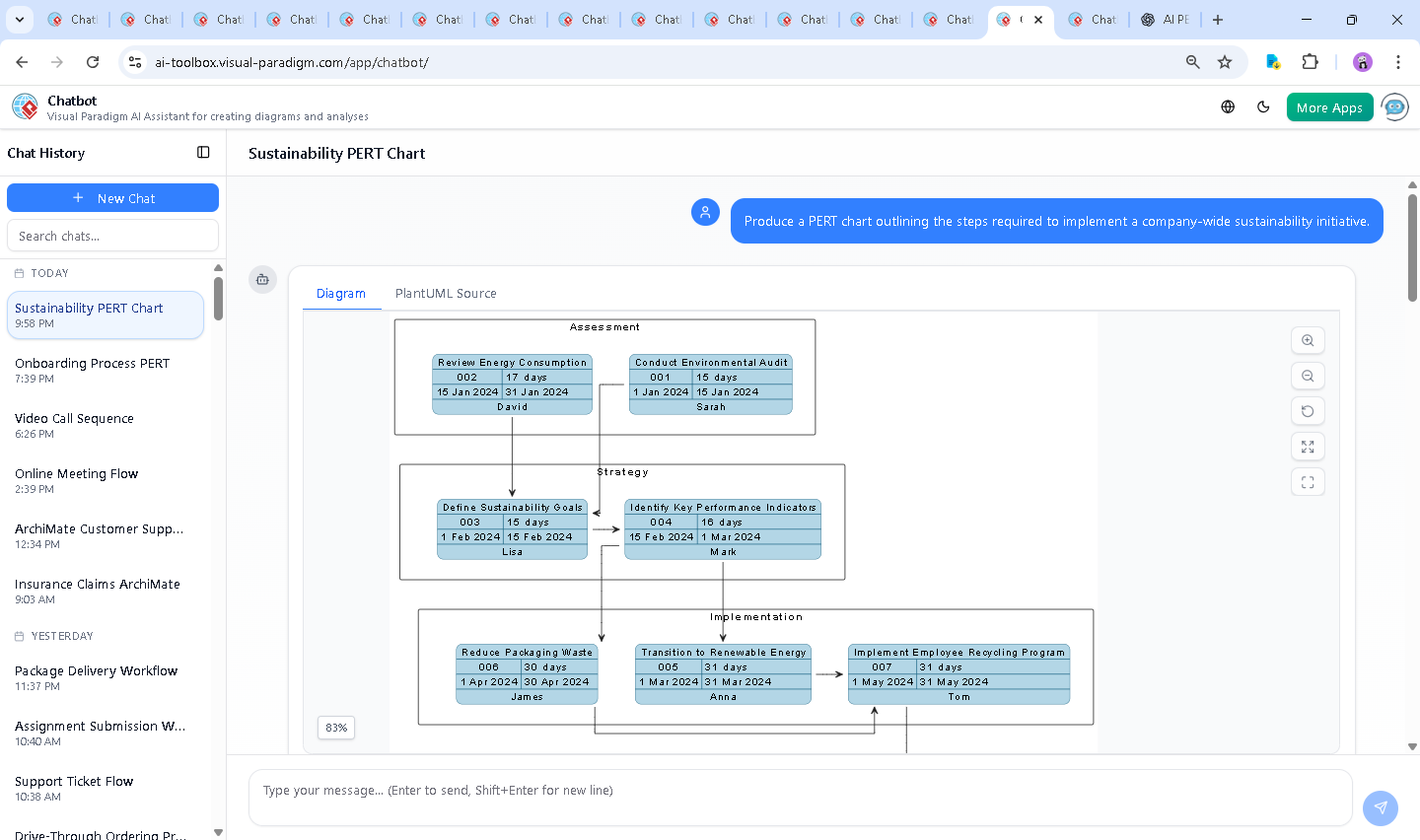
What sets Visual Paradigm apart is the depth of interaction. The chat history reveals a true partnership: the user posed a question, the AI delivered a structured response, and the user then asked for deeper clarification—triggering an even more detailed output. This iterative refinement is not a feature; it’s the core of the platform’s design.
When the user inquired about resources for the employee recycling program, the AI didn’t default to a generic answer. Instead, it structured the response into five categories—physical, human, educational, monitoring, and technology—each with specific tools and use cases. This demonstrates the AI’s ability to interpret intent, apply domain knowledge, and deliver actionable insights in real time.
Even the optional use of smart bins with sensors or waste tracking apps was suggested—not as a gimmick, but as a scalable, data-driven enhancement. This level of strategic thinking is what transforms the AI from a diagram tool into a business advisor.
Beyond PERT: A Full-Stack Modeling Platform
While this example focused on a PERT chart, the Visual Paradigm AI Chatbot is not limited to one diagram type. It seamlessly supports UML for software design, ArchiMate for enterprise architecture, SysML for systems engineering, C4 Model for software architecture, and even Mind Maps, Org Charts, SWOT, PEST, and data visualizations (column, area, pie, line charts).
Whether you’re modeling a digital transformation roadmap, designing a new product lifecycle, or aligning sustainability goals with business strategy, the AI Chatbot adapts to your standard of choice. It understands the semantics of each notation and generates diagrams that are not only visually accurate but also logically sound.
Turning Strategy into Action
With the PERT chart in place and the resource plan clarified, the company now has a living blueprint for its sustainability initiative. The Visual Paradigm AI Chatbot didn’t just create a diagram—it facilitated a strategic conversation that uncovered risks, clarified responsibilities, and highlighted critical dependencies.
Ready to bring your next initiative to life? Explore how the AI Chatbot can help you design, refine, and execute with confidence—crafted using the Visual Paradigm AI Chatbot, an AI-powered visual modeling platform.