


Designing a Scalable Ride-Sharing Architecture with AI-Driven Precision
Creating a robust architecture for a ride-sharing platform demands clarity across business goals, application logic, and real-time technical dependencies. Traditional diagramming tools often require deep expertise in ArchiMate notation and lengthy manual configuration. With the Visual Paradigm AI Chatbot, this complexity is transformed into a conversational design process—where ideas evolve through natural dialogue, not rigid workflows.
From Concept to Diagram: A Collaborative Design Journey
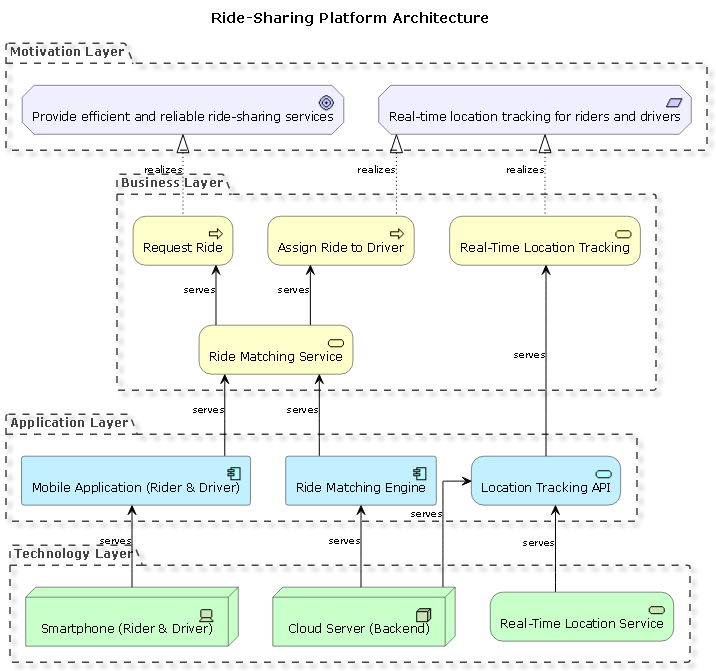
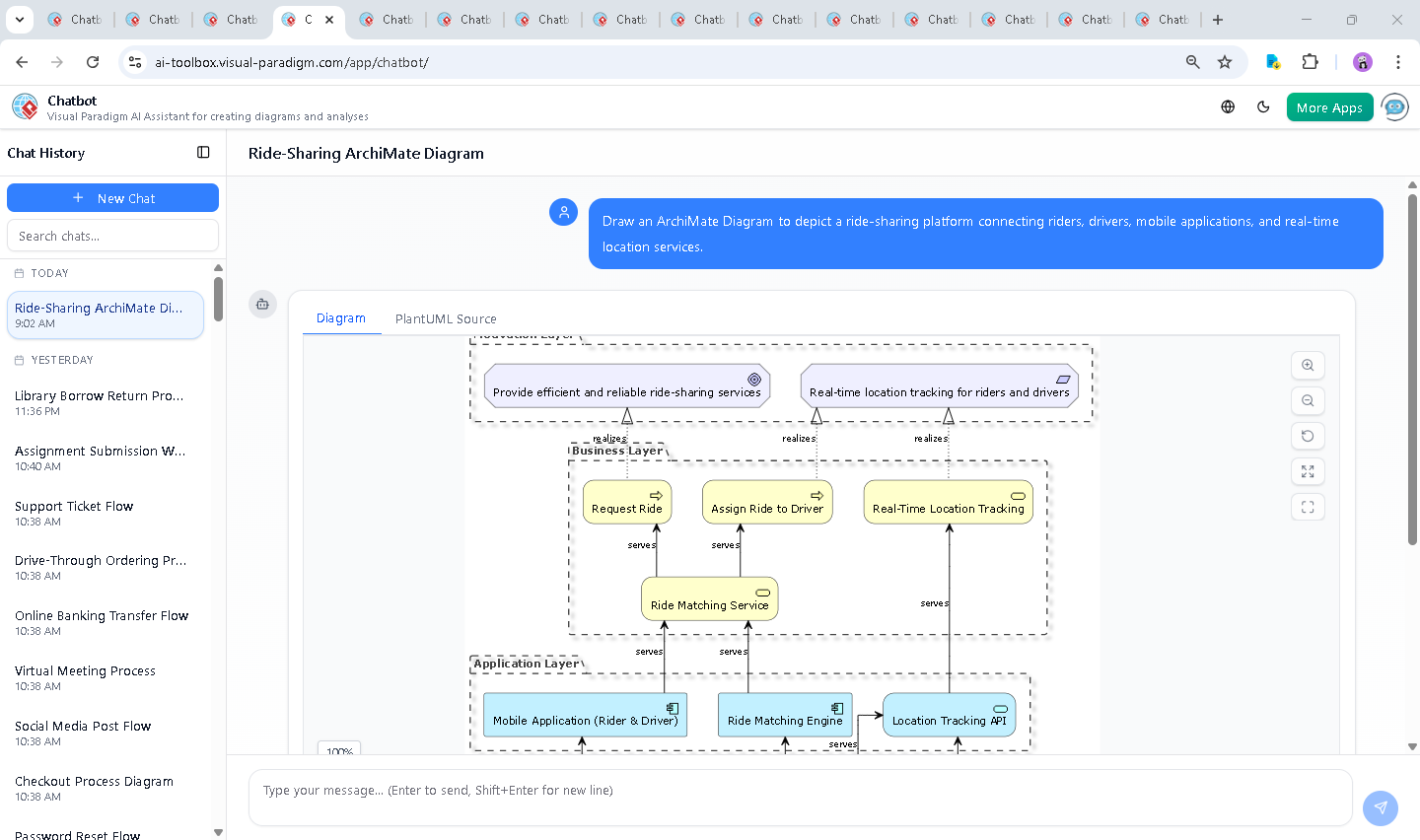
The journey began with a simple prompt: “Draw an ArchiMate Diagram to depict a ride-sharing platform connecting riders, drivers, mobile applications, and real-time location services.” The AI Chatbot immediately interpreted the intent and generated a structured ArchiMate model using PlantUML syntax, complete with layered representation across Motivation, Business, Application, and Technology domains.
But the real value emerged in the follow-up. After reviewing the initial output, the user asked: “AI, refine the logic around the ride-matching process.” The Chatbot responded by enhancing the Business_Service_RideMatching component and strengthening its relationships—ensuring it both serves the Request Ride and Assign Ride to Driver processes, while being realized by the Ride Matching Engine at the application layer.
Further, when the user requested: “Explain this branch from the Location Tracking API to the Real-Time Location Service,” the AI provided a contextual breakdown: “This reflects the service dependency where the API consumes the underlying location service, which handles GPS data aggregation and real-time updates from smartphones.” This level of explanation isn’t just documentation—it’s architectural guidance.
Visualizing the Ride-Sharing Ecosystem
Decoding the Architectural Logic
The generated ArchiMate diagram is not just visually coherent—it’s semantically accurate and aligned with enterprise modeling best practices. Here’s how each layer contributes:
- Motivation Layer: Establishes the strategic intent—delivering efficient, reliable ride-sharing—supported by the requirement for real-time location tracking.
- Business Layer: Defines key actors (Rider, Driver) and services (Ride Matching, Location Tracking), with processes like
Request RideandAssign Ride to Drivercapturing the user journey. - Application Layer: Breaks down the digital components: the
Mobile Applicationserves both riders and drivers, while theRide Matching EngineandLocation Tracking APIact as core system services. - Technology Layer: Deploys infrastructure—
Cloud Serverhosts backend services,Smartphonedevices run the app, andReal-Time Location Serviceprocesses GPS data.
Relationships are precisely modeled: Realization shows how business goals and requirements are implemented; Serving illustrates how components deliver services across layers. For example, the Location Tracking API serves the Business_Service_LocationTracking, which in turn is realized by the Real-Time Location Service—a chain that reflects actual system dependencies.
Conversational Intelligence in Action
What sets the Visual Paradigm AI Chatbot apart is its ability to act as a modeling consultant. The conversation wasn’t one-way; it was iterative and intelligent. When the user questioned the placement of the Location Tracking API, the AI adjusted the diagram’s structure to clarify that it’s an application service, not a technology component—ensuring semantic correctness.
Even after the diagram was complete, the user asked: “Can this be extended to support surge pricing?” The AI responded by adding a new Business_Service(SurgePricingEngine) in the Application layer, linked to the Ride Matching Service via a Serving relationship, and tied to the Motivation_Goal through Realization. This dynamic adaptability demonstrates how the AI doesn’t just generate diagrams—it evolves them with architectural insight.
More Than ArchiMate: A Unified Modeling Platform
The Visual Paradigm AI Chatbot isn’t limited to ArchiMate. It seamlessly supports UML, SysML, C4 Model, and Mind Maps—making it a complete suite for enterprise architects, software engineers, and business analysts. Whether you’re modeling a microservices architecture with SysML, or designing a system context with C4, the AI Chatbot delivers context-aware, accurate diagrams through natural conversation.
Final Thoughts: Designing with Intelligence
Visual Paradigm’s AI Chatbot turns architectural design from a technical chore into a collaborative dialogue. The ride-sharing platform diagram wasn’t just created—it was co-designed, refined, and validated in real time. With AI-powered modeling, every stakeholder—from developers to executives—can engage with the architecture in a way that’s both intuitive and technically sound.
Ready to build your next architecture with confidence? Explore the live session and experience how the AI Chatbot transforms your ideas into precise, professional diagrams.