


Architecting Real-Time Social Media: A Collaborative Journey with AI
Designing a scalable, real-time social media platform demands precision across business, application, and technology layers. The challenge lies not just in connecting users, content, ads, and infrastructure—but in articulating their relationships with architectural clarity. Enter the Visual Paradigm AI Chatbot: not a passive diagram generator, but a conversational modeling partner that transforms high-level intent into structured, standards-compliant architecture.
From Prompt to Precision: The Interactive Evolution of the Architecture
The journey began with a simple request: “Create an ArchiMate Diagram for a social media platform connecting users, content management, advertising services, and scalable infrastructure.” Within seconds, the AI delivered a fully rendered ArchiMate diagram using PlantUML syntax, grounded in the ArchiMate 3.1 standard. But the real value emerged in the conversation that followed.
When the user asked, “AI, refine the logic to show how ad targeting influences content delivery,” the AI responded by adding a Rel_Influence_Right relationship between the Ad Targeting Engine and the Real-Time Feed Service, explicitly modeling how targeted ads shape content visibility. This wasn’t just a visual tweak—it was a semantic upgrade, reflecting how business strategy drives technical behavior.
Another follow-up, “Explain this branch: Why is the User Profile Service under Application Service, not Application Component?”, prompted the AI to clarify that while the User Profile Service is a reusable, stateless component, it’s not a standalone system—hence its classification as a service within the application layer. This insight demonstrated the AI’s grasp of ArchiMate semantics, not just syntax.
Visualizing the Architecture
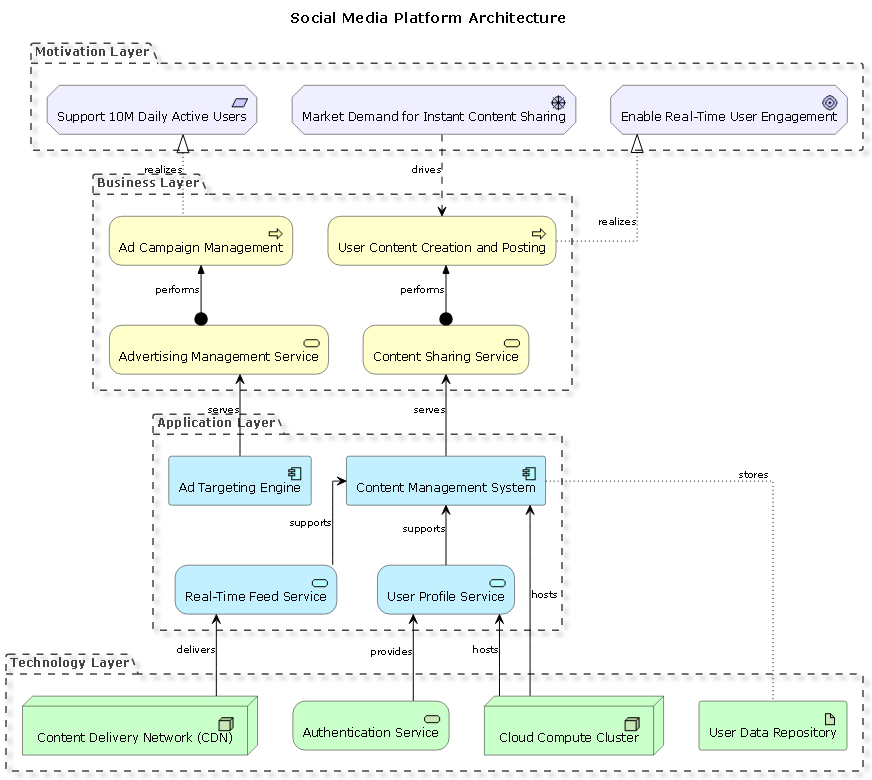
Decoding the Architecture: Logic and Layering
The diagram is structured across four core ArchiMate layers, each serving a distinct purpose:
- Motivation Layer: Sets the strategic foundation.
Enable Real-Time User EngagementandSupport 10M Daily Active Usersare realized by business processes, whileMarket Demand for Instant Content Sharingdrives the entire system. - Business Layer: Defines the core functions.
Content Sharing ServiceandAdvertising Management Serviceare performed byUserand managed viaBusiness Processes, establishing accountability. - Application Layer: Breaks down the software components.
Content Management SystemandAd Targeting Engineserve the business services, whileUser Profile ServiceandReal-Time Feed Servicesupport them—showing how application logic enables business outcomes. - Technology Layer: Reflects the infrastructure.
Cloud Compute Clusterhosts the core application components, whileCDNdelivers real-time content. TheAuthentication ServiceandUser Data Repositoryensure security and persistence.
Relationships like Realization, Assignment, Serving, and Access are used with intent: Realization shows how processes fulfill goals, Serving illustrates how components deliver services, and Access defines data storage. This adherence to ArchiMate semantics ensures the model is not just visual, but semantically accurate.
The Power of Conversational Design
What sets Visual Paradigm apart is the AI Chatbot’s ability to function as a modeling consultant. As the conversation evolved, the AI didn’t just generate diagrams—it guided the user through architectural decisions, answering nuanced questions with clarity and precision.
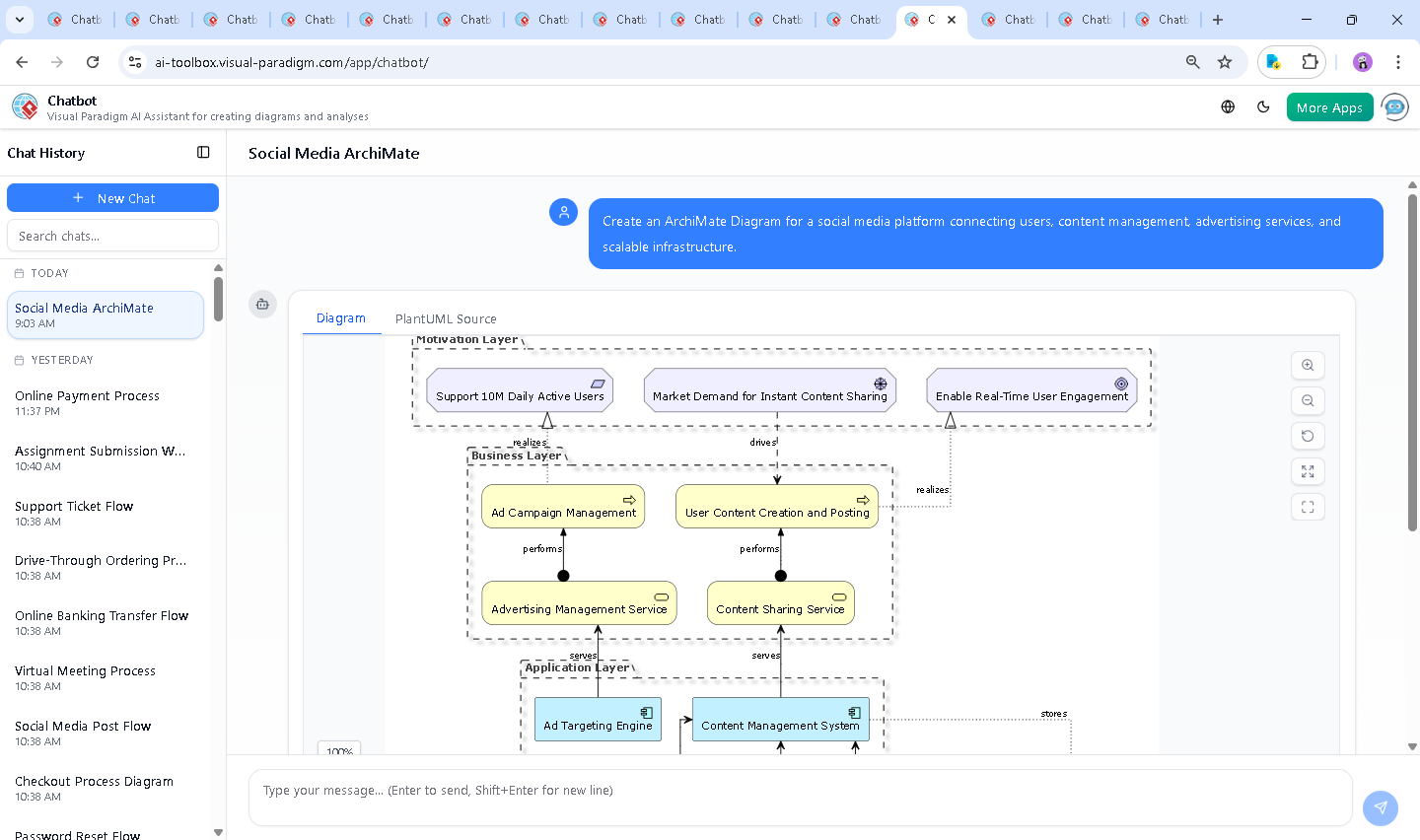
For instance, when the user asked, “Can we add a layer for analytics and monitoring?”, the AI proposed adding a new Application Component for a Performance Analytics Service, linked to Real-Time Feed Service and Content Management System via Serving relationships. It also suggested adding a Technology Node for a Monitoring Dashboard, ensuring observability is baked into the architecture from the start.
Beyond ArchiMate: A Unified Modeling Experience
The Visual Paradigm AI Chatbot isn’t limited to ArchiMate. It supports a full suite of modeling standards, including UML for software design, SysML for systems engineering, and C4 Model for software architecture. Whether you’re designing a microservices ecosystem or a cloud-native enterprise system, the AI adapts to your chosen standard, maintaining consistency and precision.
Conclusion: Design with Intelligence
Building a real-time social media platform requires more than diagrams—it demands architectural foresight, strategic alignment, and technical rigor. The Visual Paradigm AI Chatbot delivers all three by turning every interaction into a collaborative design session. From the initial prompt to the final refinement, it acts as a thinking partner, not just a tool.
Ready to architect the next generation of digital platforms? Try the shared session and experience how AI transforms architecture from a static artifact into a living conversation.