


Designing a Smart Home Ecosystem with AI-Powered Precision
Integrating user controls, IoT devices, automation logic, and cloud platforms into a cohesive smart home ecosystem is no small feat. The complexity of interdependencies—between physical devices, software services, and user behaviors—demands a structured, yet flexible, modeling approach. That’s where the Visual Paradigm AI Chatbot steps in: not as a diagram generator, but as a collaborative design partner that turns high-level ideas into precise, standards-compliant ArchiMate models through natural conversation.
From Prompt to Architecture: A Collaborative Design Journey
It began with a simple request: “Draw an ArchiMate Diagram showing a smart home ecosystem integrating user controls, IoT devices, automation services, and cloud platforms.” The AI Chatbot responded not with a static image, but with a fully structured PlantUML script, already aligned with ArchiMate’s layered architecture—motivation, business, application, and technology layers.
But the conversation didn’t stop there. When the user asked, “Can you explain how the automation rule engine processes user interactions to trigger smart home actions?”, the AI didn’t just summarize—it deepened the model’s intelligence. It broke down the flow into a real-world, step-by-step logic: from user input to rule evaluation, triggering, execution, and feedback.
This wasn’t a one-way handoff. The AI acted as a modeling consultant, refining the narrative behind the diagram. It clarified relationships—like how the Business Process triggers the Automation Rule Engine, which in turn commands the Technology Devices via the Home Gateway. Each clarification strengthened the model’s fidelity and operational clarity.
Visualizing the Smart Home Ecosystem
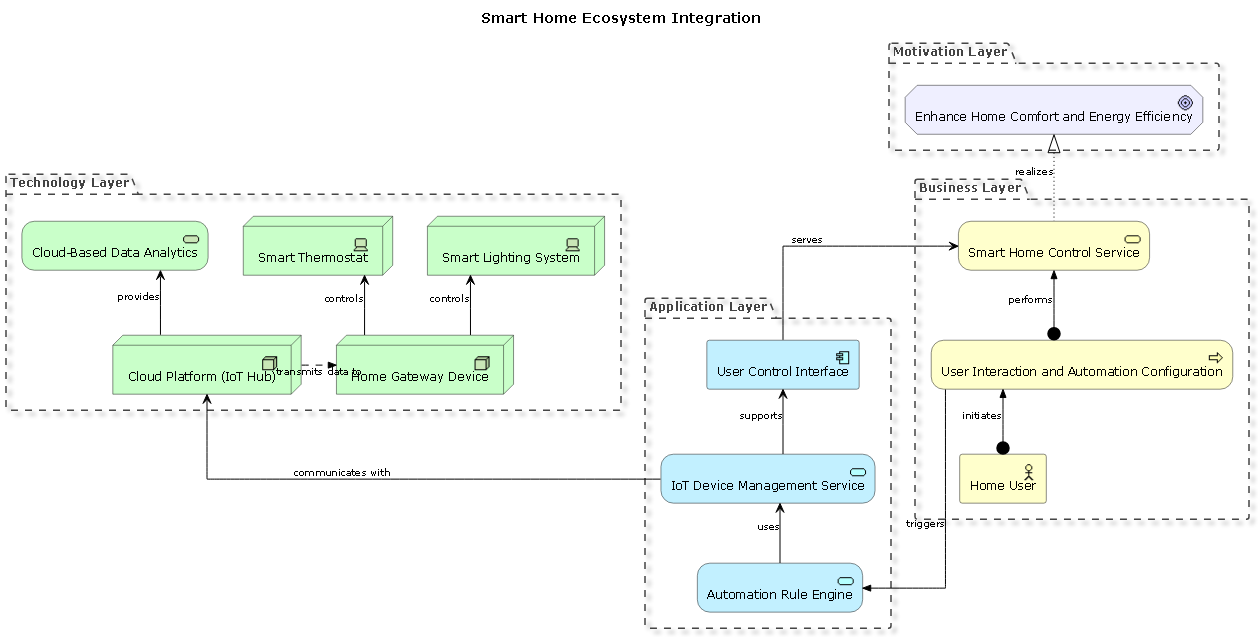
The final ArchiMate diagram captures the full lifecycle of automation: from user intent to physical action. It shows the Home User initiating a process that flows through the Smart Home Control Service, is processed by the Automation Rule Engine, and executed via the Cloud Platform and Home Gateway on physical devices like the Smart Thermostat and Smart Lighting System.
Decoding the Logic: Why Each Layer Matters
The diagram’s structure isn’t arbitrary—it’s grounded in ArchiMate’s layered modeling philosophy, which ensures clarity across technical, business, and strategic levels.
1. Motivation Layer: The Why
The Enhance Home Comfort and Energy Efficiency goal underpins every interaction. This layer answers the fundamental question: Why are we building this system? Without it, the model lacks purpose.
2. Business Layer: The Who and What
The Home User initiates actions. The Smart Home Control Service performs the core business function. The Business Process captures the sequence of user-driven automation setup—making the system user-centric.
3. Application Layer: The How
The User Control Interface and IoT Device Management Service form the application backbone. But the real intelligence lies in the Automation Rule Engine, which interprets rules and orchestrates actions based on conditions.
4. Technology Layer: The Where and How It Runs
Here, the Cloud Platform (IoT Hub) acts as the central nervous system—storing rules, processing data, and enabling remote access. The Home Gateway Device bridges the cloud and local devices, ensuring responsiveness even during internet outages. Devices like the Smart Thermostat and Smart Lighting System are the physical endpoints.
Relationships are carefully mapped: Realization shows how services fulfill goals; Serving illustrates how components enable others; Flow captures data transmission between nodes. These aren’t just lines—they’re semantic commitments to system behavior.
Conversational Intelligence: The AI as a Modeling Expert
What sets Visual Paradigm apart is how the AI Chatbot evolves with the user. When the user requested an explanation of the automation flow, the AI didn’t just describe—it contextualized. It explained how a rule like “Turn off lights after 10 PM if no motion is detected” is evaluated in real time, how sensors feed into the decision engine, and how feedback loops support learning and optimization.
Each follow-up—like asking for clarification on how a rule is triggered or which component sends the command—was met with a precise, annotated response that enriched the model’s depth. This isn’t automation; it’s co-design.
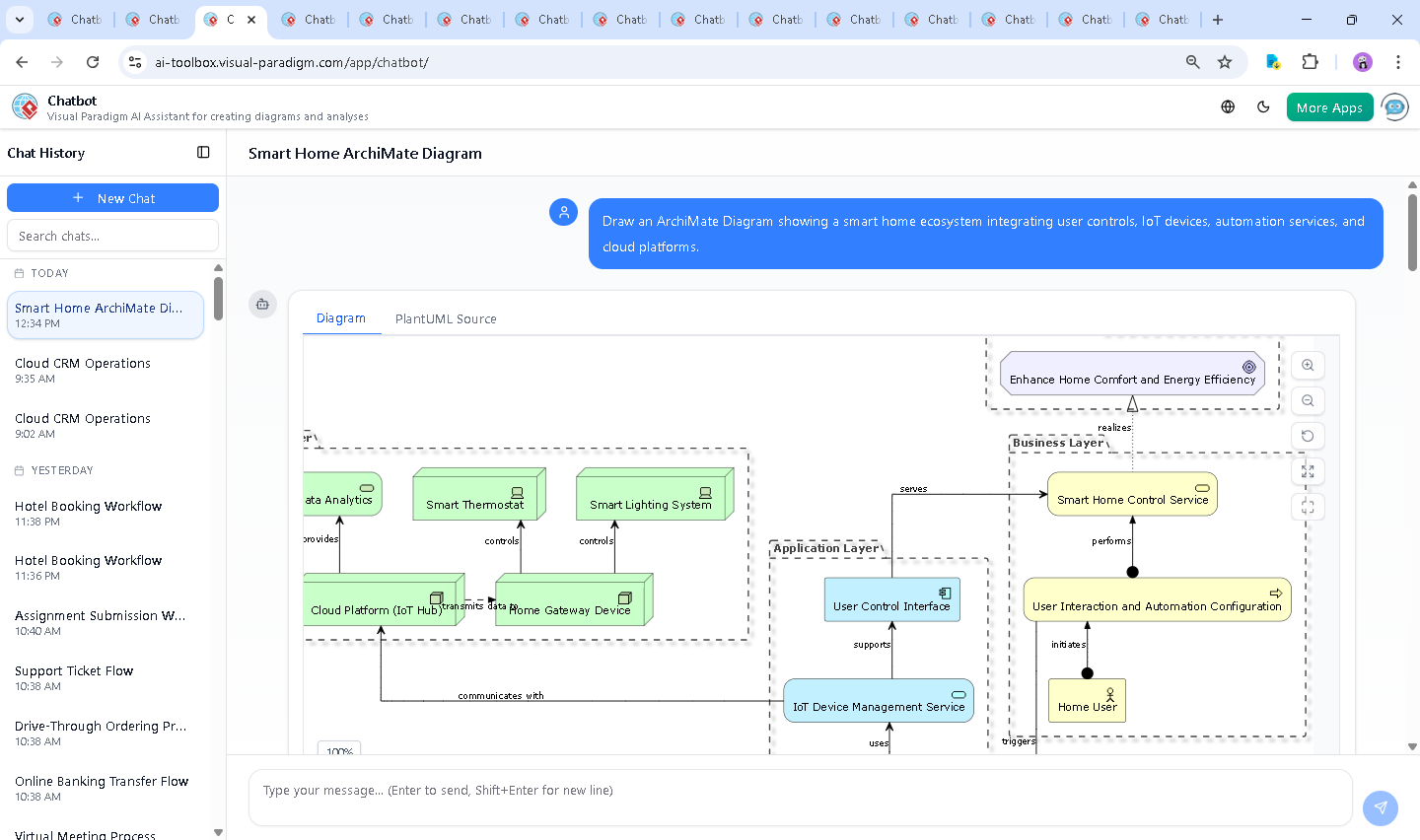
The chat history shows a true partnership: the user proposes, the AI responds with expertise, and together, they refine the architecture. This is the power of an AI-powered visual modeling platform—where every conversation strengthens the design.
Beyond ArchiMate: A Unified Modeling Suite
While this example focused on ArchiMate, the Visual Paradigm AI Chatbot is not limited to one standard. It seamlessly supports UML for software design, SysML for systems engineering, C4 Model for software architecture, and Mind Maps for process and idea visualization.
Whether you’re modeling enterprise strategy, designing a cloud-native application, or visualizing a user journey, the AI Chatbot adapts to your domain—always maintaining precision, consistency, and semantic clarity.
Conclusion: Design with Intelligence, Not Guesswork
Creating a smart home ecosystem isn’t just about connecting devices—it’s about designing a system that understands user intent, responds intelligently, and evolves over time. With Visual Paradigm’s AI Chatbot, that design process becomes a dialogue—between human vision and machine intelligence.
Try it yourself: Explore the shared session and experience how the AI Chatbot transforms ideas into structured, intelligent models—crafted using the Visual Paradigm AI Chatbot.