


Designing a Future-Ready HR System with AI-Powered Precision
Building a human resources management system that seamlessly supports recruitment, onboarding, and employee self-service demands more than just technical functionality—it requires architectural clarity, regulatory foresight, and operational agility. The challenge lies in visualizing complex interdependencies across business processes, application components, and data flows while ensuring compliance with evolving legal standards.
Enter the Visual Paradigm AI Chatbot—not just a diagram generator, but a conversational modeling partner. From the initial prompt to the final compliance integration, the AI guided the design process with contextual intelligence, turning high-level requirements into a structured, standards-compliant ArchiMate diagram.
From Concept to Compliance: A Collaborative Design Journey
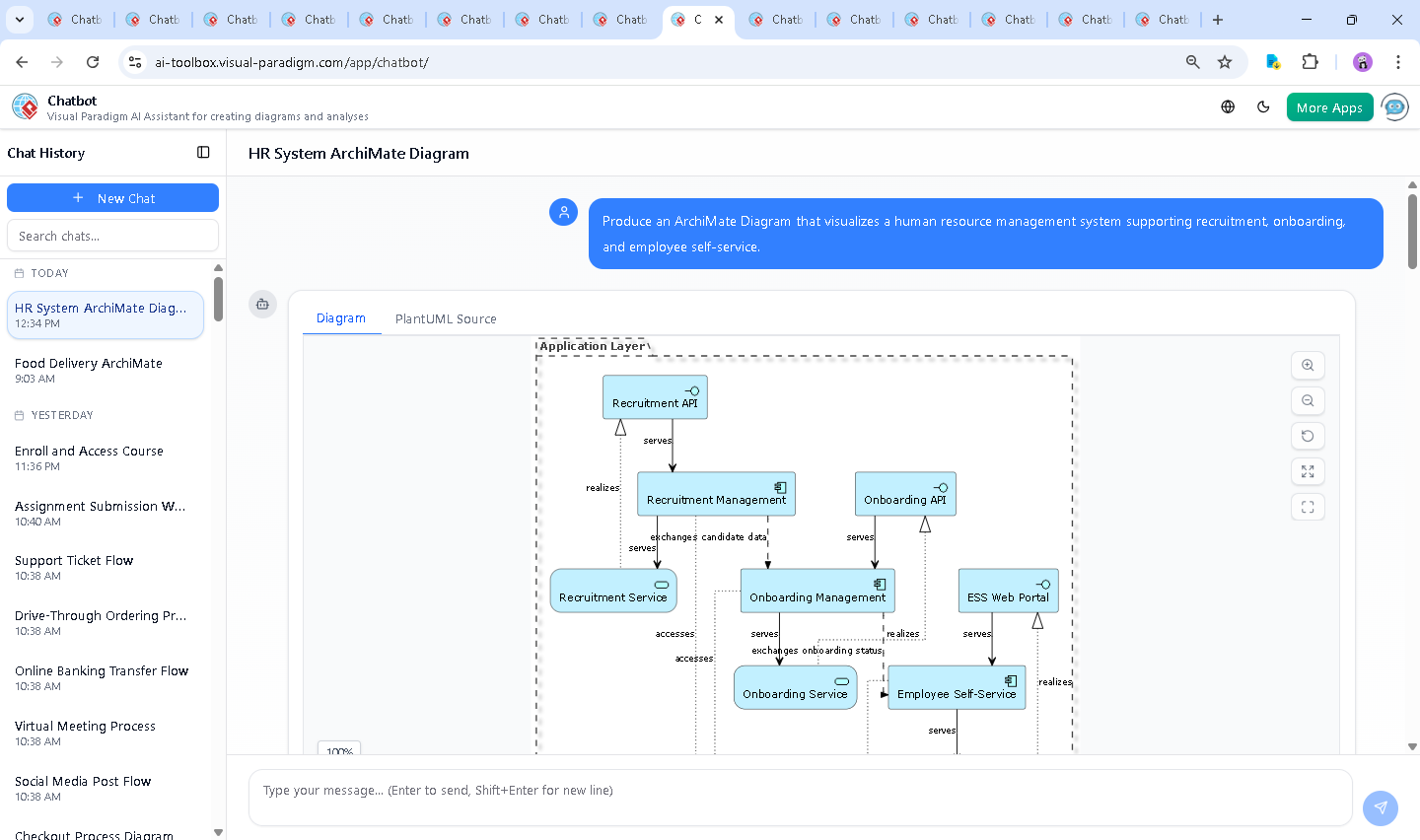
The journey began with a simple directive: “Produce an ArchiMate Diagram that visualizes a human resource management system supporting recruitment, onboarding, and employee self-service.” Within seconds, the AI responded with a fully structured PlantUML representation of the system, already reflecting the core layers of the application architecture.
But the real value emerged in the conversation. When asked, “What additional components would be needed to support compliance tracking?”, the AI didn’t offer generic suggestions. Instead, it delivered a comprehensive, functionally grounded extension—detailing a Compliance Management Module, a Rule Engine, a Document Repository, and a Real-Time Alert System, each with clear roles and integration points.
Each follow-up request was treated as a design refinement opportunity. For example, when the user requested clarification on data flow logic, the AI responded with precise ArchiMate relationships—Rel_Flow for data exchange, Rel_Access for data retrieval, and Rel_Serving to show service delivery—ensuring semantic accuracy.
This wasn’t a one-way output. The AI adapted its responses based on context, suggesting integration points, validating architectural patterns, and even proposing a Compliance Dashboard for executive visibility. The conversation evolved from a basic diagram to a living model of a risk-aware, audit-ready HR system.
The Complete HR Management System Architecture
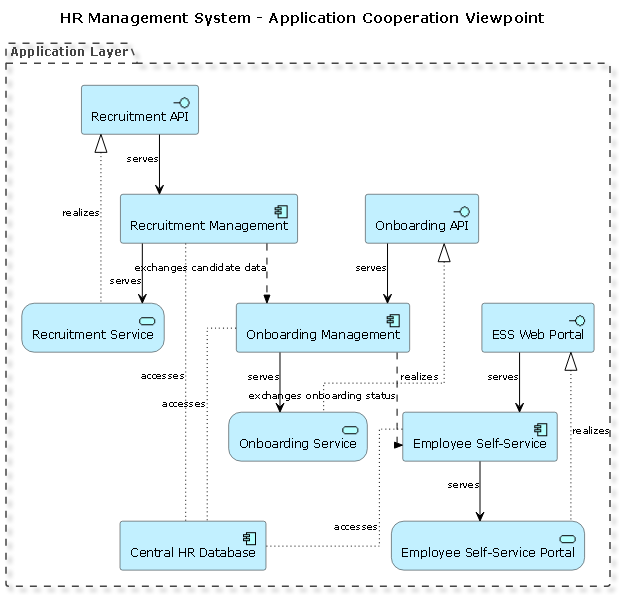
Decoding the Logic: Why This ArchiMate Design Works
The final diagram is not just visually clean—it’s semantically precise. Let’s break down the key architectural decisions:
Application Layer Structure
The system is organized into four core application components:
- HR_Recruitment: Handles job postings, candidate screening, and interview scheduling.
- HR_Onboarding: Manages new hire setup, document collection, and training plans.
- HR_ESS: Empowers employees to manage their profiles, leave requests, and benefits.
- HR_CentralHR: The shared data backbone—storing employee records, payroll, and performance data.
Service and Interface Relationships
Each component is supported by dedicated services and interfaces:
HR_RecruitmentServiceandHR_OnboardingServiceprovide backend logic.HR_RecruitmentInterface,HR_OnboardingInterface, andHR_ESSInterfaceexpose APIs and web portals for access.- These are linked via
Rel_Realization_Upto show that services are implemented by interfaces.
Data Flow and Access Patterns
Key interactions are modeled using standard ArchiMate relations:
Rel_Access: All three components access theHR_CentralHRdatabase.Rel_Flow:HR_Recruitmentexchanges candidate data withHR_Onboarding, andHR_Onboardingshares status updates withHR_ESS.Rel_Serving: Services are consumed by components, reflecting the layered architecture.
Compliance Integration (The AI-Enhanced Layer)
When compliance was introduced, the AI didn’t just add new boxes—it embedded them into the existing structure with purpose:
HR_ComplianceTrackeracts as a central monitor.Compliance_RuleEnginedynamically enforces jurisdiction-specific rules.HR_AuditLogandCompliance_AlertEngineensure traceability and proactive risk management.Compliance_Dashboardprovides visibility for leadership and auditors.
These components are designed to interoperate with existing modules, ensuring compliance isn’t an afterthought—it’s built into the system’s DNA.
Conversational Intelligence in Action
The true power of the Visual Paradigm AI Chatbot lies in its ability to engage in technical dialogue. Unlike static tools, it responds to queries with architectural insight, adjusting the model in real time.
For instance, when the user asked for a deeper explanation of a specific branch, the AI provided a detailed breakdown of the Rel_Flow relationship between onboarding and ESS—clarifying that status updates are not just sent, but verified and logged.
Each iteration refined the design, demonstrating the AI’s understanding of both business intent and modeling standards. The chat history is a testament to a collaborative design process—where the user leads with vision, and the AI responds with precision.
More Than ArchiMate: A Unified Modeling Platform
While this example focuses on ArchiMate, the Visual Paradigm AI Chatbot is built to support a full spectrum of modeling standards. Whether you’re designing a UML system for software development, a SysML model for systems engineering, or a C4 Model for software architecture, the AI adapts to your needs.
This versatility means teams can use a single platform across departments—HR, IT, engineering, and product teams—without switching tools or relearning workflows. The AI understands the nuances of each standard, ensuring consistency, accuracy, and speed in every model.
Empower Your Architecture with AI-Driven Clarity
The HR management system diagram is more than a visual—it’s a blueprint for a resilient, compliant, and user-centric organization. With the Visual Paradigm AI Chatbot, you’re not just creating diagrams. You’re co-designing systems with intelligent guidance, real-time feedback, and architectural integrity.
Ready to transform your next design challenge? Start your conversation today and experience the future of visual modeling.