


Designing a Resilient Financial Trading Platform with AI-Powered Architectural Clarity
Building a real-time financial trading platform demands more than fast code—it requires a precise, layered understanding of how market data, trading logic, and risk controls interlock. The complexity of aligning business goals, application behavior, and infrastructure performance calls for a modeling approach that’s both rigorous and intuitive. This is where the Visual Paradigm AI Chatbot steps in—not as a diagram generator, but as a collaborative modeling partner that transforms high-level intent into structured, standards-compliant architecture.
From Concept to Architecture: A Conversation That Shapes Design
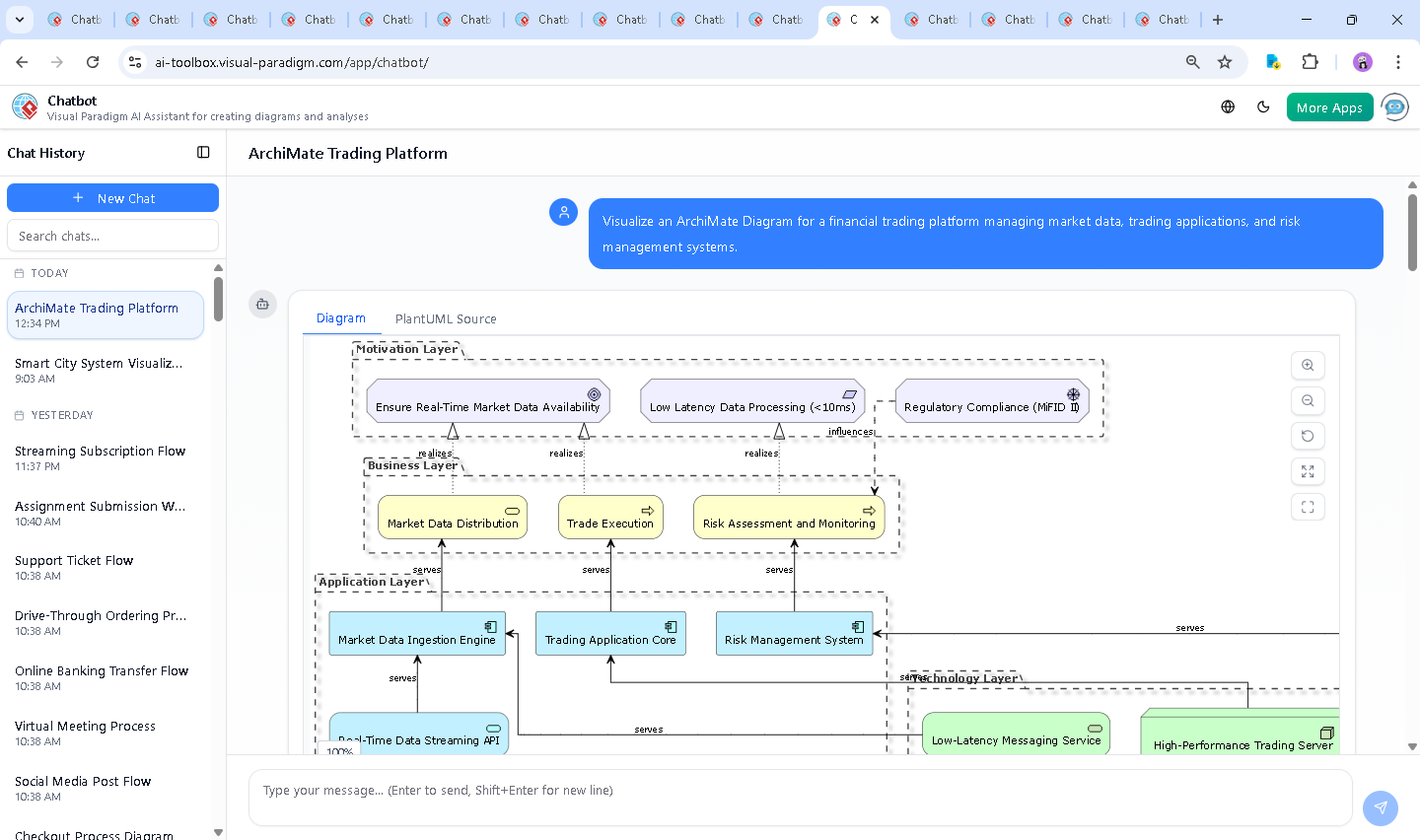
The journey began with a simple prompt: “Visualize an ArchiMate Diagram for a financial trading platform managing market data, trading applications, and risk management systems.” Within seconds, the AI Chatbot delivered a fully rendered ArchiMate diagram using PlantUML syntax, already structured across the four layers—Motivation, Business, Application, and Technology—ensuring architectural depth from the start.
But the real value emerged in the conversation that followed. When asked, “Can you explain how the risk management system interacts with the trading application core in more detail?”, the AI didn’t just restate the diagram. It launched into a detailed breakdown of the interaction logic, explaining how pre-trade validation, real-time monitoring, and post-trade analysis are orchestrated through precise ArchiMate relationships.
For instance, the AI clarified that the Rel_Serving_Up relationship between the Risk Management System and Trading Application Core isn’t just visual—it reflects a real dependency where risk checks are enforced before trade execution. It also highlighted how Rel_Realization_Up from the Risk Assessment Process to Motivation Goals ensures that risk controls are not just technical features but strategic enablers of compliance and stability.
This level of contextual insight—offering not just structure, but rationale—demonstrates the AI Chatbot’s role as a modeling consultant. It doesn’t just draw diagrams; it helps you think through them.
Decoding the Architecture: Why the Structure Works
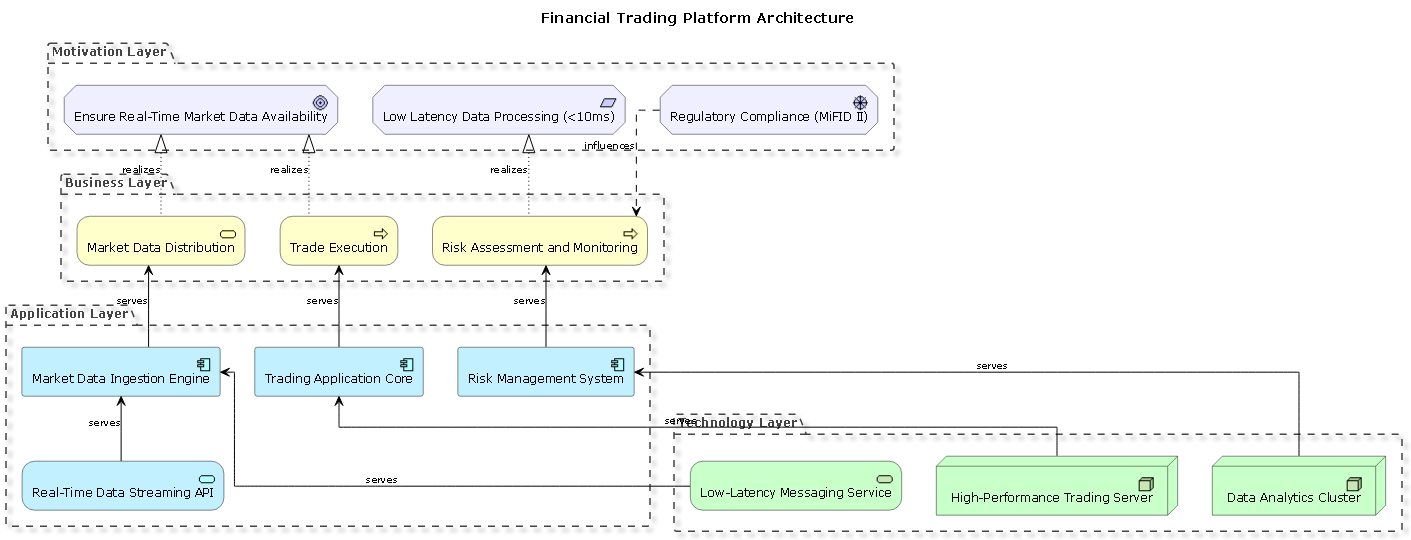
The final ArchiMate diagram is more than a visual—it’s a strategic blueprint. Let’s walk through its core components and the reasoning behind each choice:
1. Motivation Layer: The Strategic Foundation
At the top, the Business Goal of Ensuring Real-Time Market Data Availability is linked to two key drivers:
- Low Latency Data Processing (<10ms) – a technical requirement critical for high-frequency trading.
- Regulatory Compliance (MiFID II) – a compliance mandate that influences operational design.
These aren’t just labels—they’re the north stars. The AI ensured these were represented using Motivation_Goal and Motivation_Driver elements, with Rel_Influence_Right showing how regulation shapes risk behavior.
2. Business Layer: Core Operations
The business layer defines the platform’s operational heartbeat:
- Market Data Distribution – the service that delivers real-time data to traders.
- Trade Execution and Risk Assessment and Monitoring – two critical processes that define the platform’s functionality.
- Trading Desk – the business actor initiating trades.
Each is linked via Rel_Realization_Up to the motivation layer, proving that business processes are directly tied to strategic intent.
3. Application Layer: The Engine Room
This layer contains the software components that power the platform:
- Market Data Ingestion Engine – receives and processes raw data feeds.
- Trading Application Core – executes trades based on strategy and risk rules.
- Risk Management System – monitors and enforces risk thresholds.
- Real-Time Data Streaming API – exposes data to external systems.
These components are connected through Rel_Serving_Up, showing how the risk system serves the trading core, and how the data ingestion engine serves the streaming API.
4. Technology Layer: The Infrastructure Backbone
At the base, the physical and technical foundation ensures performance:
- High-Performance Trading Server – hosts the trading application.
- Data Analytics Cluster – processes historical and real-time risk data.
- Low-Latency Messaging Service – enables real-time communication between components.
- Market Data Feed Configuration File – a technical artifact that defines feed settings.
These elements are served by the application components, reinforcing that infrastructure supports functionality—not the other way around.
Conversational Intelligence: Where the AI Adds Real Value
What sets Visual Paradigm’s AI Chatbot apart is its ability to engage in a true dialogue. When the user asked for a deeper explanation of the risk-trading interaction, the AI didn’t default to a static diagram. Instead, it:
- Explained the why behind each relationship.
- Provided a real-world scenario showing how a high-risk trade is blocked.
- Highlighted how low-latency interactions (<10ms) are essential in HFT environments.
- Reinforced compliance with MiFID II and Basel III.
This isn’t automation—it’s intelligent collaboration. The AI isn’t just generating diagrams; it’s guiding architectural decisions with domain expertise.
More Than ArchiMate: A Unified Modeling Platform
While this example focused on ArchiMate, the Visual Paradigm AI Chatbot is built to support a full spectrum of modeling standards. Whether you’re designing a UML system architecture, a SysML model for complex systems engineering, or a C4 Model for software architecture, the same AI intelligence applies.
Ask for a component diagram for a microservices system, and it delivers with precise notation. Request a context diagram for a new fintech product, and it generates a clean, compliant model—complete with natural language reasoning. The AI doesn’t switch modes; it adapts its knowledge to the standard, the context, and your intent.
Conclusion: Architecting with Confidence
Visual Paradigm’s AI Chatbot isn’t a tool—it’s a modeling partner. By turning natural language prompts into structured, standards-compliant ArchiMate diagrams, and then deepening the design through conversational refinement, it empowers architects to build resilient, compliant, and future-ready systems.
Whether you’re designing a high-frequency trading platform or a cloud-native enterprise system, the platform’s ability to understand intent, respond with precision, and evolve through dialogue makes it the ideal choice for modern architecture.
Ready to design your next system with AI-powered clarity? Explore the live session and see how the AI Chatbot turns ideas into architecture—step by step, conversation by conversation.