


Designing a Secure Multi-Recipient Fund Transfer: From Idea to Precision with AI
Creating a robust sequence diagram for an online banking system’s fund transfer process demands more than technical accuracy—it requires foresight into real-world edge cases. The challenge lies in modeling not just the core flow, but also error handling, scalability, and compliance. That’s where the Visual Paradigm AI Chatbot steps in as a collaborative modeling expert, transforming natural language into structured, precise UML diagrams—without requiring users to master complex syntax.
From Single Transfer to Multi-Recipient: A Collaborative Evolution
The journey began with a simple request: “Draw a sequence diagram showing how an online banking system processes a fund transfer between accounts.” The AI Chatbot responded instantly with a fully rendered PlantUML-based sequence diagram, complete with lifelines, activation bars, and conditional branches—capturing the essence of a secure transfer from user initiation to audit logging.
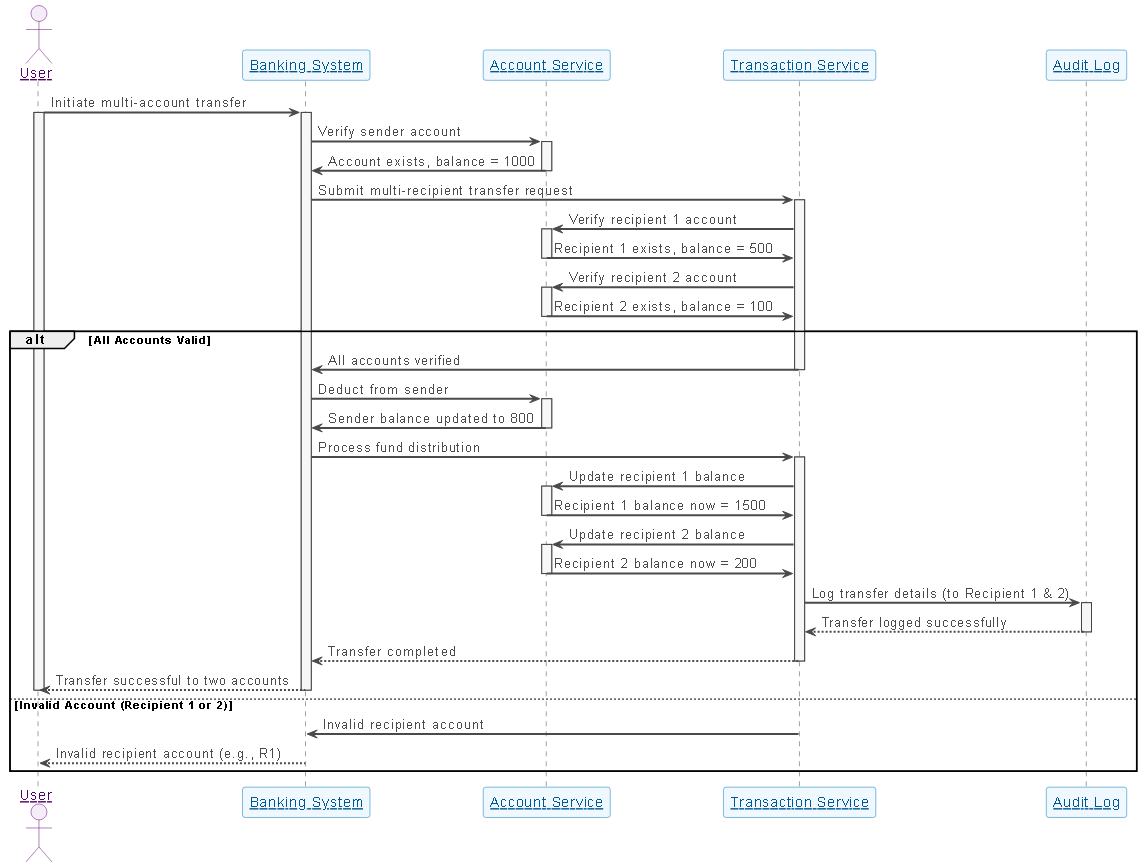
But the conversation didn’t stop there. The user asked: “How would the sequence diagram change if we added a second recipient for a multi-account transfer?” This follow-up wasn’t just a tweak—it was a design challenge. The AI responded with a revised diagram that expanded the logic to include:
- Independent verification of both recipient accounts
- Parallel or sequential validation steps
- Conditional fund distribution logic
- Enhanced audit logging for multiple recipients
- Failure handling if any recipient is invalid
Each refinement was delivered with clear explanations and a deep understanding of transactional integrity—proof that the AI isn’t just generating diagrams, but acting as a modeling consultant.
Decoding the Logic: Why This Sequence Diagram Works
The diagram’s structure follows a strict sequence of events, grounded in real-world banking operations:
- User Initiation: The user triggers the transfer via the banking interface.
- Sender Account Validation: The system checks if the sender’s account exists and has sufficient funds.
- Recipient Verification: The system verifies both recipient accounts individually—ensuring they’re valid and active.
- Fund Deduction & Distribution: After validation, the sender’s balance is reduced, and funds are distributed to each recipient.
- Audit Logging: All actions are recorded for compliance, traceability, and fraud detection.
- Success or Error Response: The system communicates the outcome—success or a specific error (e.g., invalid account, insufficient funds).
The use of alt blocks for conditional logic (e.g., alt All Accounts Valid) ensures clarity in decision-making. The deactivate commands maintain visual fidelity, showing when each component is no longer active—critical for understanding timing and concurrency.
Importantly, the AI chose Sequence Diagrams because they excel at modeling the time-ordered interactions between system components. This makes them ideal for transactional workflows where timing, dependency, and failure points matter.
Conversational Intelligence: The AI as a Modeling Partner
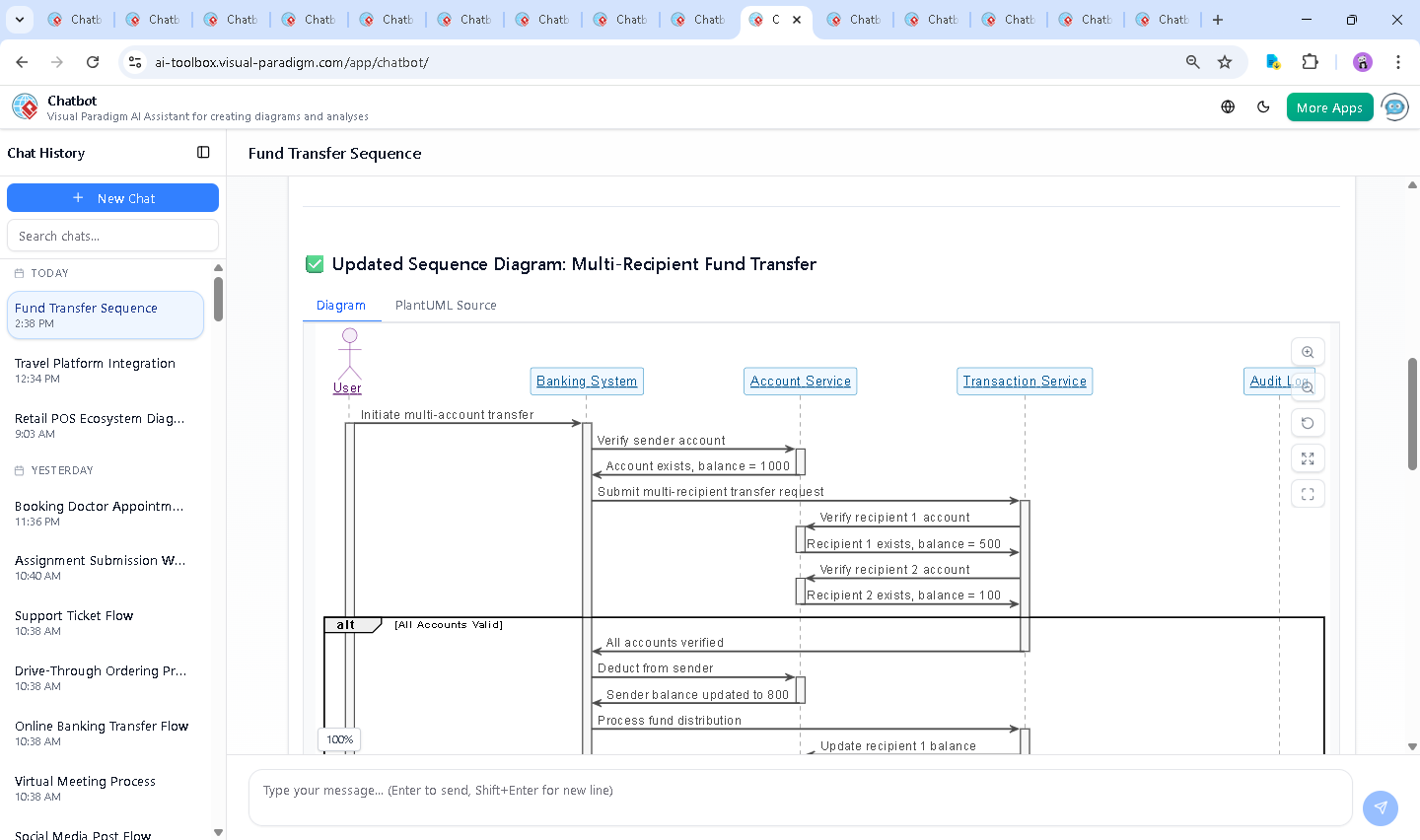
What sets Visual Paradigm apart is not just the diagram output—but the dialogue that shapes it. The AI didn’t just generate a static image. It responded to follow-up requests with precision and depth:
- “Explain this branch” → The AI clarified the difference between
altandelseblocks. - “Can we add dynamic allocation?” → The AI proposed user-defined split rules and suggested adding parameters.
- “What about rollback on failure?” → The AI hinted at atomic transaction patterns and rollback mechanisms.
These exchanges showcase the AI’s ability to think ahead—anticipating design needs before they’re explicitly stated.
Beyond Sequence Diagrams: A Full Modeling Suite
The Visual Paradigm AI Chatbot isn’t limited to sequence diagrams. It’s a multi-standard intelligence engine capable of generating models in:
- UML: Use Case, Class, Activity, and Component diagrams
- ArchiMate: Enterprise architecture models for business, application, and technology layers
- SysML: For complex systems engineering and requirements modeling
- C4 Model: Context, Containers, Components, and Code views for software architecture
- Mind Maps: For brainstorming
This versatility means teams can use a single platform for end-to-end design—from concept to deployment—without switching tools or relearning syntax.
Conclusion: Design with Confidence, Not Guesswork
Whether you’re modeling a simple fund transfer or a complex multi-recipient workflow, Visual Paradigm’s AI Chatbot turns abstract ideas into precise, production-ready diagrams—through natural conversation. It doesn’t just draw diagrams; it guides design decisions, anticipates edge cases, and ensures consistency across standards.
Ready to build smarter? Try the shared session and experience how the AI transforms your vision into a clear, actionable model.