


From Idea to Precision: How the Visual Paradigm AI Chatbot Models Blog Comment Flows
Designing a clear, accurate sequence diagram for a blog comment system isn’t just about drawing lines and boxes—it’s about capturing the real-world logic of user interaction, error handling, and system coordination. The challenge lies in balancing simplicity with completeness, ensuring every path—from successful posting to network failures—is modeled with precision.
Enter the Visual Paradigm AI Chatbot: not a passive diagram generator, but an intelligent modeling partner. When prompted to visualize how a user posts and views comments on a blog platform, the AI didn’t just produce a static diagram. It initiated a conversational design process—refining logic, clarifying intent, and adapting to feedback in real time.
Interactive Journey: Conversing with the AI to Shape the Model
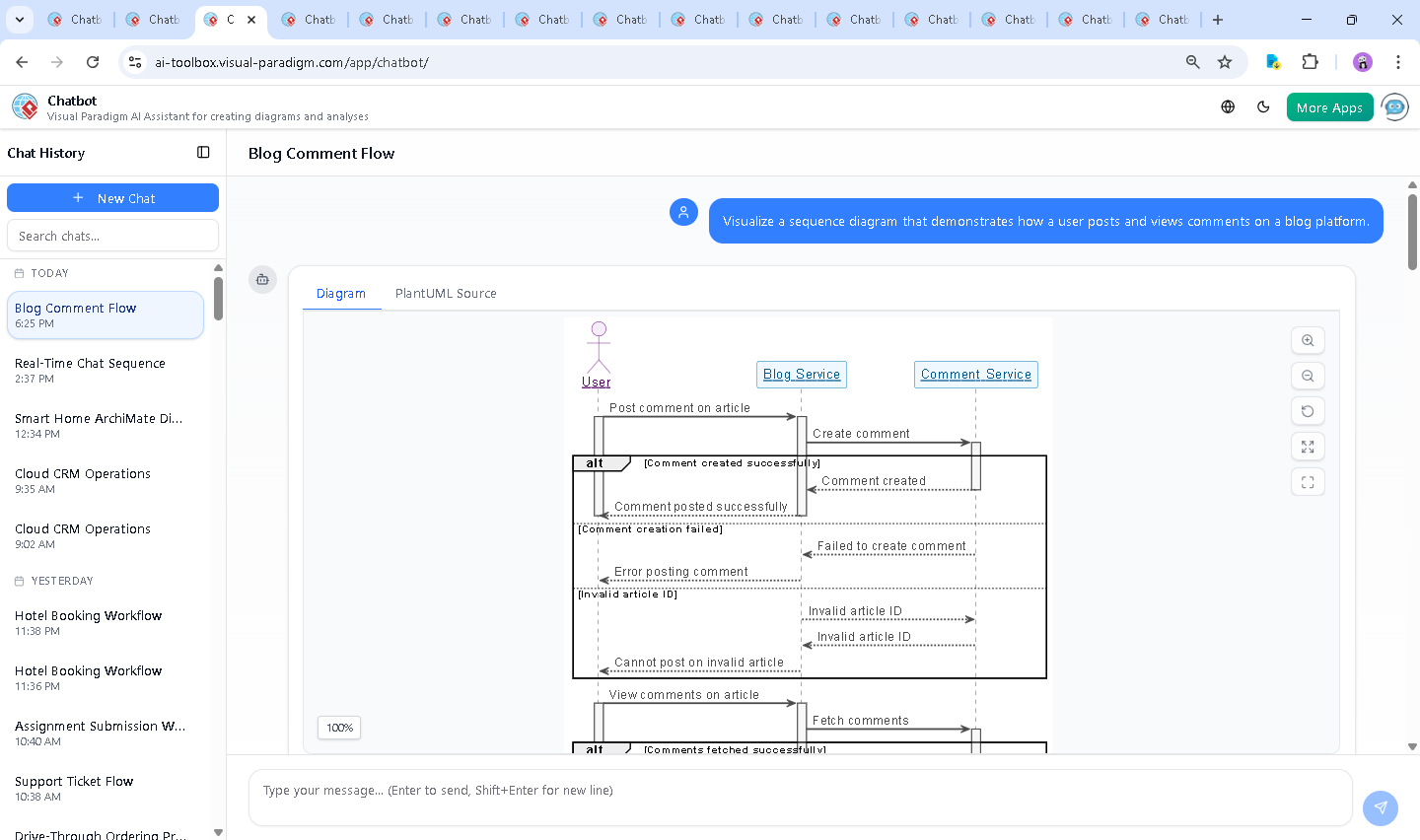
The collaboration began with a simple request: “Visualize a sequence diagram that demonstrates how a user posts and views comments on a blog platform.” Within seconds, the AI delivered a fully rendered UML sequence diagram using PlantUML syntax, complete with realistic participant roles, message flows, and conditional branches.
But the real value emerged in the follow-up. The user asked: “Explain this diagram.” Instead of a generic summary, the AI responded with a structured breakdown—detailing each interaction, identifying failure modes, and explaining the purpose behind every alt and else block. It didn’t just describe the diagram; it taught the user how to read it.
When the user requested further refinement—such as clarifying error handling or adding authentication layers—the AI adjusted the model dynamically. For instance, after a request to “refine the logic for invalid article ID,” the AI expanded the error path to show how the system validates input before forwarding it to the Comment Service, reinforcing data integrity.
This iterative dialogue is the hallmark of the Visual Paradigm AI Chatbot: it doesn’t stop at output. It listens, adapts, and elevates the design through continuous conversation.
Logic Breakdown: How the Sequence Diagram Captures Real-World Behavior
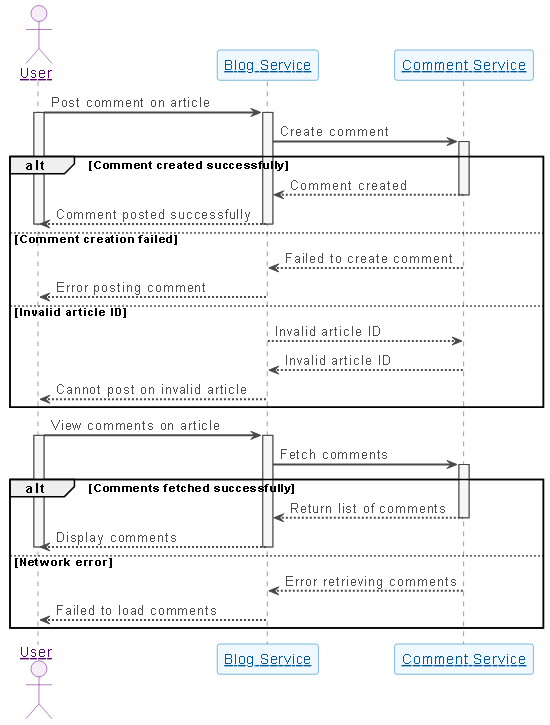
The final sequence diagram models two core user actions: posting a comment and viewing comments. Here’s how each flow is structured:
1. Posting a Comment
- User → Blog Service: Initiates the action by sending a request to post a comment.
- Blog Service → Comment Service: Validates the request and forwards it for processing.
- Comment Service: Attempts to create the comment in the database.
- Response Branches:
- Success: Comment is created, and the Blog Service confirms success to the user.
- Failure: Network or server error—feedback is sent back with an error message.
- Invalid Article ID: The system detects the article doesn’t exist and blocks the action early.
These alt and else blocks aren’t just decorative—they reflect real-world resilience. By modeling failure scenarios, the diagram becomes a living blueprint for testing, debugging, and improving the system.
2. Viewing Comments
- User → Blog Service: Requests to view comments on a specific article.
- Blog Service → Comment Service: Fetches the list of comments.
- Comment Service: Retrieves data from the database.
- Response Branches:
- Success: Returns the comment list, which the Blog Service displays to the user.
- Network Error: The system fails to retrieve data and informs the user.
The choice of sequence diagram notation is critical here. It visualizes time-based interactions, making it ideal for showing message order, lifelines, and conditional behavior. Unlike static flowcharts, sequence diagrams expose how components collaborate over time—making them indispensable for backend design, API modeling, and system integration planning.
Conversational Value: The AI Chatbot as a Design Consultant
What sets this process apart is the depth of insight the AI provides through conversation. After the initial diagram was delivered, the user asked for an explanation—triggering a detailed breakdown that covered:
- Participant roles and responsibilities
- Why the Blog Service acts as a coordinator
- How error paths improve system reliability
- Real-world analogs (e.g., Alice posting a comment)
These weren’t just answers—they were design principles. The AI didn’t just describe the diagram; it contextualized it, turning it into a teaching tool for developers, product managers, and QA teams.
And the conversation didn’t end there. The user could have asked for:
- Authentication flow integration
- Comment moderation workflows
- Support for replies or nested comments
- Visual styling updates (e.g., color themes, fonts)
Each request would be handled seamlessly—proof that the AI is not a one-off tool, but a persistent modeling collaborator.
Platform Versatility: Beyond Sequence Diagrams
The Visual Paradigm AI Chatbot isn’t limited to sequence diagrams. It supports a full suite of modeling standards, including:
- UML: For detailed system behavior and class interactions
- ArchiMate: For enterprise architecture modeling, showing business, application, and technology layers
- SysML: For complex system engineering and requirements modeling
- C4 Model: For software architecture visualization, from context to container, component, and code levels
- Mind Maps: For brainstorming
Whether you’re modeling a payment system, a cloud migration, or a user journey, the AI adapts to your standard of choice—making Visual Paradigm the only platform where AI doesn’t just generate diagrams, but understands your modeling context.
Conclusion & Call to Action
The journey from a simple request to a fully annotated, error-resilient sequence diagram demonstrates the power of the Visual Paradigm AI Chatbot: it’s not a tool—it’s a design partner. By combining natural language input with intelligent modeling, it turns abstract ideas into precise, actionable blueprints.
Whether you’re building a blog platform, an e-commerce system, or a mission-critical enterprise application, the AI Chatbot ensures your models are not only accurate but also aligned with best practices in software design.
Try it yourself: Explore the shared session and experience how the AI transforms your ideas into high-fidelity models—naturally, intelligently, and collaboratively.