


Visualizing the Digital Wallet Checkout Flow with AI-Powered Precision
Designing a seamless user experience for online payments demands clarity in system interactions. The challenge lies in modeling complex, conditional flows—such as a user checking out via a digital wallet—while ensuring accuracy, error handling, and real-world relevance. Traditional diagramming tools often require deep technical knowledge and manual effort. With Visual Paradigm’s AI Chatbot, this process transforms into a collaborative conversation, where ideas are refined in real time through natural language.
From Prompt to Diagram: A Conversational Design Journey
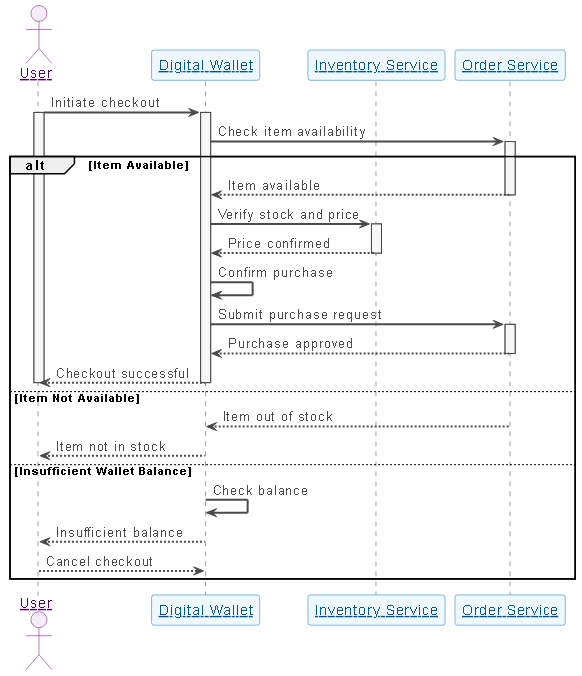
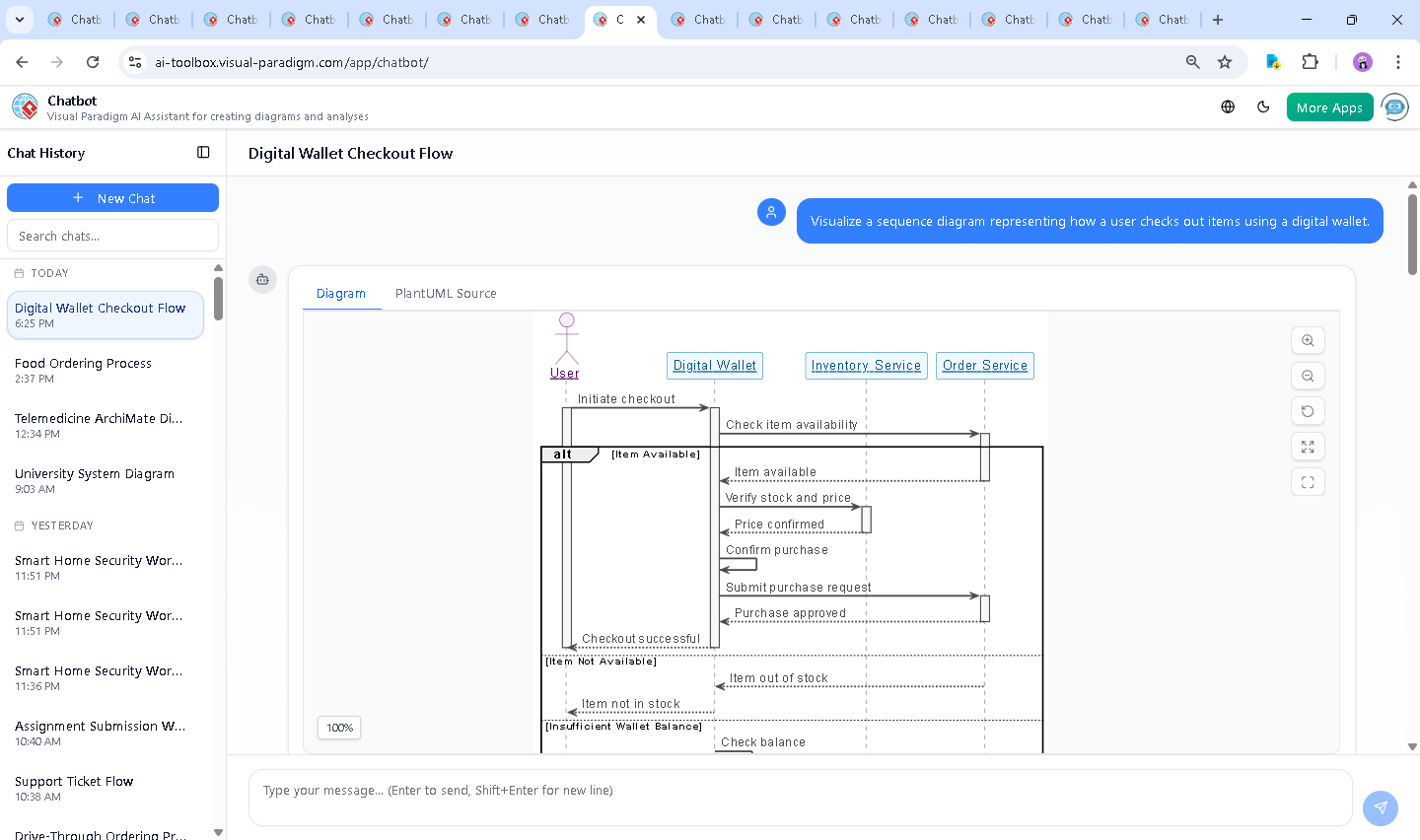
The journey began with a simple request: “Visualize a sequence diagram representing how a user checks out items using a digital wallet.” Within seconds, the Visual Paradigm AI Chatbot delivered a fully formed UML sequence diagram—complete with conditional logic, participant roles, and lifeline activation.
But the real power emerged in the follow-up. When the user asked, “Explain this diagram,” the AI didn’t just describe lines and arrows—it broke down the flow into intuitive stages, clarifying the roles of each component and the decision points that shape the user experience. The assistant explained how the alt block captures failure paths: item unavailability, stock issues, and insufficient balance—each with distinct feedback mechanisms.
Further refinement came when the user requested deeper insight: “Explain this branch.” The AI responded with a structured breakdown of the success path, highlighting how the Digital Wallet acts as a coordinator between the Order Service and Inventory Service. It emphasized the importance of validating both stock and price before confirming the purchase—a critical safeguard in real-world systems.
These interactions weren’t just explanations—they were design consultations. The AI didn’t just generate a diagram; it guided the user through the logic, ensuring the model was not only accurate but also aligned with best practices in user-centered system design.
Decoding the Sequence Diagram: Logic and Intent
The generated sequence diagram captures the full lifecycle of a digital wallet checkout with precision and clarity. Here’s a breakdown of the key logic and design choices:
1. Participant Roles and Responsibilities
- User (USR): Initiates the checkout process.
- Digital Wallet (DW): Acts as the central orchestrator—validating balance, checking inventory, and communicating with services.
- Order Service (OS): Manages transaction logic, including availability checks and approval.
- Inventory Service (IS): Provides real-time stock and pricing data.
2. Flow of Events
- Start: User triggers checkout → Digital Wallet activates.
- Check Availability: Wallet queries Order Service.
- Conditional Branching: The
altblock handles three distinct outcomes:- Item Available: Wallet confirms price via Inventory Service, checks balance, and submits request.
- Item Not Available: Order Service returns a failure; user is notified.
- Insufficient Balance: Wallet checks balance, informs user, and allows cancellation.
3. Why Sequence Diagrams?
Sequence diagrams are ideal for modeling the temporal flow of interactions. In this case, they highlight:
- Order of messages between components.
- Activation bars that show when each participant is actively processing.
- Conditional paths that reflect real-world system behavior.
By using activate and deactivate keywords, the diagram visually communicates system responsiveness and state changes—critical for developers and architects to anticipate bottlenecks or failure points.
Conversational Intelligence: The AI as Your Modeling Partner
What sets Visual Paradigm apart isn’t just the ability to generate diagrams—it’s the intelligence behind the generation. The AI Chatbot doesn’t operate in isolation. It learns from context, adapts to feedback, and evolves the model with each interaction.
For example, after the initial diagram was generated, the user requested clarification on the alt branches. Instead of a static explanation, the AI provided a structured, step-by-step analysis—mapping each condition to a real-world outcome. This level of insight transforms the chatbot from a tool into a collaborative design partner.
Even more impressively, the AI seamlessly supports a wide range of modeling standards. When asked, it could pivot to generate a C4 model of the same system, or a SysML block definition diagram, or even an ArchiMate view of the business and application layers—demonstrating that the platform is not limited to one diagram type.
More Than a Diagram Tool: A Full Modeling Ecosystem
Visual Paradigm’s AI Chatbot is not confined to sequence diagrams. It’s a unified AI-powered visual modeling platform that supports:
- UML: For software design and system architecture.
- ArchiMate: For enterprise architecture, modeling business, application, and technology layers.
- SysML: For systems engineering, including requirements, behavior, and parametric modeling.
- C4 Model: For software architecture documentation, focusing on context, containers, components, and code.
- Mind Maps: For brainstorming.
This versatility means teams can use the same AI assistant across projects—from product design to enterprise integration—without switching tools or learning new interfaces.
Conclusion: Design Smarter, Not Harder
Creating a detailed, accurate sequence diagram for a digital wallet checkout is no longer a time-consuming task. With Visual Paradigm’s AI Chatbot, it’s a conversational design process—one where every question leads to deeper insight, and every refinement strengthens the model.
Whether you’re a developer, architect, or product designer, the platform empowers you to focus on the logic and user experience—not the syntax.
Ready to turn your next idea into a precise, AI-crafted model? Start your session now and experience the future of visual modeling.