


From Idea to Precision: How the AI Chatbot Built a Real-World Subscription Activation Sequence Diagram
Designing a clear, accurate sequence diagram for an online subscription activation process is more than just drawing lines and boxes—it’s about capturing the nuanced flow of system interactions, especially when payment confirmation triggers downstream actions. The challenge lies in modeling both the success path and failure scenarios with precision, ensuring that every participant—user, payment service, subscription engine, and notification system—plays its role in the correct sequence.
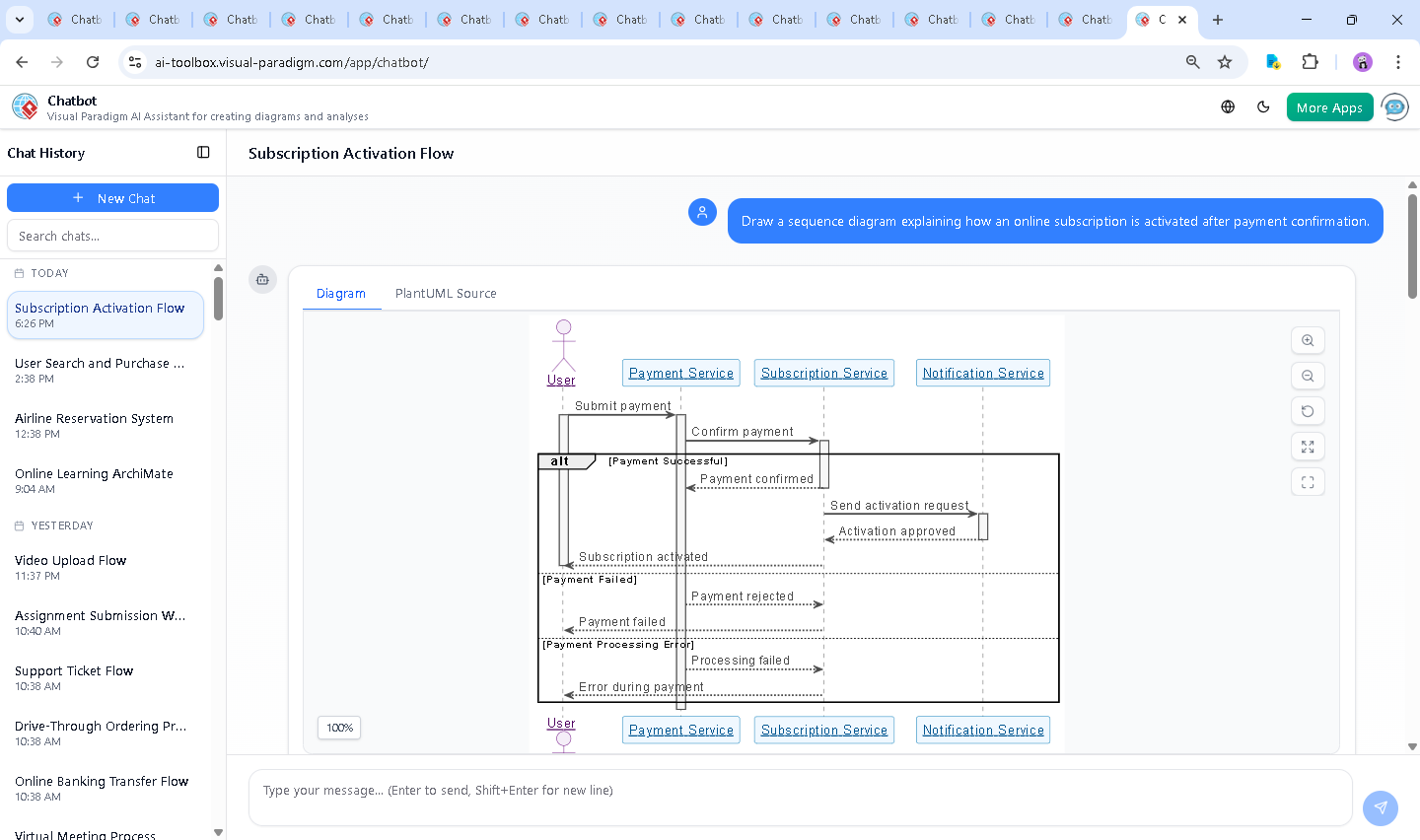
Enter the Visual Paradigm AI Chatbot: not a passive diagram generator, but an active modeling collaborator. When prompted to “Draw a sequence diagram explaining how an online subscription is activated after payment confirmation,” the AI didn’t just produce a static image. It initiated a conversational design process, refining logic, anticipating edge cases, and evolving the model in real time.
Interactive Journey: The Evolution of a Diagram Through Dialogue
The journey began with a simple request: a sequence diagram for subscription activation post-payment. The AI instantly generated a PlantUML-based diagram, complete with properly styled participants and clear lifelines. But the real value emerged in the conversation that followed.
After the initial output, the user asked: “What happens if the subscription service fails to send an activation approval to the user?” This wasn’t a request for a new diagram—it was a probe into system resilience. The AI responded with a detailed breakdown of failure scenarios, including error detection, fallback notification paths, backend state updates, and retry mechanisms.
Instead of stopping there, the AI offered to enhance the model: “Let me know if you’d like a PlantUML diagram for this failure scenario or a flowchart version!” This proactive suggestion reflects the AI Chatbot’s role as a design partner—not just a tool, but a consultant who anticipates next steps.
Each interaction refined the model’s depth. The AI didn’t just describe the logic; it embedded it into the diagram’s structure, using alt, else, and deactivate blocks to reflect conditional behavior and lifecycle management. This level of detail is only possible when the AI understands both the syntax and the intent behind UML.
Logic Breakdown: Decoding the Sequence Diagram’s Structure
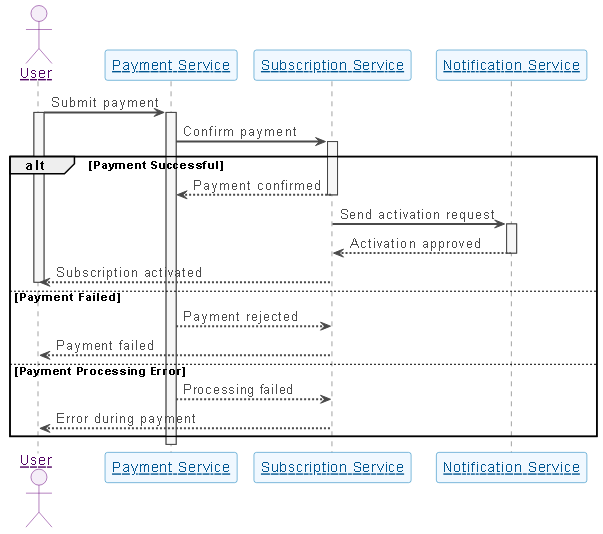
The generated sequence diagram captures the end-to-end flow of a subscription activation after payment confirmation. Let’s walk through the key components and their purpose:
Participants and Roles
- User (USR): Initiates the process by submitting payment.
- Payment Service (PS): Handles transaction processing and confirms payment status.
- Subscription Service (SS): Validates payment and manages subscription lifecycle.
- Notification Service (NS): Sends activation confirmation to the user.
Flow and Conditional Logic
- Payment Submission: The user triggers the process by submitting payment. The
USR → PS: Submit paymentmessage activates both the user and payment service. - Payment Confirmation: The Payment Service sends a confirmation to the Subscription Service. This triggers the Subscription Service’s activation logic.
- Success Path (alt Payment Successful): If the payment is confirmed, the Subscription Service sends an activation request to the Notification Service. Upon receiving approval, it notifies the user.
- Failure Paths (else): If the payment is rejected or processing fails, the system notifies the user accordingly—ensuring transparency.
- State Management: The diagram implicitly shows state changes—activation status, error logging, and retry readiness—through message flow and lifecycle management.
The use of alt and else blocks is critical here. It visually separates success and failure paths, enabling developers and architects to understand error handling without cluttering the main flow. The activate and deactivate keywords ensure that lifelines are properly managed, reflecting active processing periods.
Conversational Value: AI as a Design Consultant
The true power of the Visual Paradigm AI Chatbot lies in its ability to evolve a model through dialogue. When the user questioned what happens if activation fails, the AI didn’t just answer—it deepened the design.
It outlined a full failure-handling protocol: logging, fallback notifications, state updates, and retry mechanisms. This wasn’t speculative—it was grounded in real-world system design principles. The AI even suggested creating a new diagram for the failure scenario, demonstrating its awareness of modeling needs beyond the initial request.
Such responsiveness is only possible because the AI Chatbot is trained on thousands of real-world modeling patterns across UML, ArchiMate, SysML, and C4 Model standards. It doesn’t just generate diagrams—it understands the context, the business logic, and the technical implications of every interaction.
Platform Versatility: One AI, Many Modeling Standards
While this article focuses on sequence diagrams, the Visual Paradigm AI Chatbot is not limited to UML. It seamlessly supports:
- ArchiMate: For enterprise architecture modeling, showing business, application, and technology layers.
- SysML: For complex systems engineering, including requirements, behavior, and parametric modeling.
- C4 Model: For software architecture, enabling clear context diagrams, container views, and component-level breakdowns.
- Mind Maps: For idea mapping.
Whether you’re designing a subscription flow, modeling a microservices architecture, or mapping business processes, the AI Chatbot adapts to your standard of choice—offering consistent, intelligent support across the entire modeling spectrum.
Conclusion
Creating a reliable, user-friendly subscription activation flow requires more than visual representation—it demands precision, foresight, and adaptability. The Visual Paradigm AI Chatbot delivers all three: it transforms natural language into structured, executable models, evolves through conversation, and supports multiple standards in a single platform.
Explore how the AI Chatbot can streamline your next modeling project. Try it today and experience the future of visual modeling: conversational, intelligent, and built for real-world complexity.
Try the AI Chatbot now and turn your ideas into precise, shareable models—crafted using the Visual Paradigm AI Chatbot.