


Mapping the Journey: Building and Launching an E-Commerce Website with AI-Powered Precision
Launching a successful e-commerce website involves more than coding and design—it demands a structured, timeline-driven approach. The complexity of coordinating tasks, dependencies, and resources often leads to delays or overlooked bottlenecks. That’s where the Visual Paradigm AI Chatbot steps in: not as a passive diagram generator, but as a collaborative modeling partner that transforms high-level ideas into actionable, intelligent visual plans.
From Idea to Execution: The Interactive Journey
It began with a simple prompt: “Generate a PERT chart to represent the stages of building and launching an e-commerce website.” The AI Chatbot responded instantly with a fully structured PlantUML-based PERT chart, complete with task lanes, realistic timelines, and interdependencies. But this wasn’t the end—it was the beginning of a dynamic dialogue.
When the user asked, “What resources or tools would be needed for the functional testing phase?”, the AI didn’t just list tools. It delivered a detailed, categorized breakdown of testing infrastructure, team roles, and workflow support—complete with real-world examples and a summary table. This wasn’t a canned response; it was contextual, expert-level guidance rooted in practical software delivery experience.
Each follow-up request—like refining the logic of task dependencies or clarifying the sequence between testing and launch—was met with precise, actionable insights. The AI didn’t just answer; it guided. For instance, when the user requested a deeper dive into test data needs, the chatbot suggested mock geolocation and shipping data, reflecting real-world edge cases. This level of responsiveness is what defines the Visual Paradigm AI Chatbot: it’s not just a tool, but a modeling consultant in conversation.
The PERT Chart in Action
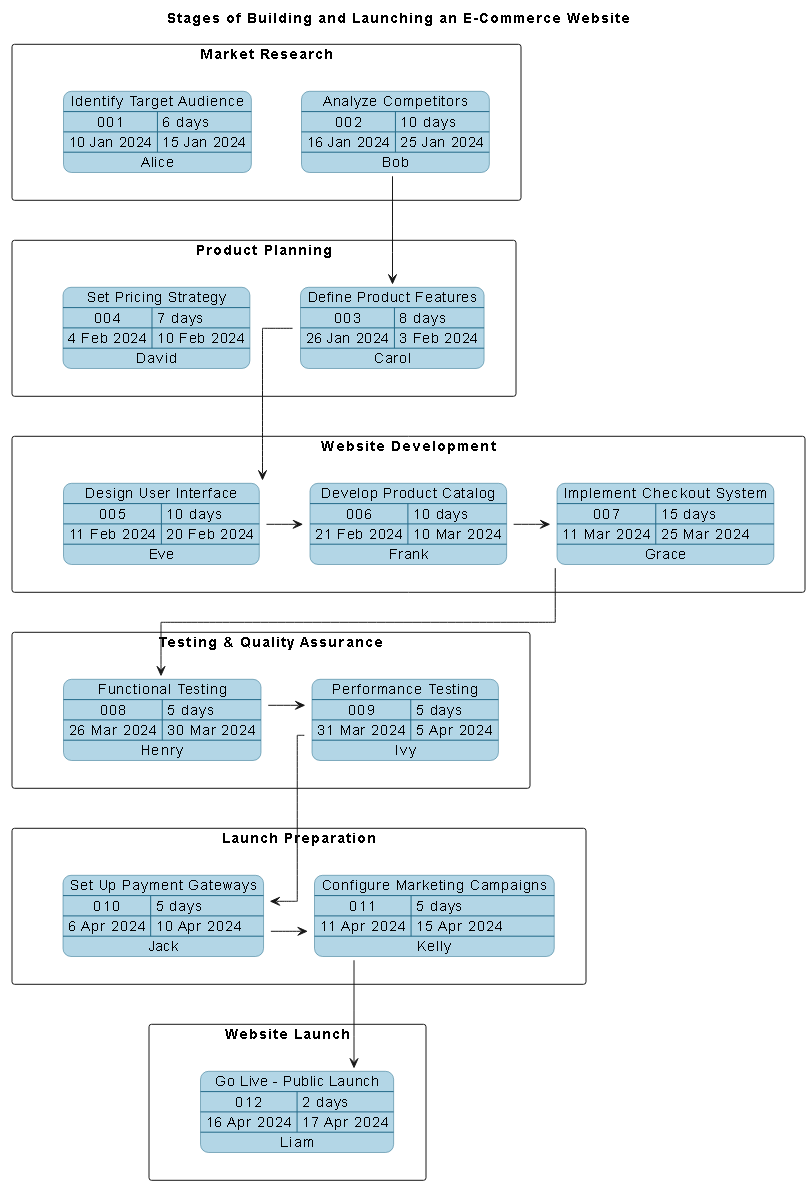
The final PERT chart visualizes the full lifecycle of an e-commerce launch across six key phases: Market Research, Product Planning, Website Development, Testing & Quality Assurance, Launch Preparation, and Public Launch. Each task is assigned a start date, finish date, duration, and responsible owner—ensuring accountability and clarity.
Decoding the Logic: Why PERT and How It Works
The diagram uses PlantUML with the pert-chart.puml library, which enables dynamic, timeline-aware visualization. The structure is built around $tasksInLane blocks, grouping related activities into logical lanes. For example:
- Market Research (Jan 10–25, 2024): Identifies audience and competitor landscape.
- Product Planning (Jan 26–Feb 10, 2024): Defines features and pricing based on research.
- Website Development (Feb 11–Mar 25, 2024): Builds UI, catalog, and checkout system—each task dependent on the previous.
- Testing & QA (Mar 26–Apr 5, 2024): Functional and performance testing ensure reliability.
- Launch Preparation (Apr 6–15, 2024): Sets up payments and marketing.
- Website Launch (Apr 16–17, 2024): Final go-live.
Dependencies are defined using $dependency(task02, task03), ensuring that no task starts before its predecessor finishes. This prevents scheduling conflicts and highlights critical paths—like how the checkout system cannot be developed until the product catalog is ready.
The use of PERT (Program Evaluation and Review Technique) is intentional. It’s ideal for projects with uncertain durations and complex dependencies—exactly what an e-commerce launch entails. The AI’s choice of PERT over Gantt or Kanban reflects its understanding of project management best practices.
Conversational Intelligence in Action
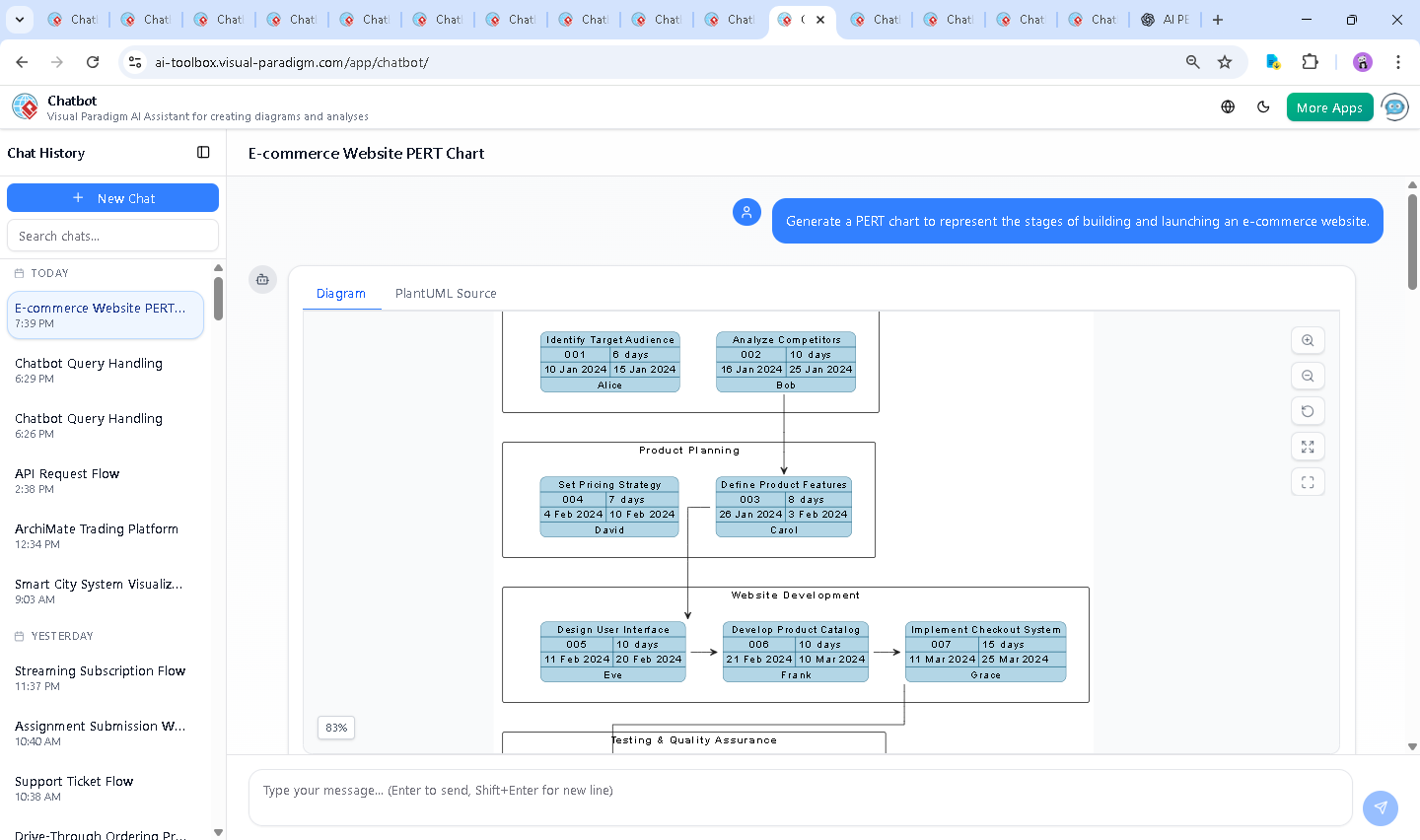
The chat history reveals the true power of the Visual Paradigm AI Chatbot: it doesn’t just generate diagrams—it engages in a design conversation. When the user asked for resources for functional testing, the AI didn’t stop at listing tools. It provided a full ecosystem of support: testing tools (Selenium, Cypress), environment setup (staging, BrowserStack), data simulation, and team roles (QA engineers, UX researchers).
This depth of insight shows the AI’s capability to act as a domain expert. It anticipates follow-up questions and proactively offers value—such as suggesting a test case template or a workflow diagram. These aren’t random suggestions; they’re intelligent extensions of the original model, designed to support real-world implementation.
More Than a PERT Tool: A Full Modeling Suite
While this example focuses on PERT charts, the Visual Paradigm AI Chatbot is built to handle a wide range of modeling standards. It seamlessly supports:
- UML: For system design, class diagrams, and use case modeling.
- ArchiMate: For enterprise architecture and business capability mapping.
- SysML: For systems engineering and requirements modeling.
- C4 Model: For software architecture visualization (Context, Containers, Components, Code).
- Mind Maps, Org Charts, SWOT, PEST: For strategic planning and stakeholder alignment.
This versatility means teams can use a single platform for everything—from high-level strategy to detailed technical design. The AI Chatbot adapts to the context, whether you’re modeling a business process or a distributed system.
Final Thoughts: Your AI Modeling Partner
Building and launching an e-commerce website is a complex endeavor. But with the Visual Paradigm AI Chatbot, you’re not alone. It turns abstract ideas into structured, collaborative models—complete with timelines, dependencies, and expert insights.
Whether you’re refining a PERT chart, validating a system architecture, or planning a product roadmap, the AI Chatbot acts as your intelligent co-designer. It doesn’t just draw diagrams—it helps you think through the process.
Ready to turn your next project into a visual reality? Explore the live session and experience the power of AI-powered visual modeling.