


Mapping the Critical Path: How AI Shapes National Election Planning
Organizing a national election is a high-stakes, time-sensitive operation involving hundreds of interdependent tasks. Without a clear visual roadmap, delays in one phase can cascade across the entire process — jeopardizing transparency, public trust, and democratic integrity. The challenge lies not just in scheduling, but in modeling the complex web of dependencies that define the timeline.
Enter the Visual Paradigm AI Chatbot — not a passive diagram generator, but a collaborative modeling expert. It transforms natural language into precise, structured visual models, guiding users through every phase of design with intelligent insight. In this case, a simple request — “Generate a PERT chart to show the dependencies involved in organizing a national election” — sparked a dynamic conversation that evolved into a fully validated, actionable timeline.
From Prompt to Precision: The AI-Driven Design Journey
The journey began with a straightforward user input: a request for a PERT chart outlining election organization. The AI Chatbot responded immediately by generating a fully functional PlantUML script embedded with real-world task logic. It didn’t just draw a diagram — it structured the workflow with:
- Realistic start and end dates
- Responsible team members
- Clear task dependencies
- Logical grouping by operational phase
But the conversation didn’t stop there. When the user asked, “Can you explain how the dependencies between tasks would change if voter registration were delayed?”, the AI didn’t offer a generic answer. Instead, it conducted a scenario analysis — breaking down the ripple effect across the timeline, identifying critical path shifts, and proposing mitigation strategies like buffer time and parallel data collection.
This level of responsiveness isn’t automation — it’s AI-powered design intelligence. The chatbot didn’t just generate a diagram; it acted as a modeling consultant, refining logic, explaining impact, and even offering to regenerate the chart with updated timelines.
Visualizing the Election Timeline
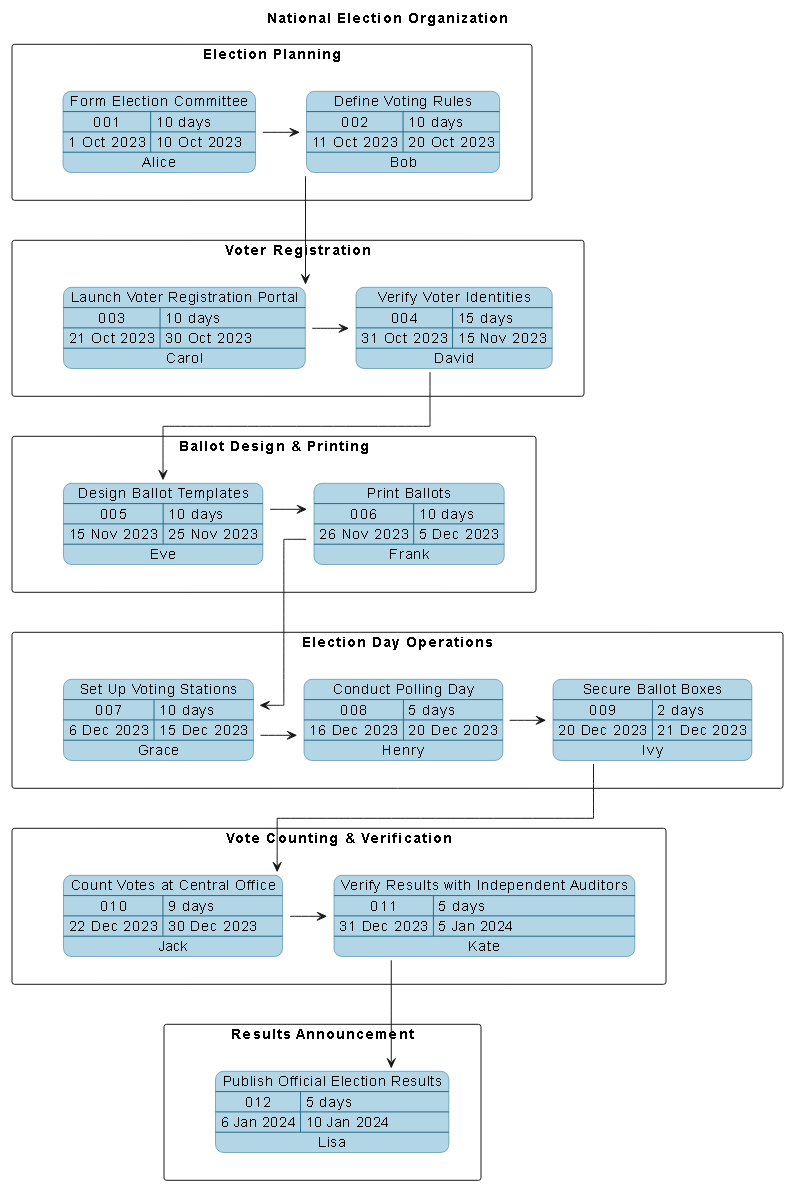
The resulting PERT chart captures the full lifecycle of a national election, organized into five key phases:
- Election Planning: Forming the committee and defining voting rules.
- Voter Registration: Launching the portal and verifying identities.
- Ballot Design & Printing: Creating templates and producing physical ballots.
- Election Day Operations: Setting up stations, conducting polling, and securing ballots.
- Vote Counting & Verification: Centralized counting and independent auditing.
- Results Announcement: Publishing official outcomes.
Each task is annotated with start dates, durations, and responsible personnel, while dependencies are clearly mapped using PlantUML’s $dependency syntax. The chart reveals a single critical path — a linear chain where delays in one task directly impact the next.
Decoding the Logic: Why PERT, and How It Works
The choice of PERT (Program Evaluation and Review Technique) over Gantt or flowchart formats was strategic. PERT excels in visualizing dependencies and identifying the critical path — the sequence of tasks that determines the project’s minimum duration.
Here’s how the logic unfolds:
- Task01 (Form Election Committee) starts on October 1, 2023, and takes 10 days. This is a prerequisite for defining voting rules.
- Task02 (Define Voting Rules) begins immediately after Task01, ensuring policy alignment before public outreach.
- Task03 (Launch Voter Registration Portal) starts on October 21, but only after rules are finalized — a key dependency.
- Task04 (Verify Voter Identities) cannot begin until the portal is live, and it spans 15 days to handle large-scale verification.
- From there, the chain continues: ballot design (Task05) depends on verified data, printing (Task06) requires finalized templates, and so on.
The AI’s use of $tasksInLane ensures the chart is not only accurate but also visually organized by function — making it easy for stakeholders to follow. The $dependency commands enforce the logical flow, while $finalize() completes the diagram with proper rendering.
Conversational Intelligence in Action
What truly sets Visual Paradigm apart is how the AI Chatbot responds to follow-up questions with depth and precision. When the user queried about delays in voter registration, the AI didn’t just adjust dates — it:
- Identified the critical path impact
- Modeled downstream effects across ballot design, printing, and polling
- Provided a table summarizing the shift in start dates
- Suggested mitigation strategies like buffer time and parallel registration
- Offered to regenerate the chart with the delay applied
This isn’t just chat — it’s co-design with an expert. The AI doesn’t just answer questions; it anticipates them, offering proactive insights that elevate the planning process.
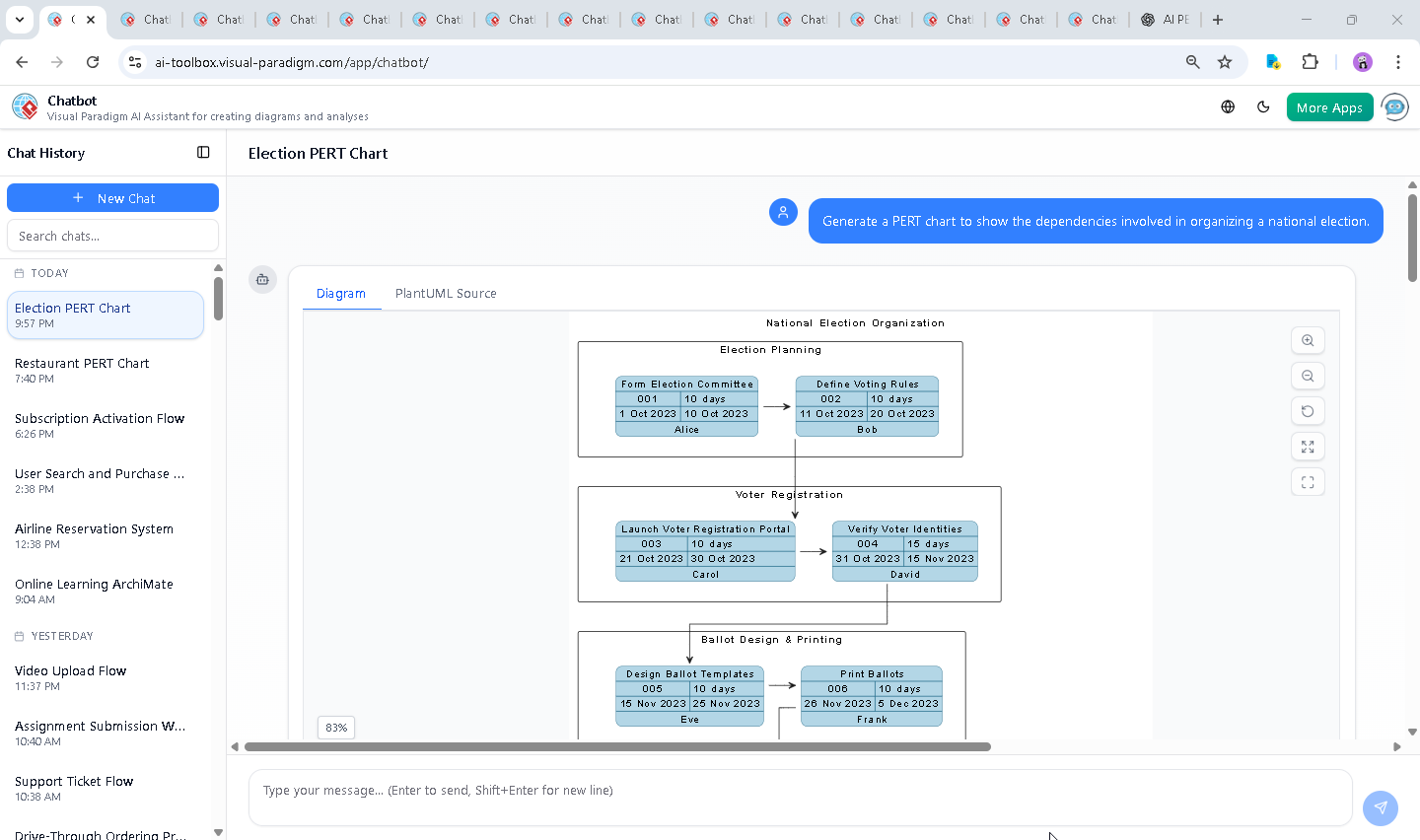
The chat interface reflects this intelligence: real-time feedback, task-by-task clarification, and the ability to refine logic through natural language. Every interaction builds a deeper, more resilient model — one that accounts for uncertainty, risk, and real-world complexity.
Beyond PERT: A Full-Spectrum Modeling Platform
While this example focused on a PERT chart, the Visual Paradigm AI Chatbot is built for versatility. It supports a full suite of modeling standards, including:
- UML (for software and system design)
- ArchiMate (for enterprise architecture and business strategy)
- SysML (for complex system engineering)
- C4 Model (for software architecture and component visualization)
- Mind Maps, Org Charts, SWOT, PEST, and data charts (for strategic planning and reporting)
Whether you’re designing a national election process, modeling a digital transformation, or mapping organizational structure, the AI Chatbot adapts to your domain — acting as a consistent, intelligent partner across all modeling needs.
Conclusion: Design with Confidence, Not Guesswork
Planning a national election demands precision, foresight, and resilience. The Visual Paradigm AI Chatbot turns abstract ideas into structured, actionable models — not through templates, but through intelligent conversation.
By combining the clarity of PERT with the adaptability of AI, users gain more than a diagram. They gain a strategic tool that anticipates risks, reveals dependencies, and supports decision-making at every stage.
Ready to model your next complex project? Start with a simple prompt — and let the AI guide you through the rest.