


Designing Safety-Critical Flight Control Systems with AI-Powered Precision
Designing a commercial aircraft flight control system demands rigorous adherence to safety, redundancy, and regulatory certification standards. The complexity of integrating mechanical, electrical, and software subsystems under high-stress operational conditions requires a modeling approach that is both precise and collaborative. Enter the Visual Paradigm AI Chatbot—a conversational design partner that transforms abstract safety goals into structured, traceable SysML requirement diagrams.
From Concept to Diagram: A Collaborative Modeling Journey
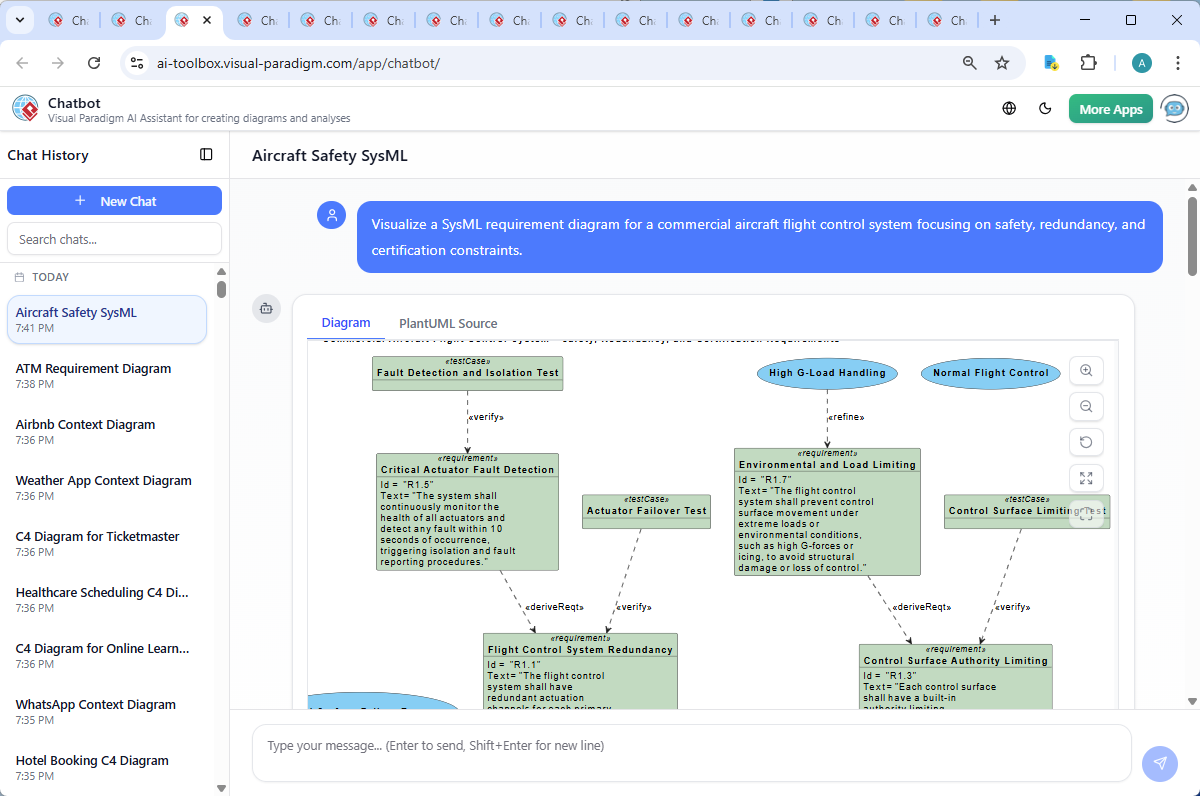
The journey began with a simple prompt: “Visualize a SysML requirement diagram for a commercial aircraft flight control system focusing on safety, redundancy, and certification constraints.” Within seconds, the AI Chatbot generated a fully formatted PlantUML script, delivering a professional-grade requirement diagram with clear traceability and logical relationships.
But the real value emerged in the conversation. When the user asked, “Can you explain how the fail-safe configuration is implemented during a control surface failure?”, the AI didn’t just provide a textual answer—it deepened the design context. It explained the failure detection mechanism, the transition to reduced authority, the role of redundancy, and the importance of pilot feedback—all while referencing specific requirements like R1.2 and R1.8.
This wasn’t a static output. It was an evolving design dialogue. The AI responded to follow-up requests with surgical precision: refining logic, clarifying dependencies, and even suggesting how to model the fail-safe transition as a use case linked to multiple requirements. For instance, it refined useCase02 (Control Surface Failure Recovery) to explicitly trace back to both req02 (Fail-Safe Operation) and req08 (Control System Autonomy During Fault), demonstrating how the model supports both functional and safety requirements.
Each interaction reinforced the AI’s role not as a generator, but as a modeling consultant—ensuring that every element was aligned with real-world aerospace engineering practices and certification standards like DO-178C and AC-200.
Decoding the Logic: Why This Requirement Diagram Works
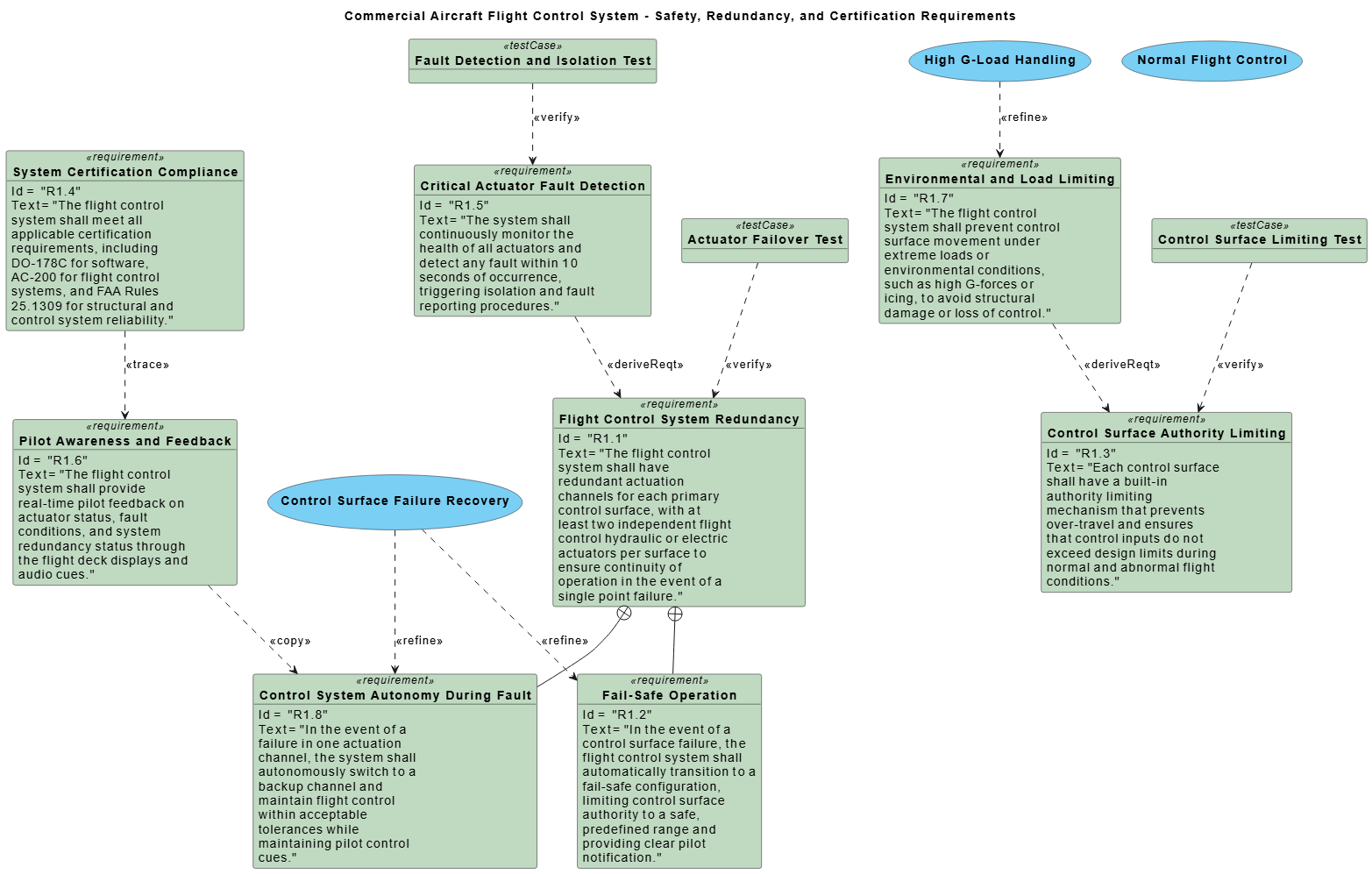
The diagram’s structure is built on the core principles of SysML requirement modeling, with a focus on traceability, verification, and logical dependency. Here’s how each element contributes:
1. Core Safety Requirements
- R1.1 (Redundancy): Ensures at least two independent actuators per control surface, directly supporting system resilience.
- R1.2 (Fail-Safe Operation): Mandates automatic transition to a safe state upon failure, reducing risk during emergencies.
- R1.3 (Authority Limiting): Prevents over-travel and structural stress, protecting the airframe.
2. Verification & Traceability
$verify(testCase01, req01): Links the Actuator Failover Test to the redundancy requirement, ensuring it can be validated.$trace(req04, req06): Shows that certification compliance (R1.4) is linked to pilot awareness (R1.6), reinforcing the human-in-the-loop safety model.$deriveReqt(req05, req01): Indicates that fault detection (R1.5) is derived from the redundancy requirement—meaning it’s a necessary consequence of having redundant channels.
3. Logical Relationships & Constraints
$containment(req01, req08): Demonstrates that the autonomy during fault (R1.8) is contained within the broader redundancy framework (R1.1).$refine(useCase02, req02): Shows that the failure recovery use case is refined by the fail-safe requirement, ensuring operational clarity.$copy(req06, req08): Indicates that pilot feedback (R1.6) is copied into the autonomy requirement, emphasizing that autonomy must be transparent to the pilot.
This layered approach ensures that every safety constraint is not only defined but also verifiable, traceable, and interconnected—critical for certification audits and system validation.
Beyond Requirements: The AI Chatbot as a Multi-Standard Modeling Expert
What makes Visual Paradigm stand out is its ability to transcend single-diagram workflows. The AI Chatbot isn’t limited to SysML requirement diagrams. It supports a full suite of modeling standards, including:
- UML: For software design and behavior modeling.
- ArchiMate: For enterprise architecture and business-IT alignment.
- SysML: For systems engineering, including requirements, blocks, and parametric modeling.
- C4 Model: For software architecture visualization at multiple levels (context, containers, components, code).
- SWOT, PEST, Org Charts, Mind Maps, PERT Charts: For strategic planning, risk assessment, and organizational modeling.
Whether you’re designing a safety-critical avionics system or mapping the digital transformation of an airline’s operations, the AI Chatbot adapts to your needs—providing consistent, accurate, and context-aware modeling support across domains.
Conclusion: The Future of Safety-Critical Design Is Conversational
The evolution of the flight control system requirement diagram—from a high-level prompt to a detailed, traceable, and certified-ready model—shows how AI is reshaping systems engineering. The Visual Paradigm AI Chatbot doesn’t just generate diagrams; it collaborates, explains, refines, and validates—acting as a trusted design partner throughout the lifecycle.
Explore the full model in action: View the shared session and experience the power of AI-powered visual modeling firsthand.