


Designing a Secure Smart Home: How AI Transforms Requirement Modeling
Creating a robust smart home automation system demands more than just functional features—it requires a precise, traceable, and compliant foundation. The challenge lies in clearly defining user needs, system behaviors, and regulatory obligations without falling into the trap of vague or ambiguous statements. This is where the Visual Paradigm AI Chatbot steps in—not as a diagram generator, but as a collaborative modeling partner.
When prompted to produce a SysML requirement diagram for a smart home automation system, the AI didn’t just generate a static diagram. It initiated a dialogue, asking clarifying questions, refining logic, and adapting to evolving design needs. The result? A fully traceable, compliance-ready requirement model that aligns with real-world engineering standards.
From Prompt to Precision: The Interactive Journey of Modeling
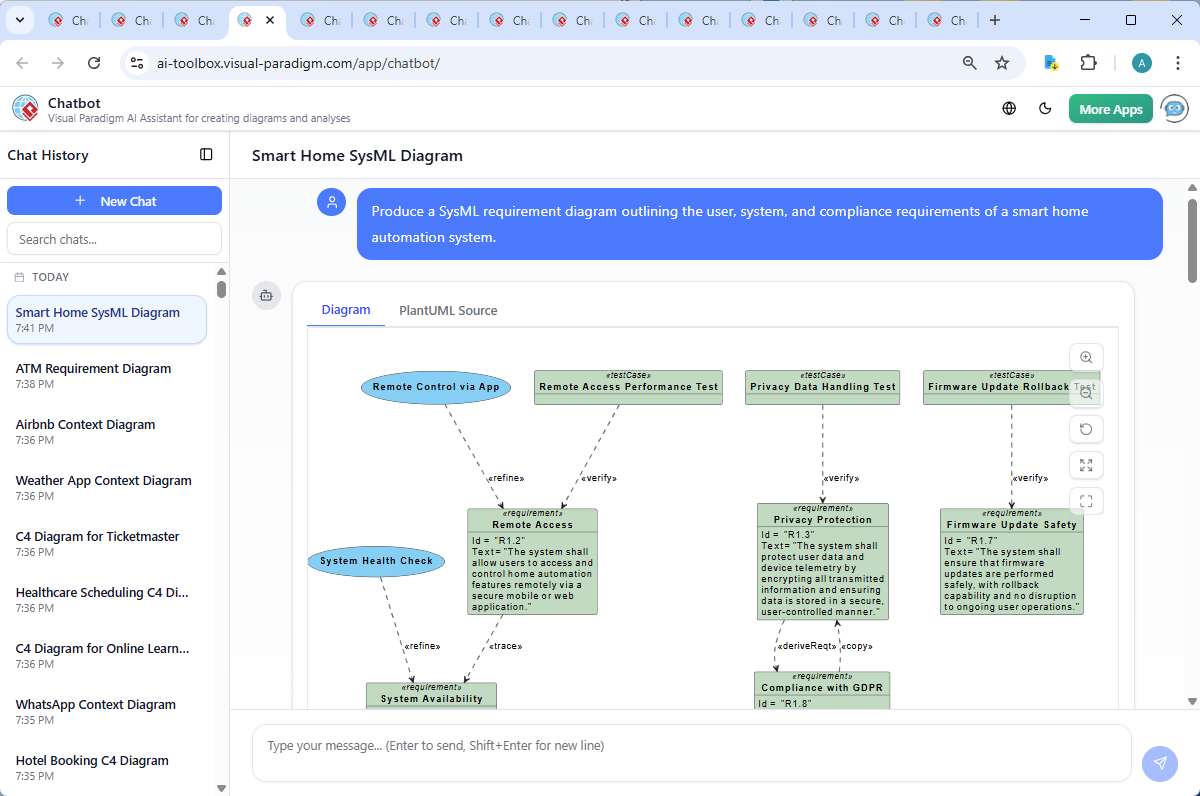
The process began with a straightforward request: “Produce a SysML requirement diagram outlining the user, system, and compliance requirements of a smart home automation system.” The AI responded with a fully structured PlantUML script, instantly rendering a professional-grade requirement diagram with clear relationships between requirements, use cases, test cases, and compliance mandates.
But the conversation didn’t stop there. When the user asked, “Can you explain how the system ensures data privacy when voice commands are processed on the cloud?”, the AI didn’t offer a generic answer. Instead, it delivered a detailed, technical breakdown—complete with on-device processing, end-to-end encryption, anonymization, and compliance with GDPR and CCPA.
This wasn’t just a response—it was a modeling consultation. The AI explained how privacy is enforced at multiple layers: from data minimization at the edge, to secure cloud storage, to user consent mechanisms. It even referenced the diagram’s own $deriveReqt(req03, req08) and $containment(req09, req01) relationships to show how privacy (R1.3) and emergency shutdown (R1.9) are logically tied to authentication (R1.1).
Each follow-up refined the model’s depth. Requests like “Explain this branch” or “Refine the logic on compliance” were met with targeted, context-aware explanations—proving that the AI isn’t just generating visuals, but acting as a senior systems architect in real time.
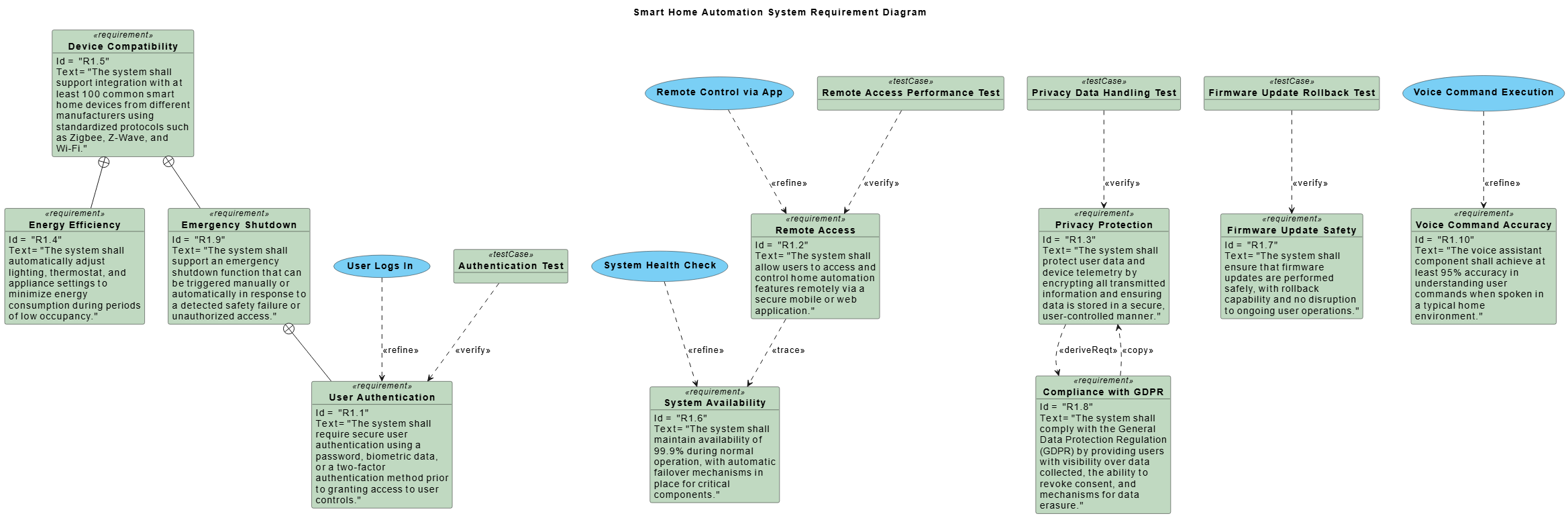
Decoding the Diagram: The Logic Behind the Structure
The generated SysML requirement diagram uses a precise notation system to ensure clarity, traceability, and compliance. Here’s how each element contributes to the overall design:
✅ User Requirements
These define what the end user expects from the system:
- R1.1 – User Authentication: Ensures only authorized users can access controls.
- R1.2 – Remote Access: Enables control via mobile or web apps.
- R1.3 – Privacy Protection: Mandates encryption and user-controlled data storage.
- R1.10 – Voice Command Accuracy: Sets a performance benchmark for voice interaction.
✅ System Requirements
These define how the system must behave to meet user and compliance needs:
- R1.4 – Energy Efficiency: Automatic adjustments to reduce energy use.
- R1.6 – System Availability: 99.9% uptime with failover support.
- R1.7 – Firmware Update Safety: Safe updates with rollback capability.
✅ Compliance Requirements
These ensure legal and regulatory alignment:
- R1.8 – Compliance with GDPR: User rights to access, correct, and delete data.
- R1.9 – Emergency Shutdown: Manual or automatic shutdown in safety-critical scenarios.
🔗 Key Relationships: The Intelligence Behind the Diagram
The real power lies in how these requirements are linked:
$refine(useCase01, req01): The User Logs In use case refines the authentication requirement, showing traceability.$verify(testCase01, req01): A test case is directly linked to verify the authentication requirement.$deriveReqt(req03, req08): Privacy (R1.3) is derived from GDPR compliance (R1.8), showing regulatory lineage.$containment(req05, req04): Device compatibility (R1.5) contains energy efficiency (R1.4), indicating that compatibility supports efficiency goals.$trace(req02, req06): Remote access (R1.2) is traced to system availability (R1.6), ensuring reliability.
This structured approach ensures that every requirement is not just defined—but connected, testable, and auditable.
Why This Isn’t Just a Diagram: The AI as a Modeling Consultant
What sets Visual Paradigm apart is that the AI Chatbot doesn’t just render diagrams—it participates in the design process. The chat history shows a dynamic exchange: user asks, AI responds with technical depth, user probes further, and AI adapts—delivering insights that elevate the model from documentation to strategic architecture.
For example, when the user questioned how cloud-based voice processing maintains privacy, the AI didn’t default to marketing language. It explained the technical safeguards—on-device preprocessing, encryption, anonymization, and compliance enforcement—while referencing the diagram’s own relationships. This level of integration between conversation and visual model is what makes Visual Paradigm more than a tool: it’s a thinking partner.
The AI’s ability to handle follow-up requests like “Refine the logic on emergency shutdown” or “Explain the compliance trace” proves its deep understanding of SysML semantics and real-world system design.
Beyond SysML: A Unified Platform for Enterprise Modeling
While this example focused on SysML, the Visual Paradigm AI Chatbot is not limited to one standard. It seamlessly supports:
- UML: For software design and system architecture.
- ArchiMate: For enterprise architecture and business-IT alignment.
- C4 Model: For contextualizing system architecture at different levels (context, containers, components, code).
- Mind Maps, Org Charts, PERT, SWOT, PEST, and Data Charts: For strategic planning and visualization across domains.
Whether you’re designing a smart home, a financial system, or a healthcare platform, the AI Chatbot adapts to your standard, your domain, and your workflow—always maintaining precision and traceability.
Conclusion: Build Smarter, Faster, with AI-Powered Confidence
Designing a secure, compliant, and user-centric smart home automation system requires more than diagrams—it demands a clear, auditable, and intelligent approach to requirements. With Visual Paradigm’s AI Chatbot, you’re not just creating a diagram. You’re co-designing a system with an expert partner that understands SysML, compliance, privacy, and real-world engineering.
Try it today and see how the AI transforms your next requirement model—from idea to validated architecture in minutes.
Ready to build smarter? Start your AI modeling session now.