


Designing a Secure and Compliant Patient Management System: An AI-Powered Requirement Diagram Journey
Creating a robust patient management system demands more than functional features—it requires strict adherence to privacy, availability, and interoperability standards. Traditional modeling approaches often fall short when translating complex regulatory needs into actionable system requirements. That’s where the Visual Paradigm AI Chatbot steps in: not as a passive diagram generator, but as an intelligent collaborator that understands both technical architecture and compliance frameworks.
From Vision to Precision: A Collaborative Modeling Journey
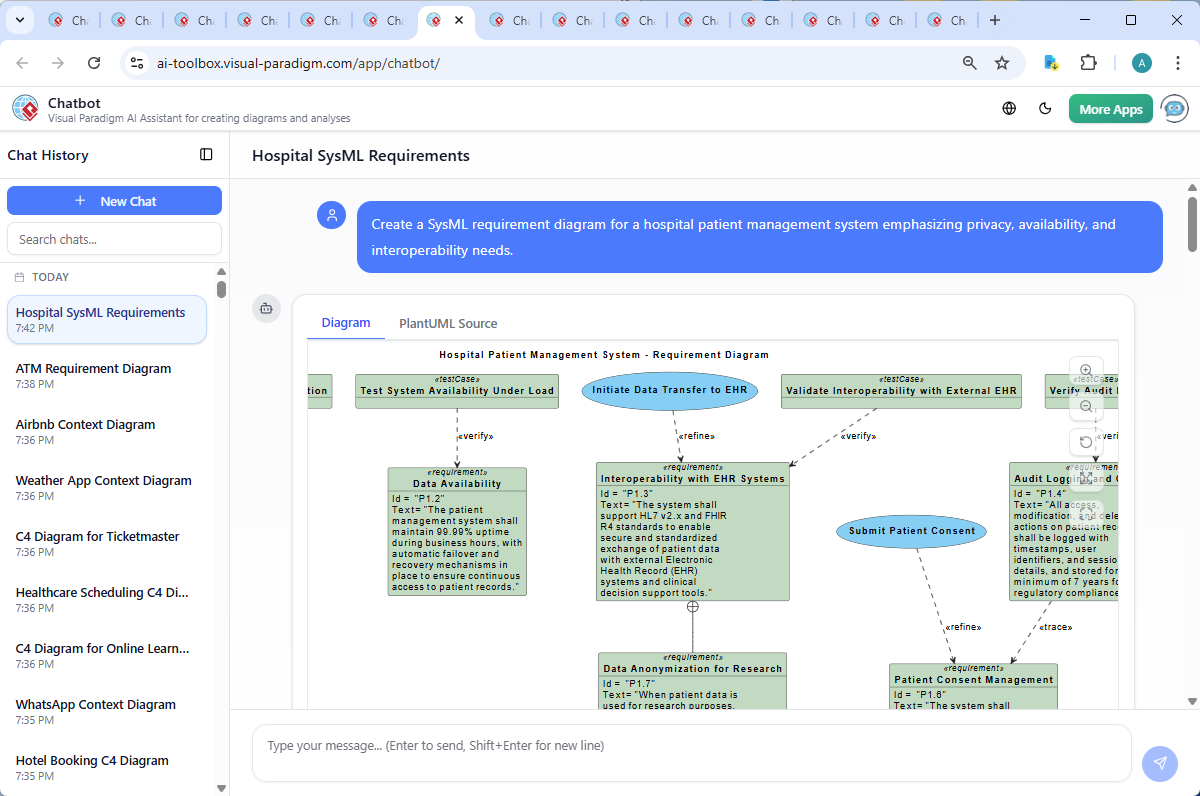
The journey began with a clear directive: “Create a SysML requirement diagram for a hospital patient management system emphasizing privacy, availability, and interoperability needs.” The AI Chatbot responded not with a static output, but with a fully structured SysML requirement diagram using PlantUML syntax—complete with traceability, verification, and refinement links.
But the real value emerged in the conversation. When the user asked, “Can you provide more details on how the patient consent management interface complies with HIPAA and GDPR?”, the AI didn’t just restate rules—it delivered a layered, compliance-focused explanation that mapped each regulatory principle to specific system behaviors, data handling practices, and user interface features.
This wasn’t a one-way response. The AI proactively refined its output by:
- Linking the
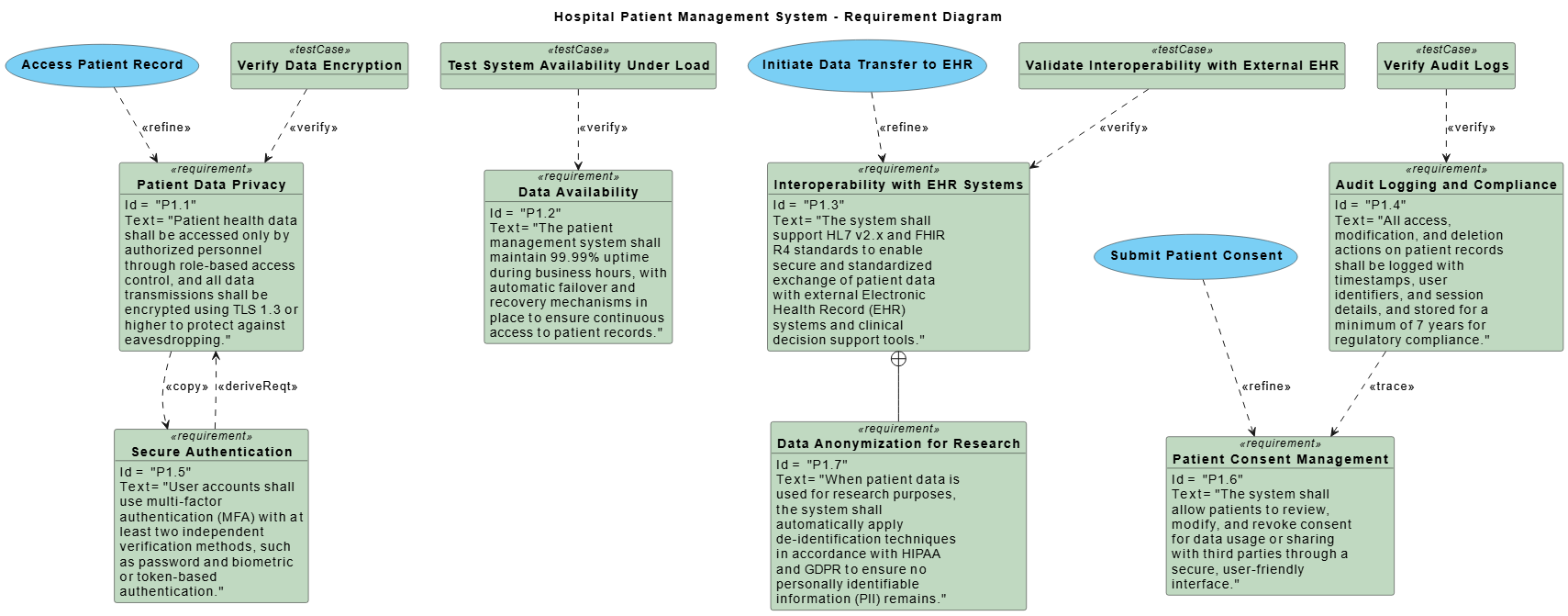
req06 (Patient Consent Management)toreq04 (Audit Logging)via$trace, showing compliance visibility. - Using
$deriveReqt(req05, req01)to show that secure authentication (MFA) supports data privacy. - Adding
$containment(req03, req07)to demonstrate how interoperability requirements include data anonymization for research.
Each refinement was a deliberate design decision—proof that the AI isn’t just generating diagrams, but reasoning through architectural implications.
Decoding the Requirement Diagram Logic
The diagram is built on SysML’s formal requirement modeling conventions, ensuring clarity, traceability, and audit readiness. Here’s how each element contributes:
Core Requirements
- req01 (Patient Data Privacy): Enforces role-based access and TLS 1.3 encryption—critical for both HIPAA and GDPR.
- req02 (Data Availability): Specifies 99.99% uptime with automatic failover—essential for mission-critical patient access.
- req03 (Interoperability with EHR Systems): Mandates HL7 v2.x and FHIR R4 support, enabling seamless data exchange with external systems.
- req04 (Audit Logging): Requires long-term retention of access logs for regulatory compliance.
- req05 (Secure Authentication): Enforces MFA—critical for preventing unauthorized access.
- req06 (Patient Consent Management): Enables patients to control data sharing—central to GDPR and HIPAA.
- req07 (Data Anonymization for Research): Ensures PII is removed before data is used in research, aligning with privacy laws.
Modeling Relationships That Matter
$verify(testCase01, req01): Tests that encryption is enforced.$refine(useCase01, req01): Shows how the “Access Patient Record” use case is governed by privacy requirements.$deriveReqt(req05, req01): Demonstrates that authentication is a derived need of data privacy.$containment(req03, req07): Indicates that interoperability includes anonymization as a sub-requirement.$trace(req04, req06): Links audit logging to consent management—ensuring every consent action is traceable.
These relationships go beyond visual hierarchy. They form a living model where every requirement is connected to its test, use case, and compliance context—making it easier to validate, update, and audit.
Conversational Intelligence in Action
When the user requested deeper compliance insights, the AI didn’t default to generic summaries. Instead, it delivered a side-by-side analysis of HIPAA and GDPR, mapping each regulation’s core principles to specific system behaviors—such as consent revocation, data minimization, and purpose limitation.
It also introduced practical implementation details:
- Consent cards with clear, plain-language explanations.
- Granular consent controls (per data category).
- Automated blocking of data sharing after revocation.
- Consent headers embedded in EHR data transfers.
This level of detail transforms the diagram from a compliance checklist into a living design artifact—one that developers, auditors, and clinicians can all trust.
Why the AI Chatbot is More Than a Diagram Tool
Visual Paradigm’s AI Chatbot isn’t limited to Requirement Diagrams. It supports a full spectrum of modeling standards, including:
- UML for software design and behavior modeling.
- ArchiMate for enterprise architecture and business-IT alignment.
- SysML for systems engineering and complex requirement modeling.
- C4 Model for clear, scalable software architecture visualization.
- Mind Maps, PERT Charts, Org Charts, SWOT, PEST, and Data Charts for strategic planning and stakeholder communication.
Whether you’re modeling a hospital system, a financial transaction platform, or a smart city infrastructure, the AI Chatbot adapts—offering consistent, accurate, and standards-compliant modeling support across domains.
Conclusion: The Future of Model-Driven Design
The Hospital Patient Management System example shows how AI isn’t just automating diagram creation—it’s enabling deeper, more intelligent design. By engaging in a natural conversation, the user and AI co-created a model that is not only technically sound but also legally defensible and user-centered.
With Visual Paradigm, you’re not just building diagrams—you’re building trust, compliance, and clarity into your systems from day one.
Ready to transform your next project with AI-powered modeling? Try the shared session and experience the future of visual modeling.