


Designing a High-Performance Cloud Platform: An AI-Powered Requirement Diagram Journey
Building a cloud computing platform that delivers on performance, scalability, and security demands requires more than just technical components—it demands precise, traceable, and verifiable requirements. The challenge lies in articulating complex system behaviors in a way that aligns development, testing, and compliance teams. This is where the Visual Paradigm AI Chatbot steps in—not as a passive diagram generator, but as a collaborative modeling expert.
When the user asked to visualize a SysML requirement diagram capturing performance, scalability, and security needs, the AI didn’t just render a static diagram. It engaged in a dynamic conversation, interpreting intent, refining logic, and evolving the model through iterative feedback. This wasn’t a one-way translation from text to diagram—it was a co-creation process powered by deep domain knowledge.
From Prompt to Precision: A Collaborative Modeling Journey
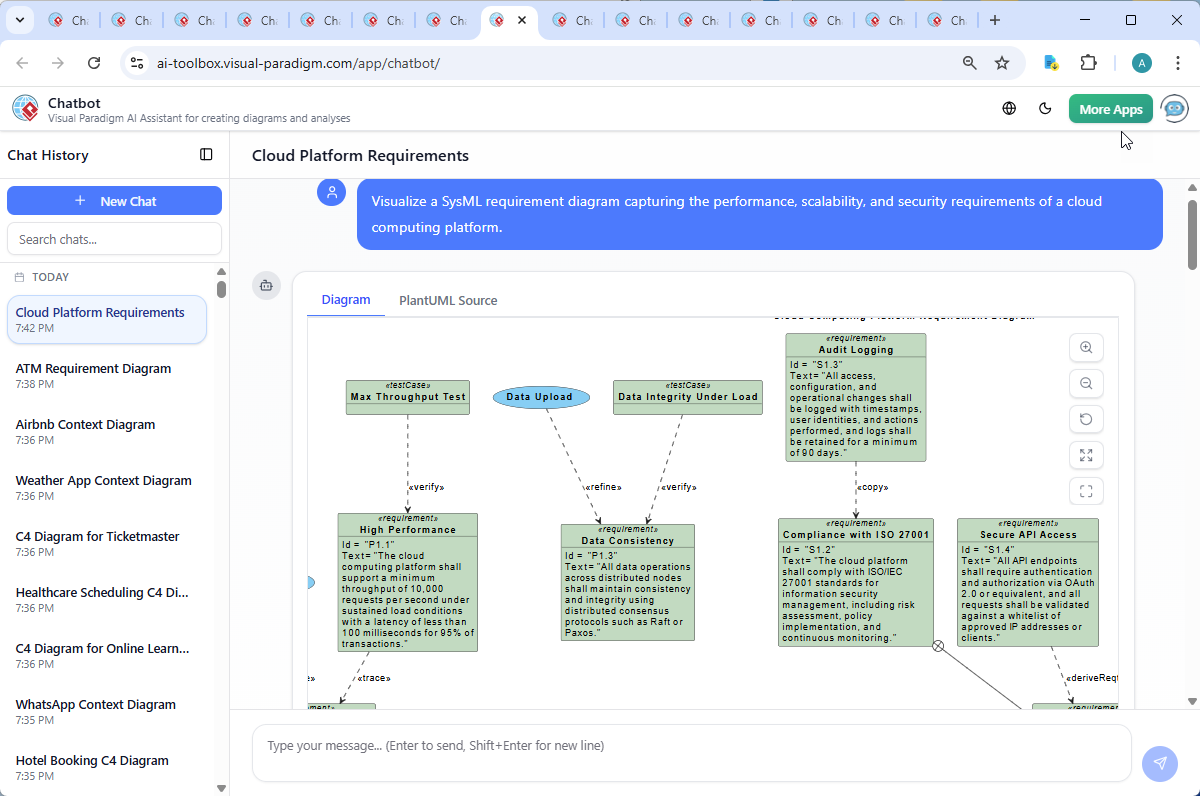
The journey began with a clear directive: “Visualize a SysML requirement diagram capturing the performance, scalability, and security requirements of a cloud computing platform.” The AI immediately responded by generating a fully structured SysML requirement diagram using PlantUML syntax, grounded in industry-standard notation and real-world constraints.
But the conversation didn’t stop there. The user followed up with a critical technical question: “What specific mechanisms ensure data consistency during high-concurrency operations in distributed nodes?” Instead of a generic answer, the AI delivered a detailed breakdown of distributed coordination mechanisms—Raft, Paxos, OCC, quorum-based writes, and conflict resolution policies—each tied to real-world cloud systems like Kubernetes, DynamoDB, and Spanner.
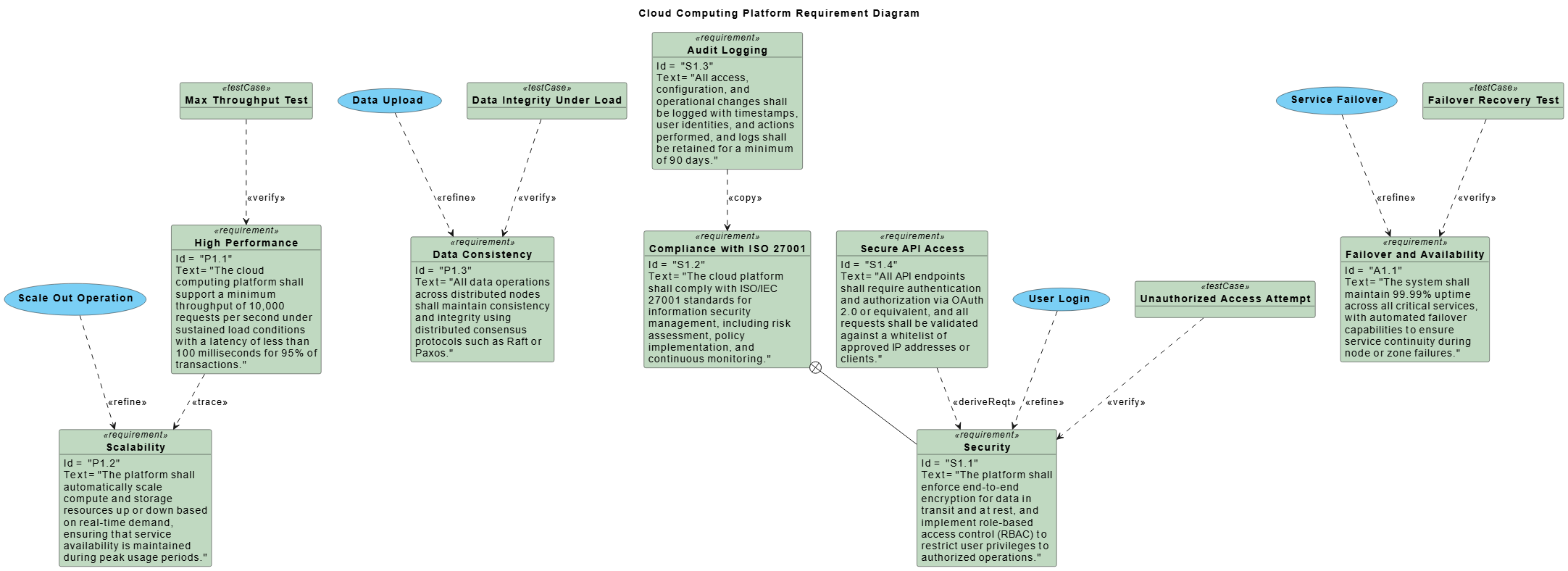
This wasn’t just a response; it was an expert-level consultation. The AI didn’t just explain the concept—it contextualized it within the original requirement diagram, reinforcing the link between req03 (Data Consistency) and its implementation via consensus protocols. It even refined the diagram’s structure by adding $deriveReqt(req08, req04) and $containment(req05, req04), showing how compliance (ISO 27001) is nested under security, and how secure API access is derived from core security requirements.
Each interaction demonstrated the AI Chatbot’s ability to act as a modeling partner—interpreting intent, validating assumptions, and deepening the design’s rigor through natural language dialogue.
Decoding the Requirement Diagram Logic
The final SysML diagram is more than a visual—it’s a living specification. Here’s how each component contributes to a robust cloud platform design:
Performance Requirements
- req01 (High Performance): Sets a hard benchmark—10,000 requests/sec with <100ms latency for 95% of transactions. This is not a wish; it’s a measurable target.
- Verification via Test Case: The
$verify(testCase01, req01)link ensures this requirement is testable, traceable, and auditable.
Scalability & Resilience
- req02 (Scalability): Requires auto-scaling of compute and storage based on real-time demand.
- req06 (Failover and Availability): Enforces 99.99% uptime with automated failover—critical for mission-critical cloud services.
- Use Case Mapping:
$refine(useCase03, req02)shows that the “Scale Out Operation” use case directly supports the scalability requirement.
Security & Compliance
- req04 (Security): Mandates end-to-end encryption and RBAC.
- req05 (Compliance with ISO 27001): Ensures the platform meets international standards for information security management.
- req07 (Audit Logging): Logs all actions for 90 days—essential for forensic analysis and compliance audits.
- req08 (Secure API Access): Requires OAuth 2.0 and IP whitelisting—defending against unauthorized access.
The diagram’s structure is not arbitrary. By using $deriveReqt and $containment, it models hierarchical relationships: security (req04) is the parent of compliance (req05), and secure API access (req08) is derived from core security. This reflects real-world dependency chains in enterprise architecture.
Why SysML for Requirements?
SysML is ideal here because it supports:
- Traceability between requirements, use cases, and test cases.
- Modeling of non-functional requirements (performance, scalability, security) alongside functional ones.
- Formal notation for verification and validation.
This level of rigor ensures that no requirement is left ambiguous, and every claim can be tested, audited, and evolved.
AI as Your Modeling Consultant: Beyond Diagram Generation
The Visual Paradigm AI Chatbot isn’t just a tool—it’s a domain-aware collaborator. Its ability to respond to follow-up questions with technical depth, such as explaining how Raft ensures consistency during high-concurrency operations, elevates the modeling process from documentation to design validation.
Each query was treated as a refinement opportunity:
- When asked about data consistency, the AI didn’t just list protocols—it compared their trade-offs, use cases, and real-world implementations.
- It reinforced the diagram’s integrity by suggesting structural refinements, such as
$copy(req07, req05), which ensures audit logging is inherited by compliance requirements. - It maintained consistency across the model by ensuring all requirements were traceable and verifiable.
This is the essence of an AI-powered visual modeling platform: not just generating visuals, but guiding the design through intelligent, context-aware dialogue.
One Platform, Multiple Standards: A Unified Modeling Suite
Visual Paradigm’s AI Chatbot isn’t limited to SysML. It supports a full spectrum of modeling standards, making it the go-to platform for modern software and enterprise architects:
- UML: For object-oriented design, component, and deployment modeling.
- ArchiMate: For enterprise architecture, mapping business, application, and technology layers.
- C4 Model: For software architecture, visualizing contexts, containers, components, and code.
- SWOT, PEST, Org Charts, Mind Maps, PERT Charts: For strategic planning, organizational design, and project scheduling.
Whether you’re modeling cloud scalability, business strategy, or system architecture, the AI Chatbot adapts to your standard, your terminology, and your workflow.
Conclusion: Build with Confidence, Design with Intelligence
Creating a cloud platform that performs under pressure, scales seamlessly, and stays secure isn’t just about technology—it’s about clarity, traceability, and collaboration. The Visual Paradigm AI Chatbot transforms this challenge into a conversational design journey, where every requirement is not just defined but validated, refined, and connected.
From the initial prompt to the final diagram, the AI acted as a modeling expert—interpreting intent, deepening logic, and ensuring compliance with best practices. The result? A high-fidelity SysML requirement diagram that serves as both a blueprint and a living specification.
Ready to design your next cloud system with intelligence? Explore the AI-Powered Visual Modeling Platform and start your next modeling session today.