


Designing a Safe Swarm: AI-Powered Requirements for Delivery Drone Coordination
Designing a fleet of delivery drones capable of operating safely in complex urban environments demands more than just advanced hardware—it requires a precise, structured approach to capturing functional and safety-critical requirements. The challenge lies in balancing real-time coordination, environmental awareness, and fault tolerance across a dynamic swarm. This is where the Visual Paradigm AI Chatbot steps in—not as a passive generator, but as a collaborative modeling expert.
When prompted to generate a SysML requirement diagram for safety, sensing, and coordination in a drone swarm, the AI didn’t just produce a static diagram. It initiated a dialogue, evolving the model through intelligent refinement and domain-specific insight. This wasn’t automation—it was co-creation.
From Prompt to Precision: The Interactive Journey of Requirement Modeling
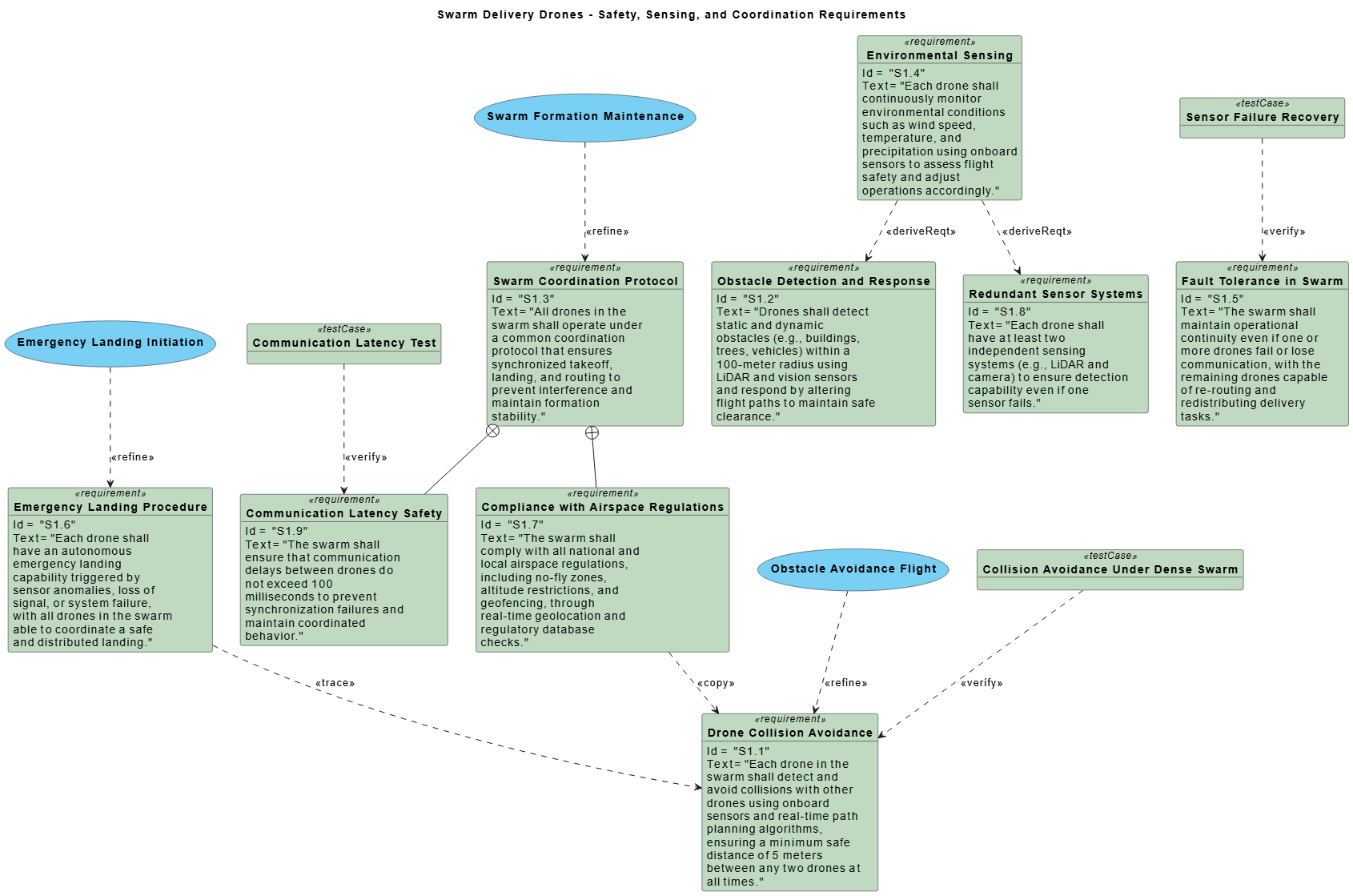
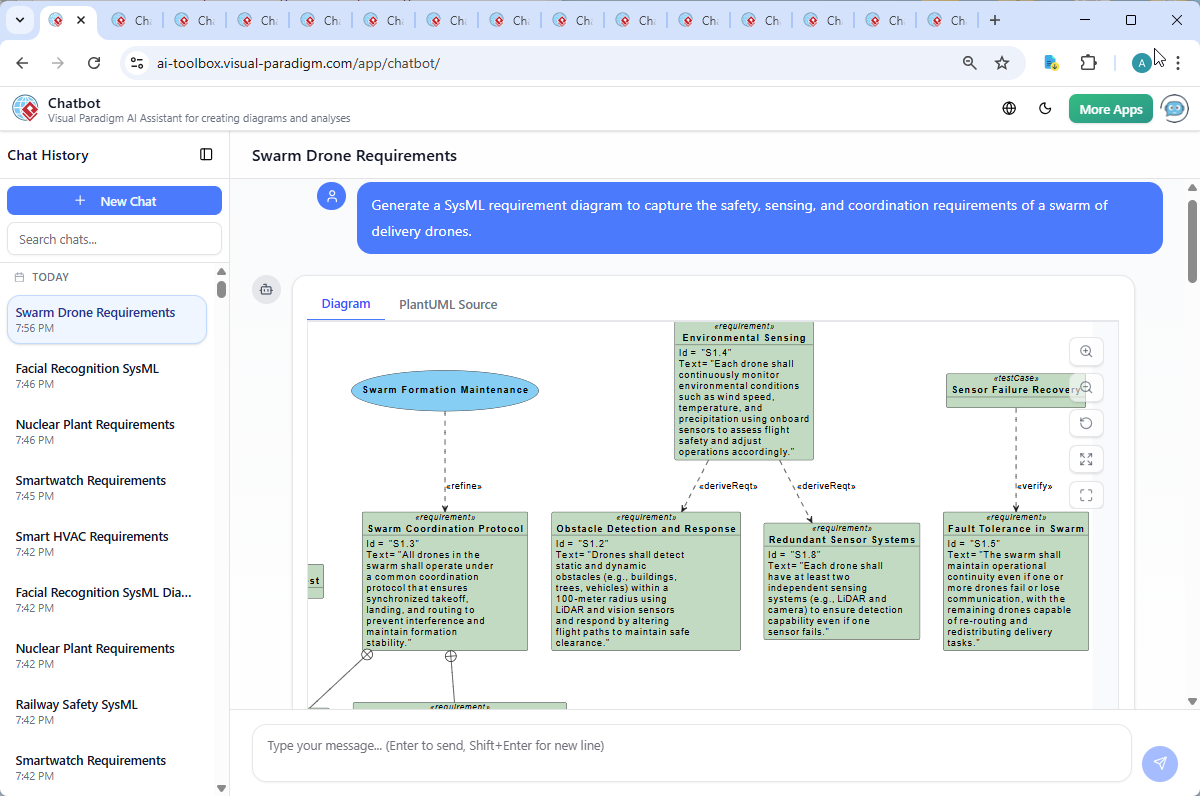
The session began with a clear directive: “Generate a SysML requirement diagram to capture the safety, sensing, and coordination requirements of a swarm of delivery drones.” Within seconds, the AI delivered a fully structured PlantUML-based SysML Requirement Diagram, complete with:
- Core safety requirements (e.g., collision avoidance, emergency landing)
- Environmental sensing mandates (wind, precipitation)
- Swarm coordination protocols and communication constraints
- Traceability links between requirements, use cases, and test cases
But the conversation didn’t stop there. When the user asked, “What specific sensors are recommended for detecting wind speed and precipitation?”, the AI responded with a detailed, sensor-level breakdown—complete with comparative tables, technical specifications, and implementation guidance. It didn’t just answer the question; it enriched the original diagram’s semantic depth by reinforcing the why behind each requirement.
For example, the AI recommended integrating a MEMS anemometer for wind detection and a capacitive humidity sensor (SHT31) combined with camera-based droplet detection for precipitation. It then suggested updating the requirement req04 (Environmental Sensing) to explicitly reference these sensors—demonstrating real-time, context-aware modeling evolution.
This wasn’t a one-way response. The AI invited further refinement: “Let me know if you’d like a SysML requirement diagram or PlantUML diagram that explicitly shows these sensor requirements!”—a clear signal of its role as a design partner, not just a tool.
Decoding the Logic: Why This Requirement Diagram Works
The generated diagram is more than a visual—it’s a living specification. Here’s how each element contributes to robust system design:
1. requirement Blocks: Capturing Verifiable, Testable Criteria
Each requirement (e.g., req01: Drone Collision Avoidance) is structured with:
- Unique ID (e.g., S1.1)
- Clear, measurable behavior (e.g., “maintain 5-meter minimum safe distance”)
- Traceability context (linked to use cases and test cases)
This ensures that every requirement can be verified, validated, and tracked throughout development.
2. useCase and testCase Integration: Bridging Design to Validation
Use cases like Obstacle Avoidance Flight and Emergency Landing Initiation are directly $refined by requirements—ensuring that operational scenarios are rooted in concrete specifications.
Test cases such as Collision Avoidance Under Dense Swarm and Communication Latency Test are $verifyd by their corresponding requirements, forming a closed-loop validation path. This is critical for safety-critical systems like drone swarms.
3. $deriveReqt and $containment: Modeling Dependencies and Constraints
For example:
$deriveReqt(req04, req02)shows that environmental sensing derives from obstacle detection—because wind and precipitation affect obstacle detection capability.$containment(req03, req09)and$containment(req03, req07)indicate that the Swarm Coordination Protocol must contain communication latency and airspace compliance as internal constraints.
This hierarchical logic prevents gaps in system behavior and ensures that no safety or coordination requirement is isolated.
4. $copy and $trace: Cross-Linking for Consistency
The $copy(req07, req01) command indicates that compliance with airspace regulations is a shared concern across multiple safety requirements—especially collision avoidance. Meanwhile, $trace(req06, req01) shows that emergency landing behavior is traced back to collision avoidance, reinforcing the system’s fail-safe logic.
Conversational Intelligence: How the AI Deepened the Design
What sets Visual Paradigm apart is not just the diagram output, but the dialogue that shaped it. The AI didn’t stop at generating a diagram—it anticipated follow-up questions and pre-emptively provided technical depth.
When the user asked about sensor selection, the AI didn’t default to generic answers. Instead, it:
- Provided a comparative table of sensor types for wind and precipitation detection
- Recommended specific models (e.g., SHT31, Bosch BME680)
- Suggested sensor fusion techniques (e.g., Kalman filtering)
- Offered a real-world implementation statement that could be directly inserted into the requirement
This level of contextual intelligence transforms the AI from a diagram generator into a modeling consultant—one that understands both the syntax of SysML and the operational realities of drone swarm deployment.
More Than Just SysML: A Unified Platform for Enterprise Modeling
While this example focused on SysML, the Visual Paradigm AI Chatbot is built to support a full spectrum of modeling standards—making it a unified platform for modern system design:
- UML for software and system architecture
- ArchiMate for enterprise architecture and business alignment
- C4 Model for software architecture visualization (context, containers, components, code)
- Org Charts, Mind Maps, PERT, SWOT, PEST for strategic planning and project management
- Charting (column, area, pie, line) for data-driven decision support
Whether you’re designing a drone swarm, a financial system, or a cloud-native application, the AI Chatbot adapts—offering consistent, intelligent support across all modeling domains.
Conclusion: Where AI Meets Engineering Excellence
The journey from a simple prompt to a comprehensive, traceable, and testable requirement model illustrates why Visual Paradigm is the leading AI-powered visual modeling platform. It doesn’t just generate diagrams—it engages in intelligent, iterative design conversations that elevate the quality and reliability of complex systems.
With the ability to refine logic, suggest sensors, and trace requirements across use cases and test cases, the AI Chatbot becomes an indispensable partner in the development lifecycle.
Ready to design your next system with intelligent precision? Explore the full interactive session and see how the AI Chatbot can transform your modeling process.