


Designing a Trustworthy Healthcare Wearable: AI-Powered Requirement Modeling for Blood Glucose Monitoring
Developing a healthcare wearable device for continuous blood glucose monitoring demands precision, reliability, and regulatory compliance. The challenge lies not just in building the hardware, but in rigorously defining and validating the system’s core capabilities—especially accuracy, battery endurance, and data privacy. These are not optional features; they are life-critical requirements that must be traceable, testable, and auditable.
Enter the Visual Paradigm AI Chatbot—a collaborative modeling expert that transforms high-level ideas into structured, standards-compliant diagrams through natural conversation. Rather than starting from scratch with a blank canvas, users can articulate their vision in plain language, and the AI translates it into a formal SysML Requirement Diagram, complete with traceability, validation logic, and compliance-ready structure.
From Prompt to Precision: The Interactive Evolution of the Requirement Diagram
The journey began with a simple request: “Create a SysML requirement diagram for a healthcare wearable device focusing on accuracy, battery life, and data privacy.” The AI Chatbot responded instantly with a fully rendered PlantUML-based SysML diagram, using the official sysml-requirement-diagram.puml library for semantic accuracy.
But the conversation didn’t stop there. When the user asked, “Explain this diagram,” the AI didn’t just list elements—it provided a structured, clinical-grade breakdown of each requirement, its purpose, and its relationship to user workflows and testing protocols. This wasn’t a static output; it was a dynamic knowledge exchange.
Each follow-up—like requesting clarification on “How is data privacy linked to user consent?” or “Can you refine the logic around battery life and data transmission?”—triggered deeper analysis. The AI responded with precise modeling constructs:
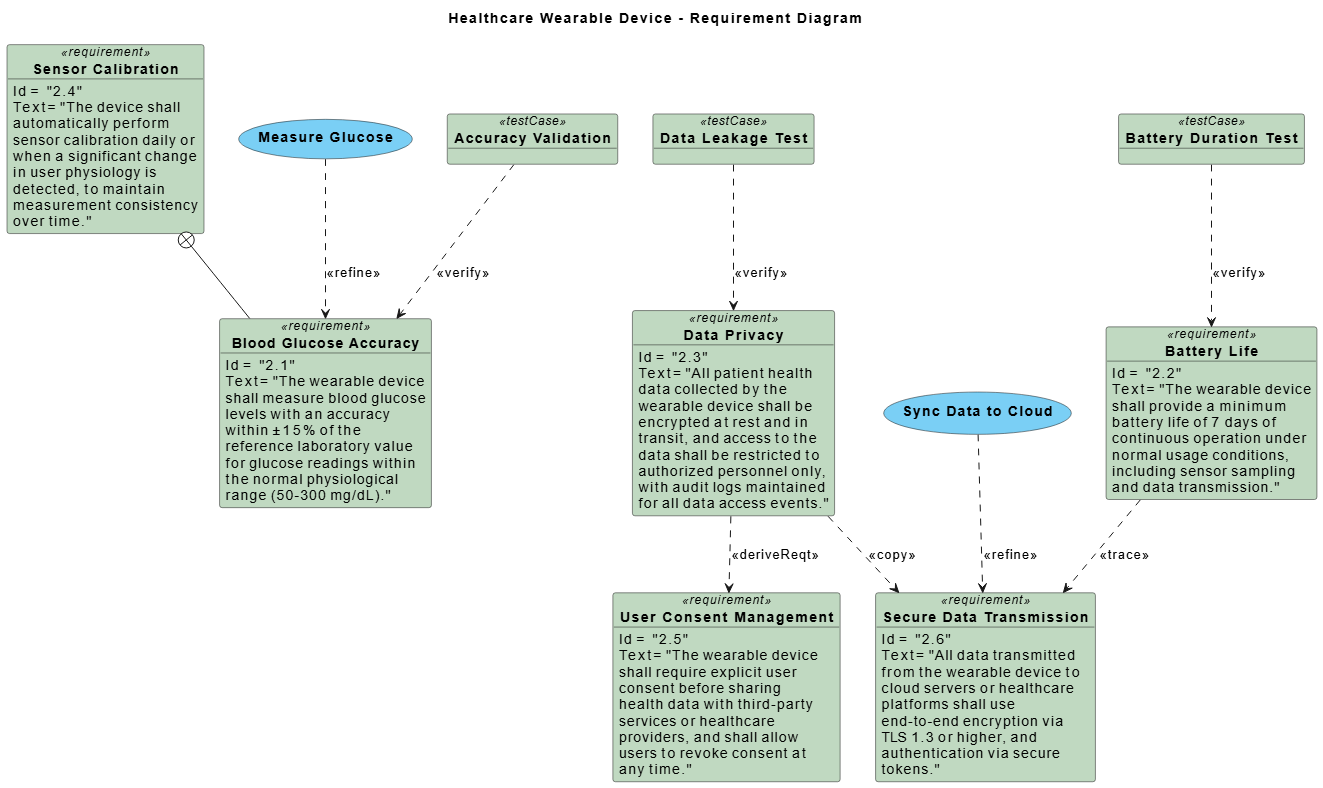
$deriveReqt(req03, req05)– showing that data privacy is derived from explicit user consent.$containment(req04, req01)– demonstrating how daily calibration supports long-term accuracy.$trace(req02, req06)– linking battery life to transmission frequency and security needs.
This iterative refinement isn’t just about editing text—it’s about building a living specification where every requirement is justified, traceable, and testable.
Decoding the Logic: Why This Diagram Works
The SysML Requirement Diagram is more than a visual list—it’s a structured framework for system validation. Here’s how each component contributes:
Core Requirements (The ‘Must-Haves’)
- req01 – Blood Glucose Accuracy: A ±15% margin against lab values is clinically acceptable and aligns with FDA and ISO 15197 standards for glucose monitoring devices.
- req02 – Battery Life: 7-day operation ensures usability without frequent charging, reducing user friction and improving adherence.
- req03 – Data Privacy: Encryption at rest and in transit, combined with audit logging, meets GDPR and HIPAA mandates.
Supporting Requirements (The ‘How It Works’)
- req04 – Sensor Calibration: Automatic daily or event-triggered calibration prevents drift and maintains accuracy over time.
- req05 – User Consent Management: Explicit opt-in and revocation rights empower patients and comply with ethical data governance.
- req06 – Secure Data Transmission: TLS 1.3+ with token-based auth ensures end-to-end protection during cloud sync.
Validation & Traceability (The ‘How We Know It Works’)
$verify(testCase01, req01)– Accuracy is tested against lab benchmarks.$verify(testCase02, req02)– Battery life is validated under real-world usage.$verify(testCase03, req03)– Simulated breach attempts confirm data protection.$refine(useCase01, req01)– The glucose measurement use case is directly tied to the accuracy requirement.
These relationships form a closed-loop validation system, ensuring that every user interaction, test, and compliance check is linked back to a defined requirement. This is essential for medical device certification and audit readiness.
The AI That Thinks Like an Architect
What sets Visual Paradigm apart is that the AI Chatbot isn’t just generating diagrams—it’s acting as a modeling consultant. It understands the semantics of SysML, knows how to structure traceability, and anticipates the need for logical dependencies.
When the user said, “Explain this branch,” the AI didn’t just describe the line—it explained the engineering rationale: why sensor calibration supports accuracy, why consent enables privacy, and how battery life influences transmission frequency. This level of contextual insight is rare in AI tools and reflects deep domain expertise.
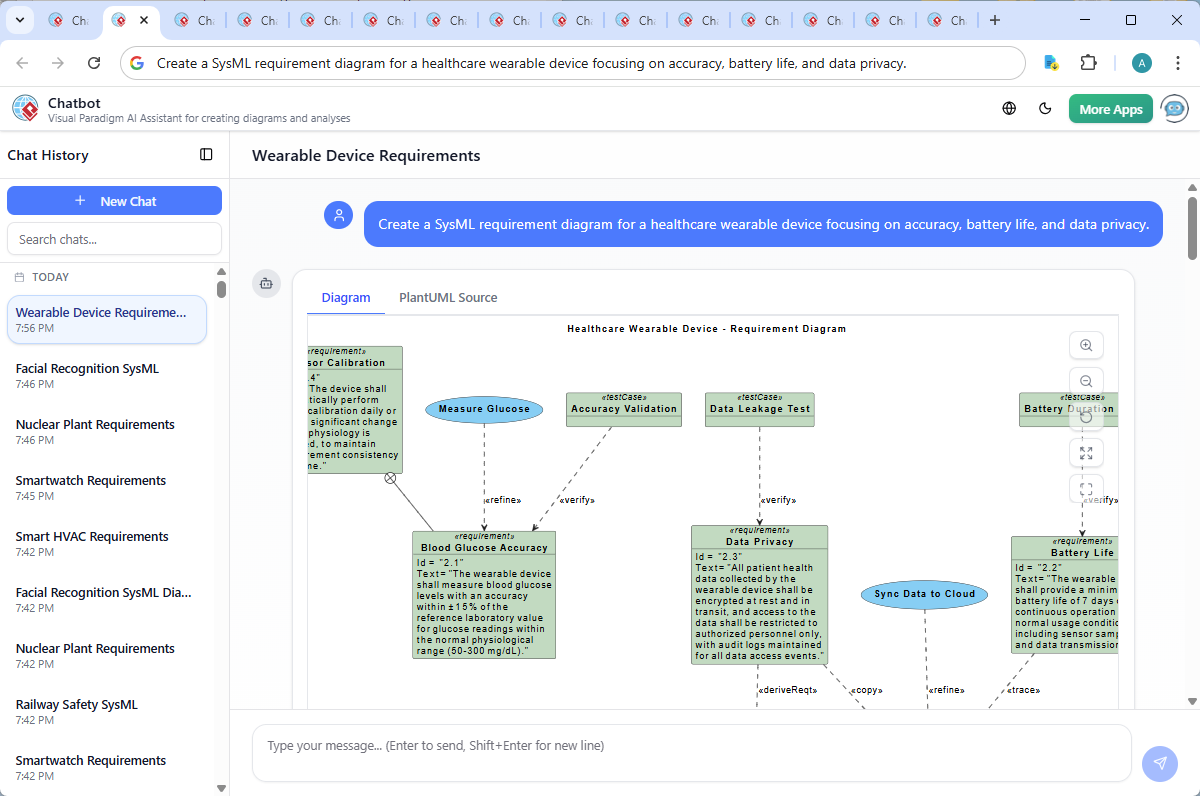
The interface shown in the screenshot isn’t just a chat window—it’s a co-design workspace, where each message refines the model, and the AI responds with precision, consistency, and architectural integrity.
Beyond SysML: A Unified Modeling Platform
While this example focused on SysML, the Visual Paradigm AI Chatbot is not limited to one standard. It seamlessly supports:
- UML – For software architecture, component design, and behavior modeling.
- ArchiMate – For enterprise architecture, business process alignment, and IT governance.
- C4 Model – For clear, scalable system context and container-level design.
- Mind Maps, Org Charts, SWOT, PEST, and Data Charts – For strategic planning, stakeholder analysis, and data visualization.
This versatility means teams can use the same AI-powered platform across the entire lifecycle—from business strategy to system design to regulatory submission—without switching tools or relearning interfaces.
Conclusion: Building Smarter Medical Devices, One Conversation at a Time
Creating a healthcare wearable device demands more than innovation—it demands rigor. The Visual Paradigm AI Chatbot turns complex requirements into structured, traceable, and testable models through natural conversation, reducing errors, accelerating design, and ensuring compliance from day one.
Whether you’re defining accuracy thresholds, validating battery performance, or securing patient data, the AI doesn’t just generate diagrams—it guides you through the logic, supports iterative refinement, and ensures every decision is grounded in engineering and regulatory best practices.
Ready to turn your next medical device concept into a validated, auditable, and AI-optimized model?
Try the Visual Paradigm AI Chatbot today and experience the future of visual modeling.