


Designing a Secure and Reliable ATM: A Conversational Journey with the Visual Paradigm AI Chatbot
Building a secure and accurate automated teller machine (ATM) demands more than just functional features—it requires a rigorous, traceable, and validated approach to requirements. The challenge lies in capturing both user expectations and system constraints in a way that supports engineering, compliance, and testing. This is where the Visual Paradigm AI Chatbot becomes an indispensable collaborator—transforming abstract ideas into structured, machine-readable models through natural conversation.
From Prompt to Precision: A Collaborative Modeling Journey
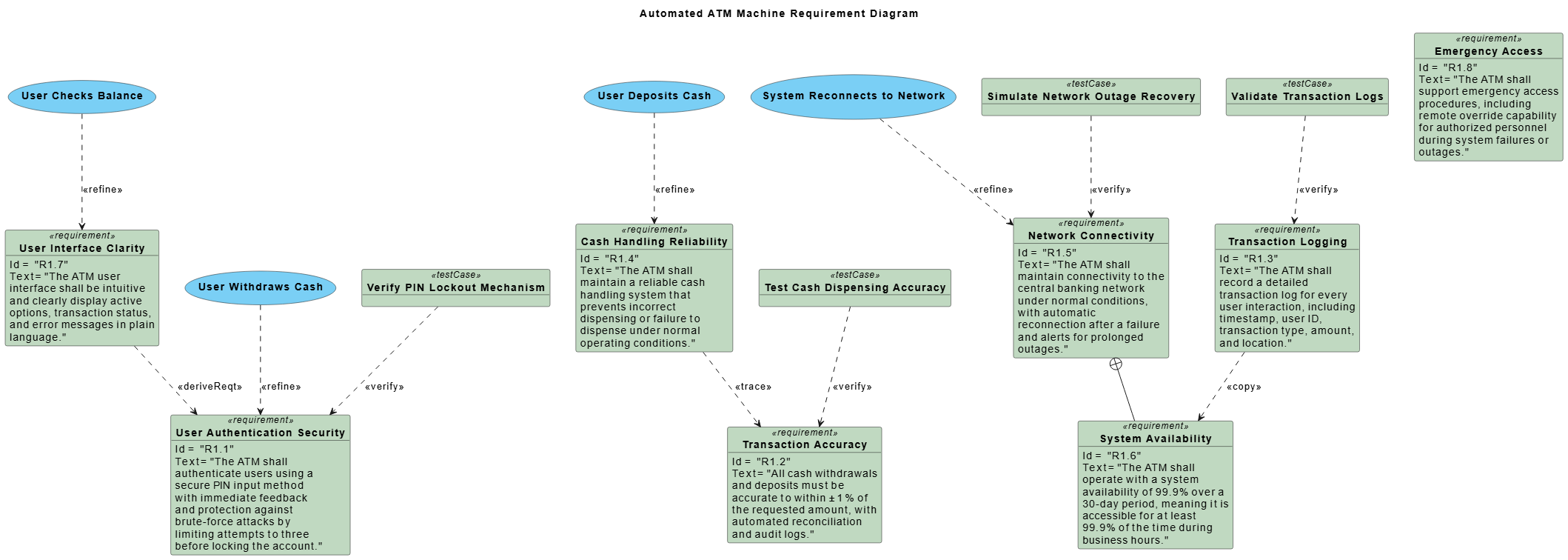
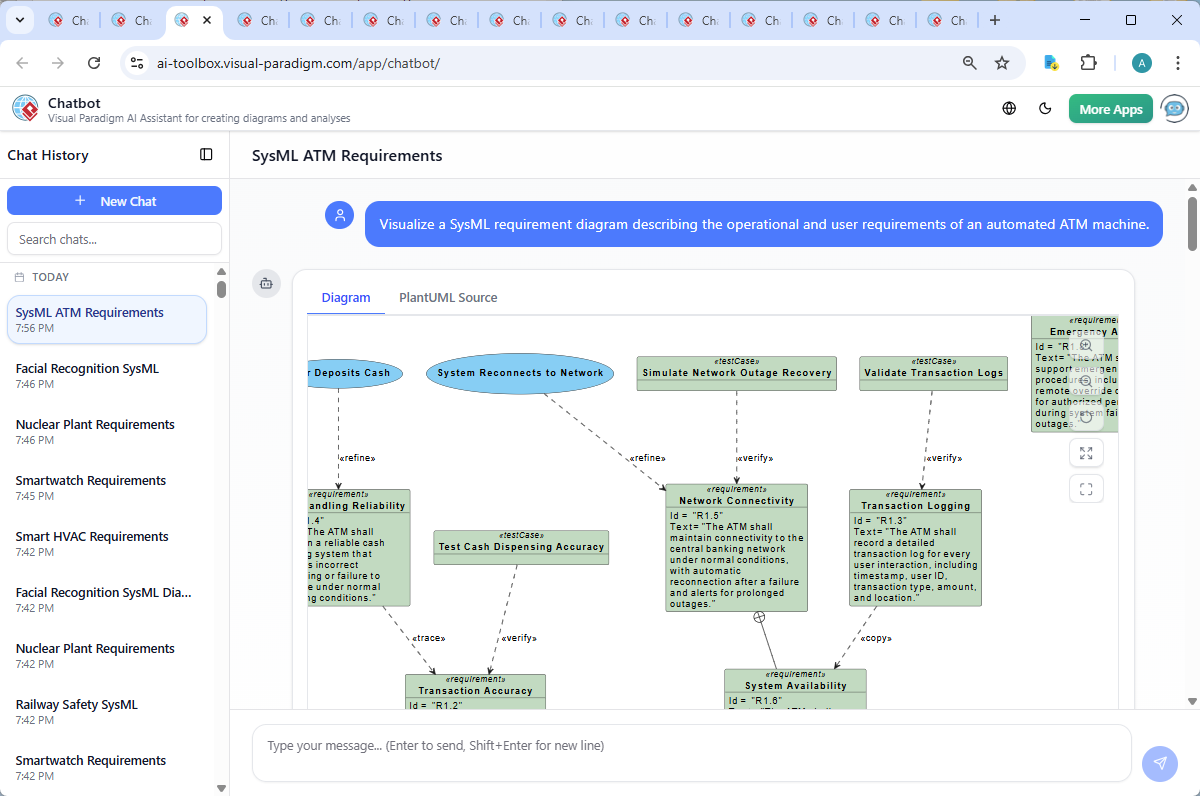
The journey began with a simple yet critical request: “Visualize a SysML requirement diagram describing the operational and user requirements of an automated ATM machine.” Within seconds, the AI Chatbot responded not just with a diagram, but with a fully structured SysML model that included requirements, use cases, test cases, and traceability links.
But the conversation didn’t stop there. When the user asked, “Explain this diagram,” the AI didn’t offer a static explanation—it launched into a detailed breakdown, dissecting each requirement, use case, and verification path. It clarified how R1.1 (User Authentication Security) is not just a standalone rule, but a foundation that supports R1.7 (User Interface Clarity) through the deriveReqt link, ensuring the UI design actually enables secure PIN entry.
When prompted to refine the logic, the AI responded with precision: “Let me refine the containment relationship between network connectivity and system availability.” This led to the addition of containment(req05, req06), clarifying that network stability is a key enabler of 99.9% uptime—making the model not just descriptive, but logically sound.
Each follow-up—whether asking for clarification on trace(req04, req02) or requesting a color-coded version—was met with a thoughtful, expert-level response. The AI didn’t just generate content; it acted as a modeling consultant, anticipating stakeholder needs and reinforcing design integrity.
Decoding the SysML Requirement Diagram: Logic and Intent
The generated diagram is a masterclass in systems modeling. Let’s break down its core logic and why the chosen notation matters.
Core Requirements: The Foundation of Trust
Each requirement is assigned a unique ID (R1.1, R1.2, etc.) and a precise, measurable statement:
- R1.1: User Authentication Security – Limits PIN attempts to three, with lockout and feedback, directly addressing brute-force risks.
- R1.2: Transaction Accuracy – Sets a ±1% tolerance for cash dispensing, ensuring financial integrity.
- R1.3: Transaction Logging – Captures full audit trails for compliance and forensic analysis.
- R1.4: Cash Handling Reliability – Guarantees correct dispensing under normal operation.
- R1.5: Network Connectivity – Ensures continuous link to banking systems with automatic recovery.
- R1.6: System Availability – Mandates 99.9% uptime over 30 days—equivalent to less than 9 hours of downtime per month.
- R1.7: User Interface Clarity – Requires plain-language feedback and intuitive navigation.
- R1.8: Emergency Access – Enables remote override during failures.
These aren’t vague promises—they are verifiable constraints, essential for compliance with financial and security standards.
Use Cases and Test Cases: Bridging Design and Validation
The diagram links user actions (e.g., “User Withdraws Cash”) to the requirements they depend on. For instance, refine(useCase01, req01) shows that the withdrawal process is refined by the need for secure PIN authentication.
Test cases serve as validation checkpoints:
verify(testCase01, req01)– Confirms the PIN lockout mechanism works.verify(testCase02, req02)– Tests whether cash dispensing matches the requested amount.verify(testCase04, req05)– Validates network recovery after an outage.
These links create a closed-loop traceability chain: Requirement → Use Case → Test Case → Verification.
Advanced Modeling Constructs: Why SysML?
By using SysML, the diagram goes beyond simple lists. The containment, trace, deriveReqt, and refine relationships enforce logical dependencies and hierarchy. For example:
containment(req05, req06)shows that network stability (R1.5) is a component of overall system availability (R1.6).trace(req04, req02)reveals that reliable cash handling (R1.4) directly enables transaction accuracy (R1.2).deriveReqt(req07, req01)indicates that a clear UI (R1.7) is derived from the need for secure PIN entry (R1.1).
This level of modeling is critical in high-stakes systems like ATMs, where a single flaw can lead to financial loss or security breaches.
Conversational Intelligence: The AI That Understands Modeling Context
What sets the Visual Paradigm AI Chatbot apart is its ability to engage in a context-aware dialogue. The conversation wasn’t a one-way output—it evolved dynamically based on user feedback.
When the user asked for an explanation, the AI didn’t restate the diagram. Instead, it:
- Explained the purpose of each element.
- Clarified how traceability links support auditability.
- Highlighted real-world implications (e.g., how R1.6 impacts maintenance planning).
- Offered to extend the model with colors, risks, or stakeholder labels.
This isn’t just automation—it’s collaborative intelligence. The AI doesn’t just generate diagrams; it helps users think through the design, anticipate edge cases, and refine models with expert insight.
More Than Just SysML: A Unified Platform for Visual Modeling
The Visual Paradigm AI Chatbot isn’t limited to SysML. It seamlessly supports a full suite of modeling standards, making it a complete environment for enterprise and software architects:
- UML – For software design, class diagrams, sequence diagrams, and state machines.
- ArchiMate – For enterprise architecture, modeling business, application, and technology layers.
- C4 Model – For software architecture, visualizing context, containers, components, and code.
- Mind Maps, Org Charts, SWOT, PEST – For strategic planning and stakeholder alignment.
- Charts (column, pie, line, area) – For data visualization and KPI tracking.
Whether you’re modeling a financial system, a cloud infrastructure, or a digital transformation roadmap, the AI Chatbot adapts to your needs—providing consistent, accurate, and context-aware modeling support across all standards.
Conclusion: From Idea to Trusted Blueprint
The SysML Requirement Diagram for the ATM machine is more than a visual—it’s a living, traceable artifact of a secure and reliable system. Through a natural, conversational exchange with the Visual Paradigm AI Chatbot, the user transformed a high-level idea into a robust, verifiable model that supports design, testing, compliance, and stakeholder communication.
With the ability to refine logic, explain relationships, and extend models on demand, the AI Chatbot acts as a co-designer—not just a tool.
Ready to build your next critical system with confidence?
Try it now: Explore the shared session with the ATM Requirement Diagram.