


Designing a Metro Train System with Precision: AI-Powered Requirements Engineering
Designing a modern metro train system demands more than just engineering excellence—it requires a disciplined, traceable, and human-centered approach to defining what the system must do. The challenge lies in balancing navigation accuracy, passenger safety, and comfort under real-world operational constraints. Enter the Visual Paradigm AI Chatbot: not just a diagram generator, but a collaborative modeling expert that transforms high-level ideas into structured, verifiable requirements through natural conversation.
From Concept to Clarity: An Interactive Journey with the AI Chatbot
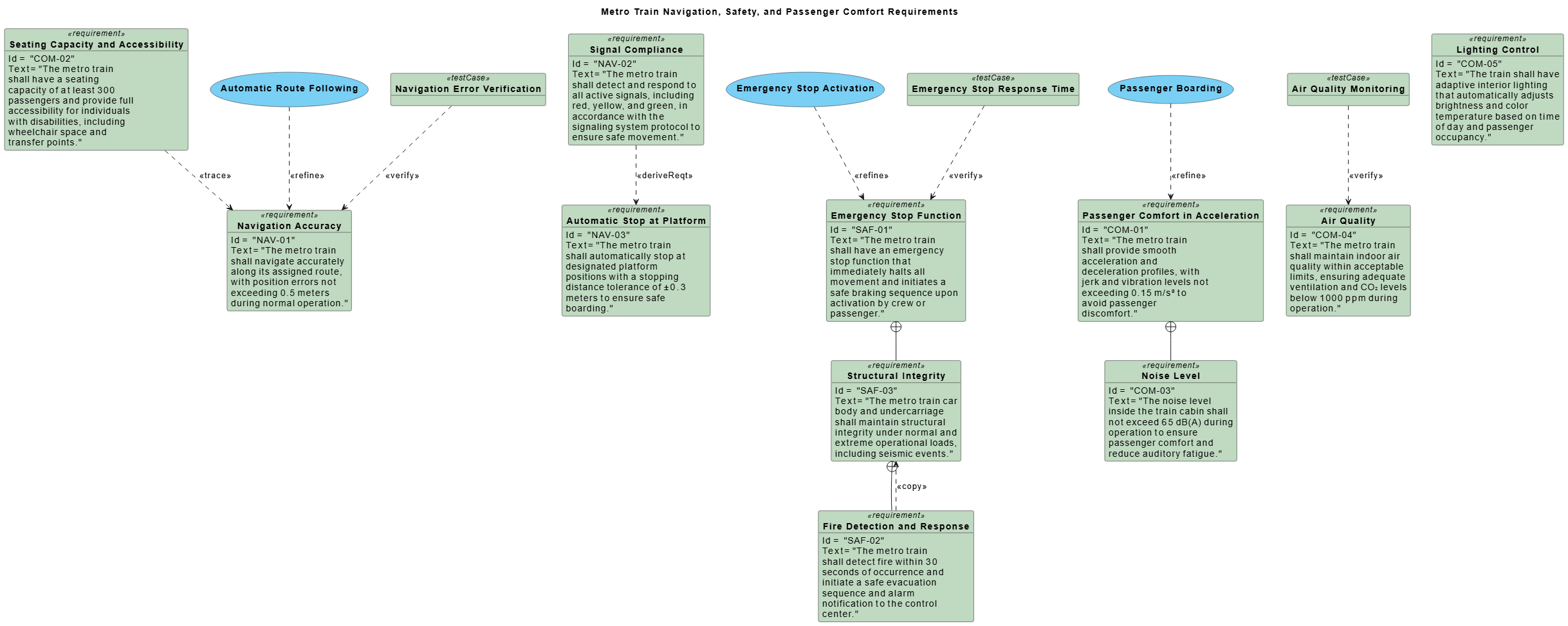
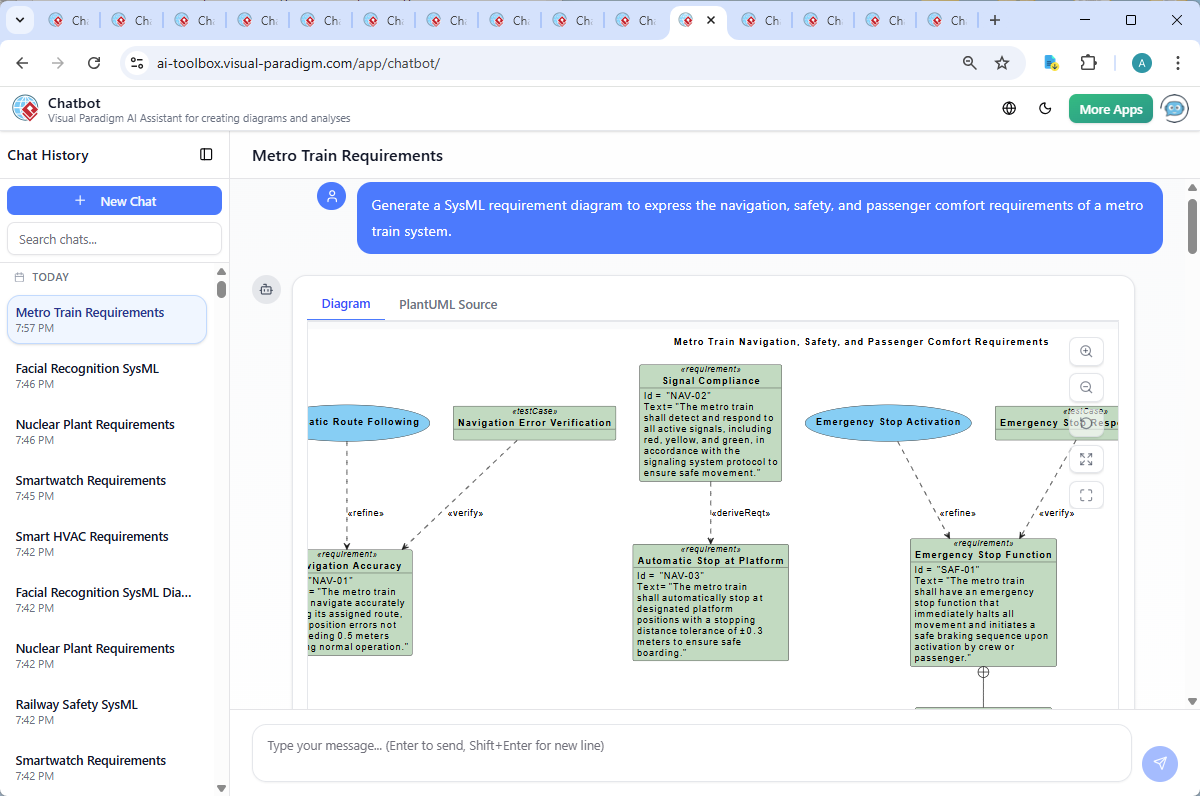
The journey began with a simple prompt: “Generate a SysML requirement diagram to express the navigation, safety, and passenger comfort requirements of a metro train system.” Within seconds, the AI delivered a fully structured SysML Requirement Diagram using PlantUML syntax, complete with formal requirements, use cases, test cases, and traceability relationships.
But the real value emerged in the follow-up dialogue. When the user asked, “Explain this diagram,” the AI didn’t just list elements—it provided a layered breakdown, categorizing each requirement by domain (navigation, safety, comfort), explaining the purpose of each use case, and clarifying the significance of relationships like $verify, $refine, and $containment.
Further refinement followed: the user requested clarification on the “relationship between emergency stop and structural integrity,” prompting the AI to explain that $containment(req04, req06) ensures the emergency braking system doesn’t compromise the train’s physical integrity—a critical safety consideration in high-speed systems.
This back-and-forth wasn’t just explanation—it was collaborative design. The AI acted as a modeling consultant, adapting to user intent, offering technical depth, and ensuring that every element served a purpose in the larger system architecture.
Decoding the Diagram: The Logic Behind the Requirements
The generated SysML Requirement Diagram is not a static image—it’s a living model of system behavior, engineered for clarity, traceability, and compliance. Here’s how it was constructed:
1. Requirement Categorization
Each requirement is labeled with a unique ID (e.g., NAV-01, SAF-02, COM-05) and grouped into three core domains:
- Navigation: Accuracy, signal compliance, and precise platform alignment.
- Safety: Emergency stop, fire detection, and structural resilience under extreme conditions.
- Passenger Comfort: Smooth motion, low noise, air quality, accessibility, and adaptive lighting.
This domain-based structure ensures that no requirement is overlooked and supports stakeholder alignment across engineering, operations, and design teams.
2. Use Case & Test Case Integration
Use cases such as Automatic Route Following and Emergency Stop Activation are linked to requirements via $refine, showing how operational scenarios give rise to specific technical needs.
Test cases like Emergency Stop Response Time and Air Quality Monitoring are tied to requirements via $verify, ensuring that every requirement is testable and verifiable—a cornerstone of systems engineering.
3. Inter-Requirement Relationships
The diagram uses advanced SysML relationships to model dependencies:
$deriveReqt(req02, req03): Signal compliance leads to automatic platform stopping—showing logical progression.$containment(req04, req06): Emergency stop must not compromise structural integrity—highlighting safety-by-design.$containment(req07, req09): Smooth acceleration reduces noise—demonstrating cross-domain influence.
These relationships ensure that changes in one requirement are reflected across the system, preventing siloed design and enhancing system coherence.
4. Why SysML? The Power of Formal Modeling
Unlike simple diagrams, SysML enables formal modeling with traceability, verification, and constraint handling. By using SysML’s standardized notation, the diagram becomes a contract between stakeholders, developers, and regulators—essential for certification under standards like ISO 25119 and ISO 26262.
Conversational Intelligence: The AI That Thinks Like an Engineer
The real strength of Visual Paradigm’s AI Chatbot lies in its ability to understand context, anticipate needs, and guide design decisions. In this session, the AI didn’t just respond—it collaborated.
When the user asked for an explanation, the AI didn’t stop at listing elements. It:
- Clarified the difference between functional and non-functional requirements,
- Explained how traceability supports audit readiness,
- Highlighted the engineering rigor behind relationships like
$containmentand$refine, - Offered next steps: exporting the diagram, adding risk analysis, or expanding to stakeholder views.
This level of insight transforms the chatbot from a tool into a design partner.
More Than Just SysML: A Full Modeling Suite
While this example focused on SysML, the Visual Paradigm AI Chatbot is not limited to one standard. It seamlessly supports:
- UML: For software and system behavior modeling,
- ArchiMate: For enterprise architecture and business-IT alignment,
- C4 Model: For architectural decision documentation and system context visualization,
- Mind Maps, Org Charts, SWOT, PEST, PERT, and data visualization charts: For strategic planning, stakeholder analysis, and project management.
This versatility makes Visual Paradigm the only AI-powered visual modeling platform that supports the full lifecycle of system and enterprise design—from concept to deployment.
Conclusion: Engineering the Future, One Conversation at a Time
The metro train system is more than a vehicle—it’s a complex, safety-critical ecosystem. By using the Visual Paradigm AI Chatbot, teams can define, refine, and validate requirements with unprecedented speed and precision.
From the initial prompt to the final explanation, every interaction was purposeful, intelligent, and grounded in engineering best practices. The result? A requirement diagram that isn’t just visual—it’s actionable, traceable, and compliant.
Ready to transform your next system design into a collaborative, AI-enhanced journey? Try the shared session and see how the AI Chatbot turns your ideas into structured models—fast, accurate, and ready for real-world deployment.