


Designing a Scalable Food Delivery Platform with AI-Powered Precision
Building a resilient and scalable food delivery platform requires more than just a functional app—it demands a clear, accurate, and maintainable technical architecture. The challenge lies in visualizing how mobile users, restaurant systems, order processing services, and payment gateways interact across distributed environments. This is where the Visual Paradigm AI Chatbot becomes a transformative partner: not just generating diagrams, but guiding the design through intelligent, iterative conversation.
From Concept to Deployment: A Collaborative Design Journey
The journey began with a simple prompt: “Visualize a deployment diagram for a food delivery platform highlighting mobile users, restaurant systems, order management services, and payment gateways.” Within seconds, the Visual Paradigm AI Chatbot delivered a fully structured PlantUML script, complete with nodes, components, and communication links—ready for rendering.
But the real value emerged in the conversation that followed. When the user asked, “Can you explain how the Order Processing Logic in the Order Management Server handles order validation and routing to the restaurant system?”, the AI didn’t just repeat the diagram—it deepened the design with expert-level insight.
It broke down the validation process into five critical steps: user input checks, restaurant availability, pricing accuracy, duplication prevention, and kitchen capacity. Then, it detailed the secure routing mechanism—JSON serialization, HTTPS API calls, and real-time status updates—ensuring every component’s role was not only visible but logically sound.
Throughout the exchange, the AI acted as a modeling consultant, responding to follow-up requests like “Explain this branch” or “Refine the logic” with clarity and precision. This isn’t a diagram generator—it’s a conversational design environment where the AI learns, adapts, and enhances the model in real time.
Decoding the Deployment Diagram Logic
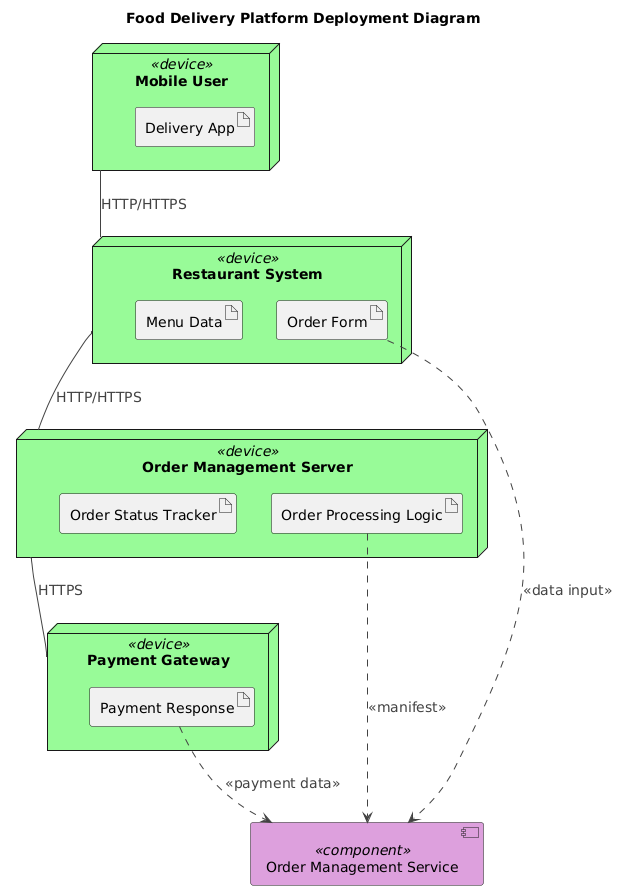
The resulting deployment diagram is more than a visual map—it’s a technical blueprint that reflects industry best practices in distributed system design. Here’s a breakdown of its core logic and notation choices:
1. node Elements Represent Physical or Logical Execution Environments
Each node (e.g., Mobile User, Restaurant System, Order Management Server) represents a runtime environment. The use of <<device>> stereotypes clearly distinguishes physical devices (like mobile phones) from server environments, which is crucial for deployment planning and infrastructure management.
2. component for Functional Separation
The Order Management Service is modeled as a component, emphasizing its role as a reusable, deployable unit of functionality. This separation allows for independent scaling, updates, and monitoring—key for microservices-based architectures.
3. artifact for Data and Interface Definition
Artifacts like Order Form, Menu Data, and Payment Response represent data entities or interface contracts. Their use in conjunction with ..> dependencies (e.g., orderform_artifact ..> ordermanagementsystem_component : <<data input>>) shows how data flows into the system, enabling traceability and integration clarity.
4. Communication Protocols and Security
Arrows between nodes specify communication paths using HTTP/HTTPS and HTTPS protocols. The emphasis on HTTPS for the payment gateway ensures that sensitive financial data is encrypted in transit—critical for compliance and trust.
5. Real-Time Status Tracking
The diagram includes implicit feedback loops via webhooks or polling mechanisms. This reflects how modern platforms maintain real-time visibility into order status—from kitchen confirmation to delivery tracking—without requiring constant polling.
Conversational Intelligence in Action
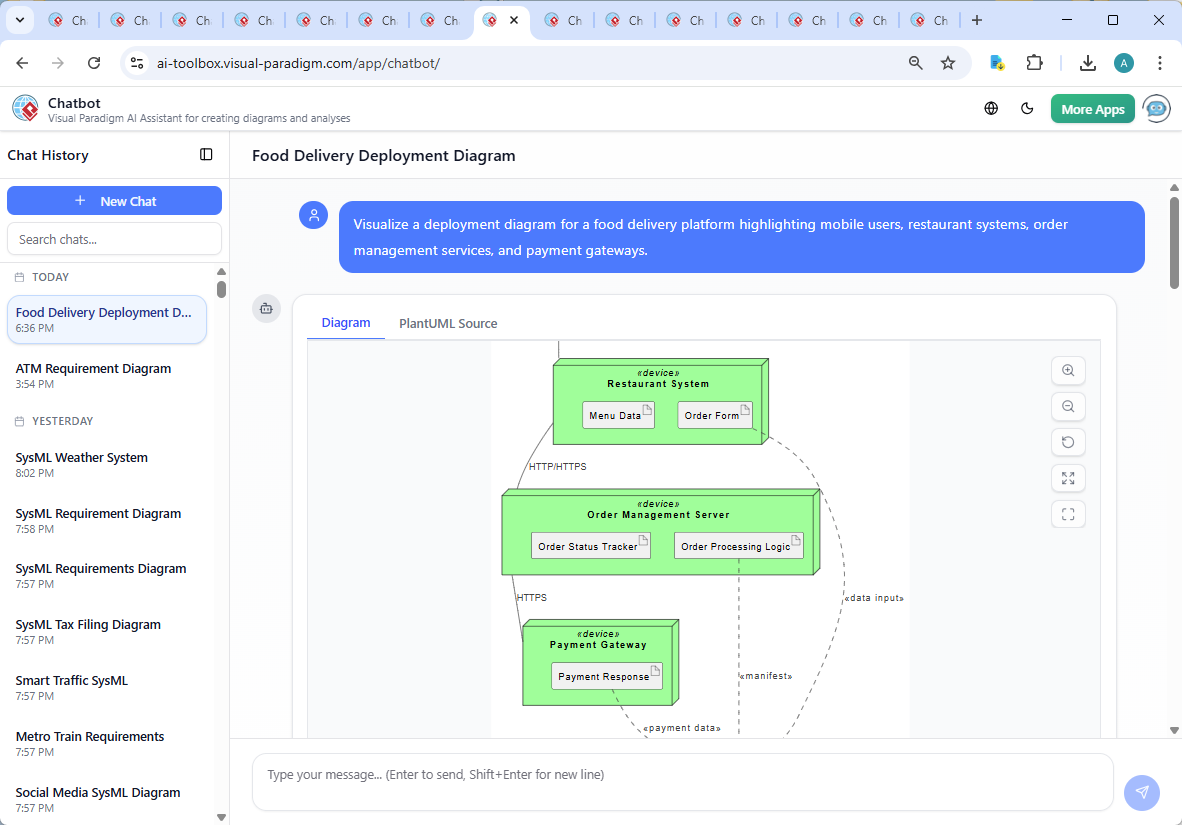
The depth of insight didn’t stop at the diagram. The AI’s ability to respond to follow-up questions—such as explaining validation logic or suggesting sequence diagrams—demonstrates its role as a collaborative modeling expert. This isn’t a one-way output; it’s an intelligent dialogue that refines the architecture as new requirements emerge.
For proof, see the Visual Paradigm AI Chatbot interface in action, where each message reflects a live iteration of the design process:
More Than Deployment: A Full Modeling Suite
While this example focuses on a deployment diagram, the Visual Paradigm AI Chatbot is not limited to one standard. It seamlessly supports UML, ArchiMate, SysML, C4 Model, Mind Maps, PERT Charts, Org Charts, and SWOT/PEST analyses.
Whether you’re modeling enterprise architecture with ArchiMate, designing complex systems with SysML, or visualizing team dynamics with Org Charts, the AI Chatbot adapts to your needs—providing consistent, accurate, and context-aware modeling support across the entire spectrum.
Build Smarter, Faster, Together
With Visual Paradigm’s AI-Powered Visual Modeling Platform, you’re not just creating diagrams—you’re co-creating intelligent systems with a modeling expert that understands both the technical and business context. From concept to deployment, the AI Chatbot ensures your architecture is not only visually clear but logically sound and future-proof.
Ready to design your next platform with confidence? Explore the live session and see how the AI transforms your ideas into precise, actionable models.