


Designing a Secure Healthcare Appointment System with AI-Powered Deployment Modeling
Deploying a healthcare appointment system requires more than just connecting components—it demands a clear, secure, and compliant architecture. The challenge lies in visualizing how patient portals, hospital systems, and databases interact while maintaining data integrity and regulatory adherence. Enter the Visual Paradigm AI Chatbot: not just a diagram generator, but a conversational modeling partner that translates intent into precise, standards-compliant designs.
From Concept to Deployment: A Collaborative Modeling Journey
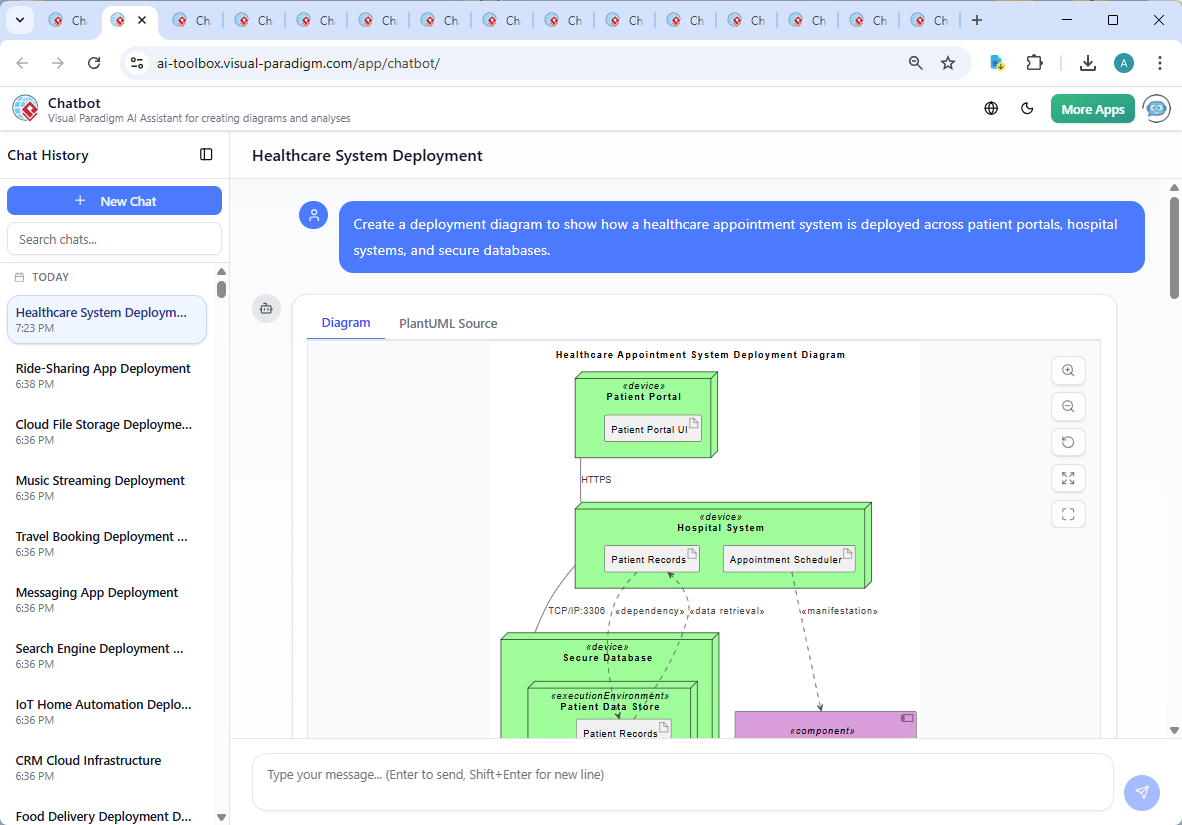
The journey began with a simple prompt: “Create a deployment diagram to show how a healthcare appointment system is deployed across patient portals, hospital systems, and secure databases.” The AI Chatbot responded instantly with a fully structured PlantUML script, generating a deployment diagram that already reflected key architectural decisions—device nodes, component relationships, and secure communication protocols.
But the real value emerged in the conversation. When the user asked, “Can you explain how the HTTPS connection between the Patient Portal and Hospital System ensures data security during appointment scheduling?”, the AI didn’t just restate the diagram—it delivered a detailed, layered explanation of TLS encryption, authentication, data integrity, and compliance with HIPAA. This wasn’t a static diagram; it was a living design conversation.
Further refinements followed: “AI, refine the logic around the data flow from the Patient Records artifact to the secure database,” and “Explain this branch of the dependency chain.” Each request was met with precise, technical clarity—proof that the AI is not just generating visuals, but acting as a modeling consultant with deep domain knowledge.
Decoding the Deployment Diagram Logic
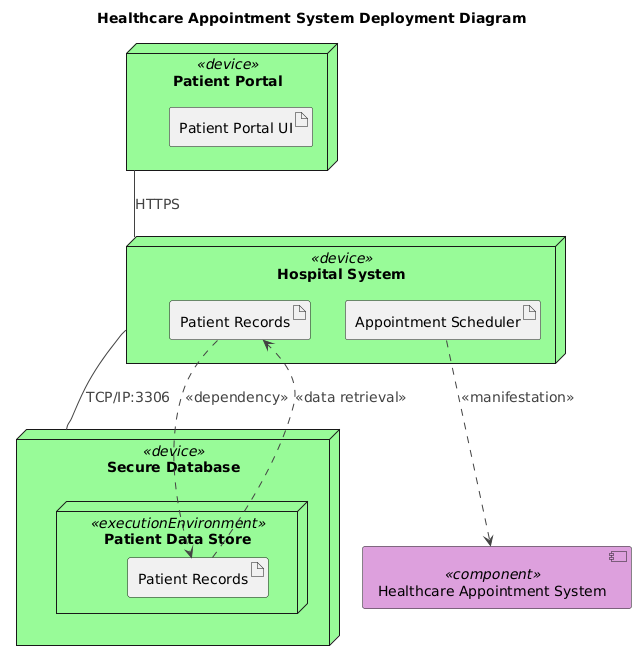
The final deployment diagram is more than a visual—it’s a technical blueprint built on sound architectural principles. Here’s how each element contributes:
1. node "Patient Portal" <>
Represents the client-facing interface where patients book appointments. It’s modeled as a device to emphasize its physical or logical deployment environment, such as a web server or mobile app container.
2. node "Hospital System" <>
Encapsulates the core backend logic: the Appointment Scheduler and Patient Records components. These are internal to the hospital’s infrastructure and handle business logic and data processing.
3. node "Secure Database" <>
Isolated as a dedicated environment for sensitive data. The Execution Environment named Patient Data Store explicitly separates data storage from processing, aligning with security best practices like data segregation.
4. Communication Protocols
- HTTPS between Patient Portal and Hospital System: Ensures end-to-end encryption and identity verification.
- TCP/IP:3306 between Hospital System and Secure Database: Reflects a standard, secure database connection (MySQL default port), with access controlled via network policies.
5. Dependency and Manifestation Relationships
appointmentscheduler_artifact ..> healthcareappointment_system_component: Shows that the scheduler is a component that is manifested within the system.patientrecords_artifact ..> patientrecords_store: Illustrates data flow from application logic to persistent storage.patientrecords_store ..> patientrecords_artifact: Indicates bidirectional data retrieval, essential for real-time updates.
Every line and label was chosen to reflect real-world deployment constraints, compliance needs, and performance considerations—hallmarks of a mature architectural design.
Conversational Intelligence: Where AI Adds Real Value
The AI Chatbot didn’t stop at diagram generation. It evolved into a technical advisor, answering nuanced questions with precision. For example:
- “How does HTTPS prevent man-in-the-middle attacks?” → The AI explained certificate-based authentication and TLS handshake mechanics.
- “Why use an execution environment for the database?” → It clarified that this enhances security by isolating data storage from application logic.
- “Can we add a logging service for audit trails?” → The AI proposed adding a
Log Servernode with aSecure Loggingartifact, demonstrating adaptability.
This back-and-forth isn’t just helpful—it’s transformative. The AI isn’t just following commands; it’s co-designing with the user, validating assumptions, and suggesting improvements based on industry standards and security best practices.
Beyond Deployment: A Full Modeling Suite
While this example focuses on a Deployment Diagram, the Visual Paradigm AI Chatbot is built to support a full spectrum of modeling standards. Whether you’re designing an enterprise architecture with ArchiMate, modeling complex systems with SysML, visualizing software architecture using the C4 Model, or brainstorming strategies with Mind Maps, SWOT, PEST, or PERT Charts, the AI adapts seamlessly.
It understands context, maintains consistency across diagrams, and ensures that every model aligns with real-world implementation needs—making it the only AI-powered visual modeling platform that truly supports end-to-end design collaboration.
Conclusion & Call to Action
Creating a secure, scalable healthcare appointment system isn’t just about technology—it’s about designing with intention, compliance, and trust. With Visual Paradigm’s AI Chatbot, you’re not just building diagrams; you’re co-creating a secure, compliant, and future-proof system through intelligent, conversational design.
Experience the power of AI-driven modeling. Explore this live session and see how the AI transforms your ideas into professional-grade visual models—crafted using the Visual Paradigm AI Chatbot.