


Designing a Secure, Scalable Online Ticketing System with AI-Powered Precision
Building a reliable online ticketing system demands more than just visual clarity—it requires accurate modeling of system components, their interactions, and the underlying logic that ensures availability, security, and real-time consistency. The challenge lies in translating complex business workflows into a structured, scalable architecture that developers, architects, and stakeholders can align on.
Enter the Visual Paradigm AI Chatbot—not just a diagram generator, but a conversational modeling partner. It transforms abstract ideas into precise, standards-compliant visual models through natural language interaction. In this example, we explore how the AI collaboratively built a Deployment Diagram for an online ticketing system, integrating user devices, ticketing servers, venue systems, and payment processors—all while refining logic through real-time feedback.
The Interactive Journey: From Prompt to Precision
The process began with a simple request: “Visualize a deployment diagram for an online ticketing system integrating user devices, ticketing servers, venue systems, and payment processors.” The AI responded immediately with a fully structured PlantUML code, generating a clean, semantic deployment model using standard UML notation.
But the real value emerged in the conversation. When asked, “Can you explain how the ‘Ticketing Service’ on the Ticketing Server interacts with the ‘Venue Schedule’ to validate event availability?”, the AI didn’t just restate the diagram—it provided a detailed, step-by-step breakdown of the interaction flow, including:
- How the user’s device initiates a request
- How the Ticketing Service queries the Venue System via REST API
- What data is exchanged (e.g., event status, capacity, time window)
- How validation rules are enforced
- Security measures like HTTPS and time synchronization
This wasn’t a static diagram—it was a living design process. The AI acted as a modeling consultant, anticipating follow-up questions and enriching the model with operational insight. For instance, when the user requested clarification on dependency logic, the AI highlighted that the Payment Rules artifact depends on the Ticketing Service, ensuring that payment logic is only activated after ticket validation.
Visualizing the Architecture
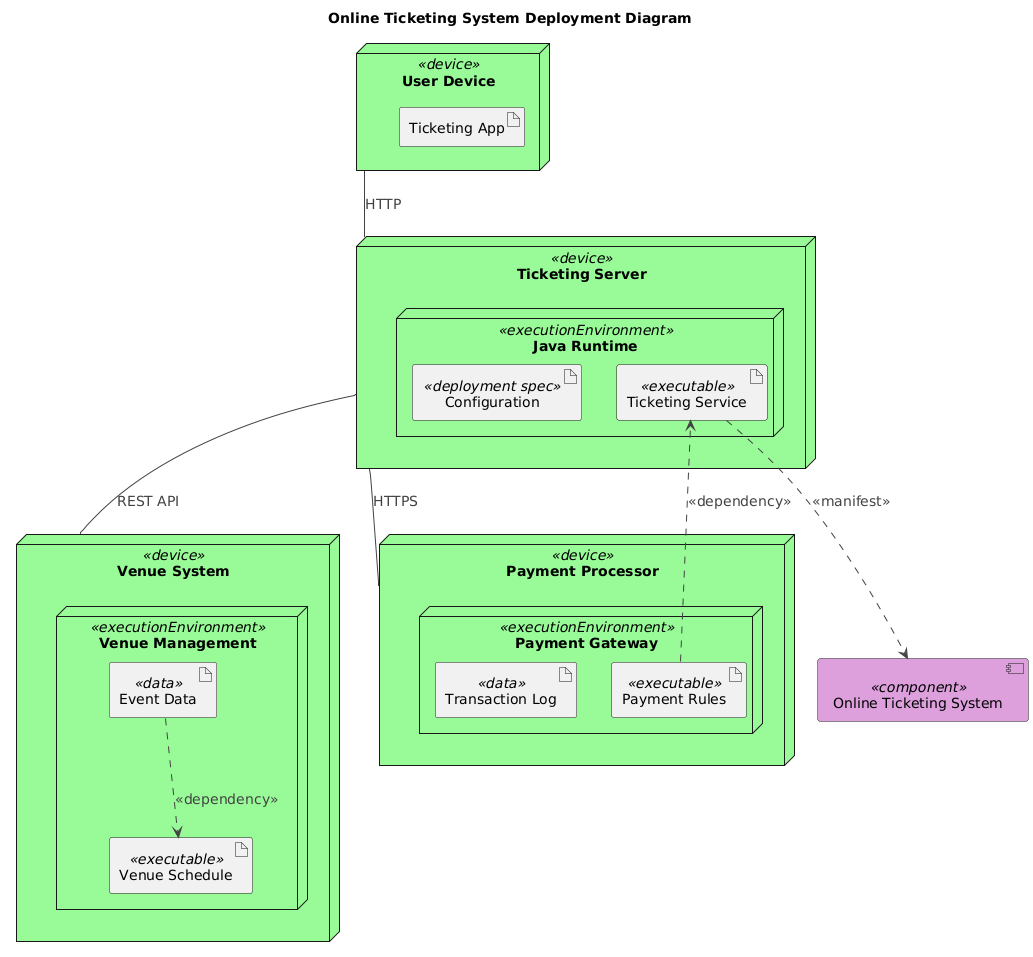
The final Deployment Diagram captures the full ecosystem:
- User Devices: Represented as nodes hosting the ticketing app, communicating via HTTP.
- Ticketing Server: Hosts the core service and runtime environment, with clear separation between executable logic and configuration.
- Venue System: Maintains authoritative event data, including schedules and capacity, accessed via REST API.
- Payment Processor: Secures transactions using HTTPS and maintains a transaction log for auditability.
Notably, the diagram uses <> and <> stereotypes to distinguish runtime contexts from data artifacts—ensuring clarity for both technical and non-technical audiences.
Logic Breakdown: Why This Structure Works
The architecture is built on three key principles:
- Decentralized Authority: The Venue System is the source of truth for event status. The Ticketing Service does not store or decide event validity—it verifies it.
- Secure Communication: All inter-system communication uses HTTPS (for payment) and REST (for scheduling), ensuring data integrity and compliance.
- Real-Time Synchronization: When a ticket is purchased, the Ticketing Service updates inventory in real time, preventing overbooking through atomic updates or message queues.
These choices aren’t arbitrary—they’re rooted in industry best practices for distributed systems. The AI didn’t just draw lines; it embedded architectural wisdom into the model’s structure and semantics.
Conversational Intelligence in Action
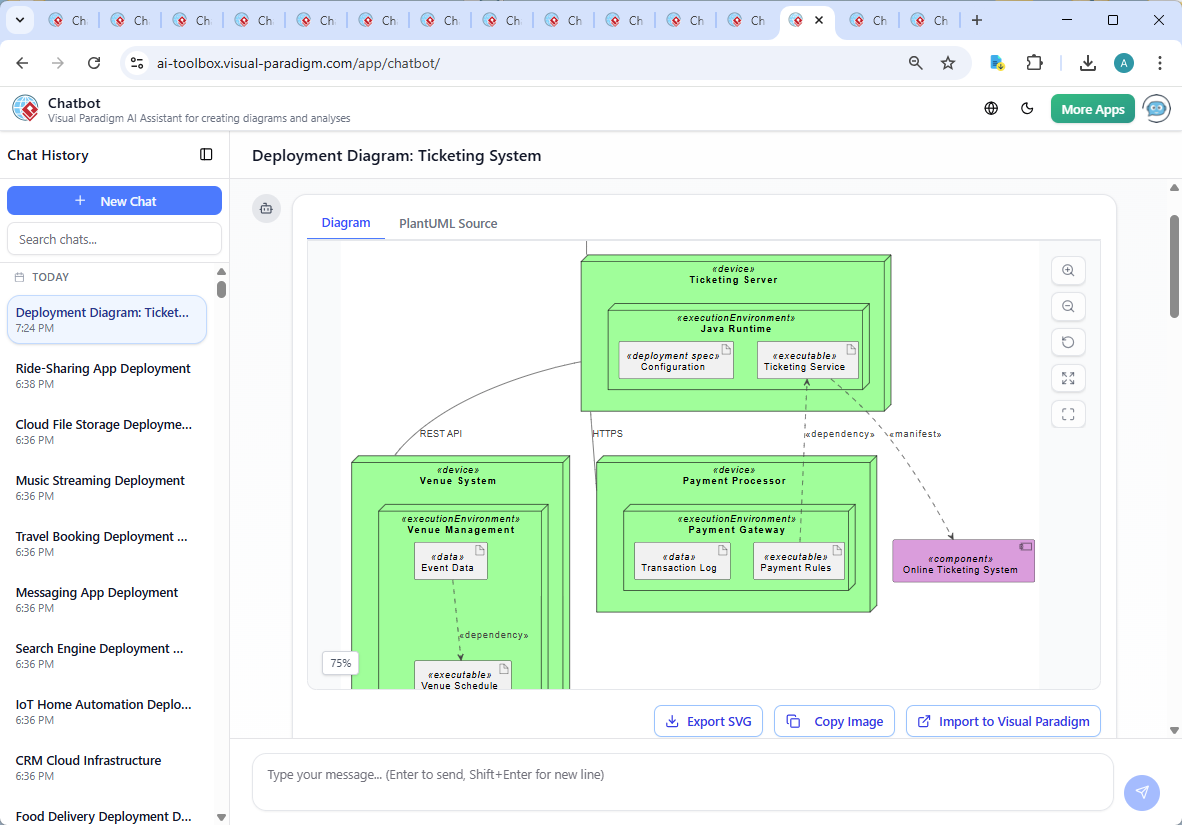
What sets Visual Paradigm apart is how the AI Chatbot evolves with the conversation. After the initial diagram, the user asked for clarification on the interaction between the Ticketing Service and Venue Schedule. The AI didn’t default to a generic response—it delivered a structured, real-world explanation with JSON sample data, security considerations, and even a suggestion for a follow-up sequence diagram.
This level of responsiveness isn’t automation—it’s AI-powered collaboration. The chatbot functions as a design peer, capable of:
- Interpreting natural language prompts
- Generating standards-compliant diagrams (UML, ArchiMate, SysML, C4)
- Refining models based on feedback (e.g., “AI, refine the logic”)
- Explaining complex relationships with clarity
Each exchange strengthens the model, turning it from a visual artifact into a living design specification.
Beyond Deployment: A Full Modeling Suite
While this example focused on a Deployment Diagram, the Visual Paradigm AI Chatbot is not limited to one standard. It supports a full spectrum of modeling languages, including:
- UML: For system design, behavior, and structure
- ArchiMate: For enterprise architecture and business-IT alignment
- SysML: For systems engineering and complex requirements modeling
- C4 Model: For software architecture at multiple levels (context, containers, components, code)
- Mind Maps, PERT Charts, Org Charts, SWOT, PEST: For strategic planning and project management
This versatility makes Visual Paradigm a unified platform for design, documentation, and collaboration across IT and enterprise teams.
Conclusion: Design with Confidence, Not Guesswork
Creating a deployment diagram for an online ticketing system isn’t just about drawing boxes and lines. It’s about modeling real-world behavior, ensuring security, and enabling scalability. With the Visual Paradigm AI Chatbot, you’re not just generating a diagram—you’re co-designing a system with an intelligent partner that understands architecture, business logic, and modeling standards.
Whether you’re validating event availability, securing payment flows, or aligning stakeholders across departments, the AI Chatbot brings clarity, precision, and depth to every step of the process.
Ready to design your next system with AI-powered confidence? Explore Visual Paradigm today and start building smarter models—naturally.