


Designing a Safe, Intelligent Railway Network with AI-Powered Modeling
Designing a reliable railway signaling system demands precision in both logic and structure—especially when ensuring real-time safety across dynamic train movements. Traditional modeling approaches often require deep technical expertise and time-consuming iterations. With Visual Paradigm’s AI Chatbot, this process transforms into a conversational journey where ideas are shaped through natural dialogue.
The challenge was clear: visualize a SysML Internal Block Diagram (IBD) of a railway signaling system that captures the interactions between control centers, signal lights, and trains. But beyond just generating a diagram, the goal was to embed intelligent decision logic—such as how the control center evaluates train position data to issue safe signal commands.
From Prompt to Precision: A Collaborative Modeling Journey
The session began with a simple yet powerful request: “Visualize a SysML Internal Block Diagram of a railway signaling system highlighting interactions between control centers, signals, and trains.” The Visual Paradigm AI Chatbot responded immediately, delivering a structured IBD in PlantUML syntax—complete with components, ports, and connectors.
But the real value emerged not in the first output, but in the conversation that followed. When the user asked, “How does the Central Control Center process the train position report to determine when to send a signal command?”, the AI didn’t just provide a static answer—it deepened the model’s intelligence by explaining the underlying logic.
It walked through a real-time decision-making pipeline: from position data reception, to safety threshold evaluation, rule-based logic application, and feedback loops. This wasn’t just documentation—it was a live modeling consultation, where the AI acted as a domain expert, refining the conceptual model step by step.
Each follow-up—like requesting clarification on the feedback mechanism or asking for a structured summary—was met with a precise, actionable response. The AI didn’t just answer; it evolved the model’s narrative, ensuring every component had a purpose and every connection reflected operational reality.
Visualizing the Core: The SysML Internal Block Diagram
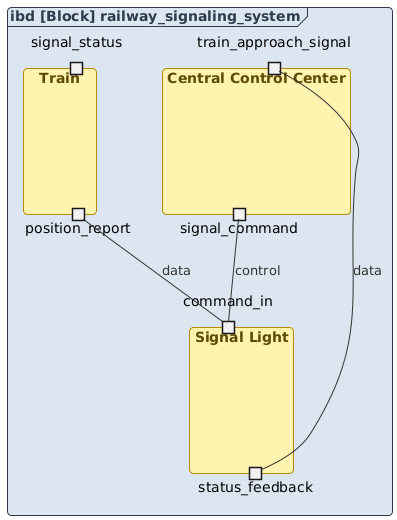
The final IBD illustrates a tightly integrated system where:
- Central Control Center acts as the decision hub, receiving position reports and sending signal commands.
- Signal Light receives commands and sends back status feedback.
- Train reports its position and receives signal status in return.
The diagram uses ports to define precise interaction points: train_approach_signal and signal_command on the control center, command_in and status_feedback on the signal, and position_report and signal_status on the train. These ports are not just visual elements—they represent the contract of communication between components.
Decoding the Logic: Why IBD? Why This Structure?
Internal Block Diagrams in SysML are ideal for this use case because they allow engineers to model both the structure and behavioral interfaces of complex systems at a component level.
Here’s how the logic maps to the diagram:
- Input Flow: The train’s
position_reportis sent to the control center via thetrain_approach_signalport. - Processing: The control center evaluates the data using safety rules (e.g., braking distance, proximity to other trains).
- Output Decision: Based on analysis, a
signal_commandis sent to the signal light. - Feedback Loop: The signal light sends
status_feedbackback to confirm the command was received and executed. - Dynamic Adaptation: If a train slows or stops, the system updates its model and adjusts future commands.
This structure supports fail-safe design—if communication fails, the system can default to pre-defined safe states. It also enables scalability: new train types, signals, or control zones can be added without reworking the entire system.
Conversational Intelligence in Action
What truly sets Visual Paradigm apart is not just the diagram generation, but the depth of insight embedded in the conversation. The AI didn’t just draw lines—it explained why they were there.
When asked to refine the logic, the AI provided a step-by-step breakdown of the decision-making process, including safety thresholds, rule-based triggers, and dynamic adjustments. This level of contextual intelligence turns the chatbot into a modeling partner, not just a tool.
Even the structure of the response—using tables, bullet points, and code snippets—was tailored to support design thinking and technical clarity.
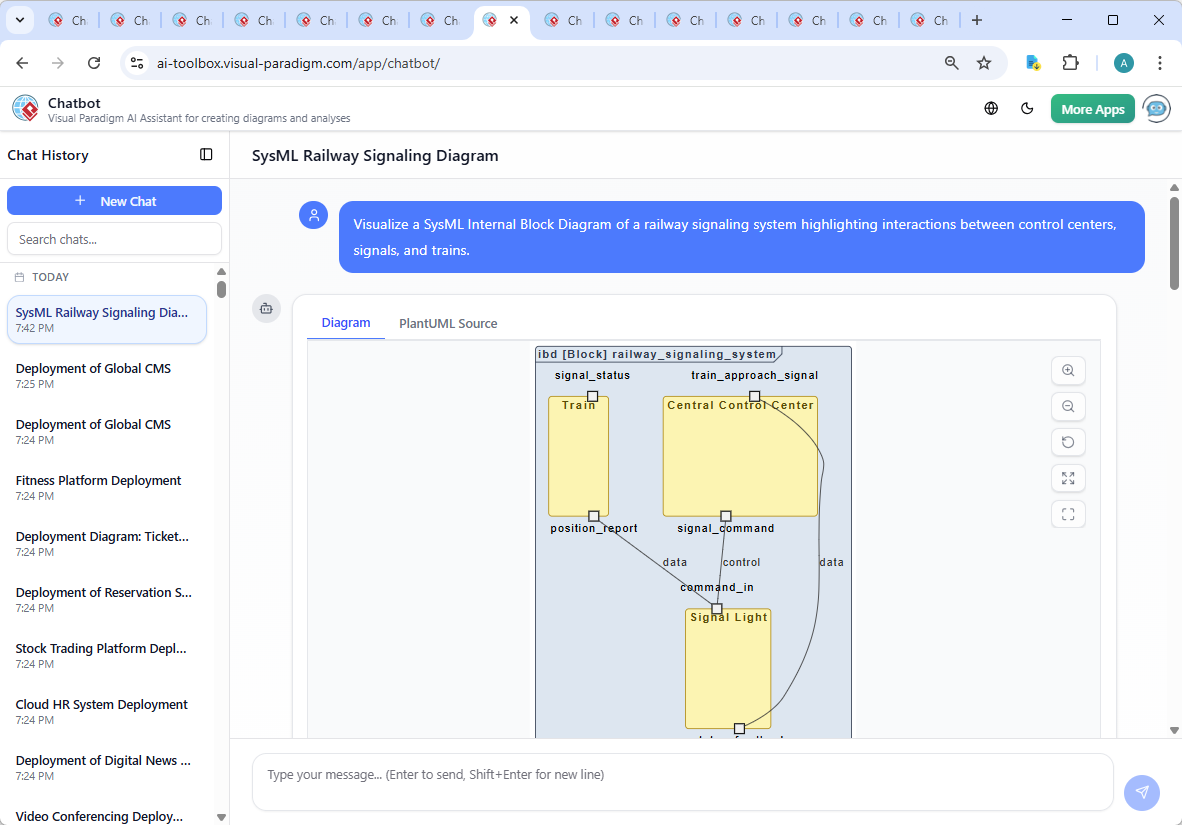
The chat interface itself becomes a design workspace. You can ask, “Explain this branch,” “Add a new train type,” or “Show how AI enhances decision logic,” and the AI responds with updated diagrams and explanations—keeping the entire process collaborative and iterative.
Beyond IBD: A Full Modeling Suite
While this example focuses on SysML’s Internal Block Diagram, the Visual Paradigm AI Chatbot is not limited to one standard. It supports a full suite of modeling languages, including:
- UML (for software and system design)
- ArchiMate (for enterprise architecture and business modeling)
- System Modeling Language (SysML) (for complex systems engineering)
- C4 Model (for software architecture at scale)
- Mind Maps, Org Charts, SWOT, PEST, and Charts (for strategic planning and visualization)
Whether you’re modeling a railway system, designing a cloud architecture, or mapping organizational change, the AI Chatbot adapts to your domain and language.
Conclusion: Where AI Meets Engineering Excellence
Creating a safe, intelligent railway signaling system is more than a technical challenge—it’s a test of modeling clarity, system integrity, and real-time responsiveness. With Visual Paradigm’s AI-powered visual modeling platform, this complexity becomes manageable through conversation.
The AI Chatbot doesn’t just generate diagrams—it guides, explains, and refines. It transforms abstract ideas into structured, validated models, one dialogue at a time.
Ready to bring your next system to life? Explore the full power of AI-driven modeling with this live session and see how the AI Chatbot can be your modeling co-pilot.