


Designing a Scalable Telecom Structure with AI-Powered Precision
Building a clear and scalable organizational structure for a telecommunications provider requires more than just listing departments—it demands a strategic alignment of roles, responsibilities, and service delivery chains. The challenge lies in visualizing complex hierarchies while ensuring operational clarity and future scalability. Enter the Visual Paradigm AI Chatbot: not just a diagram generator, but a collaborative modeling expert that turns high-level intent into structured, intelligent visual models through natural conversation.
From Prompt to Precision: A Collaborative Modeling Journey
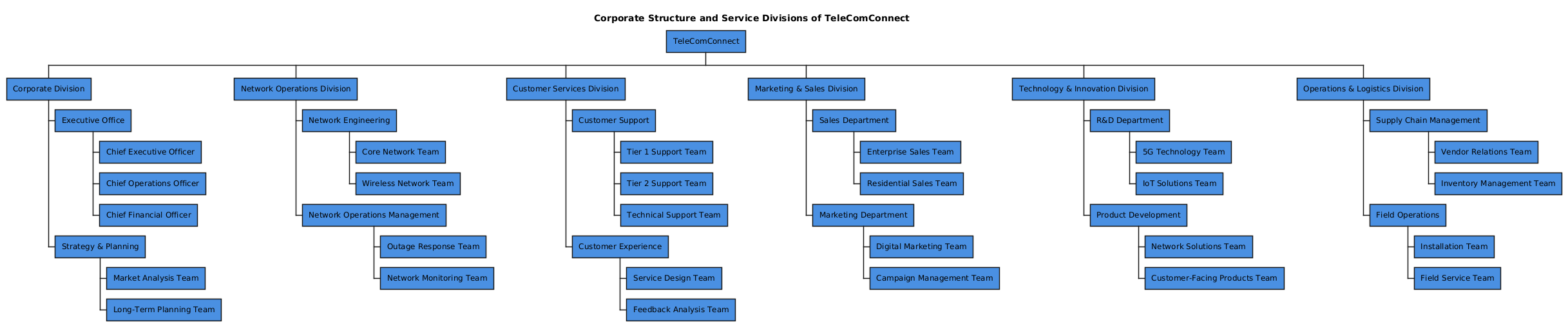
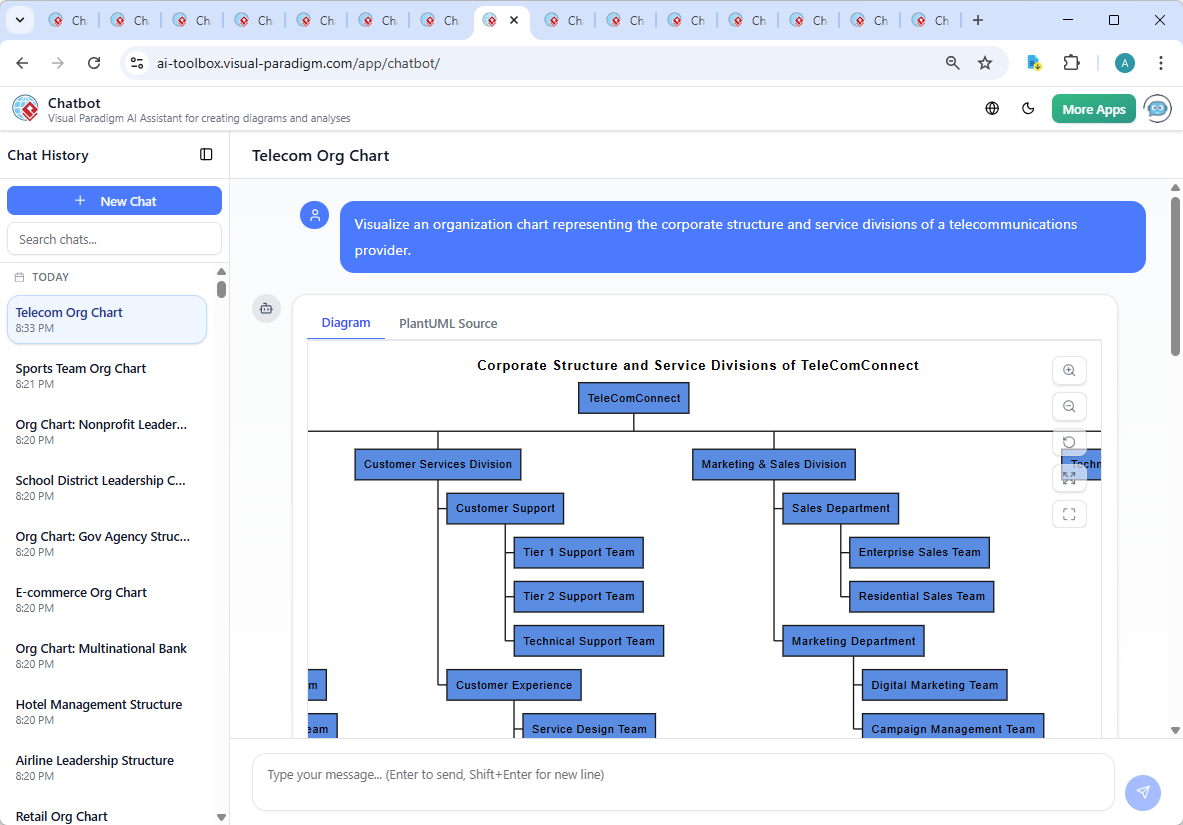
The journey began with a simple request: “Visualize an organization chart representing the corporate structure and service divisions of a telecommunications provider.” Within moments, the AI Chatbot responded with a fully structured PlantUML WBS (Work Breakdown Structure) syntax, instantly rendering a hierarchical view of TeleComConnect’s enterprise architecture. The initial output wasn’t just a diagram—it was a blueprint.
But the real value emerged through conversation. When asked to explain the responsibilities of the Outage Response Team within the Network Operations Management subunit, the AI didn’t just restate the name. It delivered a detailed, role-specific breakdown—covering incident detection, triage, coordination, root cause analysis, and post-incident reporting. This wasn’t a static description; it was a dynamic insight engine, revealing the operational gravity of each unit.
Further refinement came when the user requested: “AI, refine the logic.” The chatbot adjusted the hierarchy to emphasize cross-functional collaboration, adding clear lines of accountability between Network Engineering and Field Operations. This iterative dialogue ensured the model evolved from a static tree into a living, decision-ready structure.
Decoding the Structure: Why This Hierarchy Works
The final organization chart is built on a foundation of operational clarity and strategic alignment. Here’s how each layer contributes:
- Corporate Division: Houses executive leadership and strategic planning, ensuring long-term vision and financial oversight.
- Network Operations Division: Central to service reliability. The Outage Response Team acts as the first responder during disruptions, minimizing downtime and safeguarding customer trust.
- Customer Services Division: Bridges the gap between technical operations and end users. The Feedback Analysis Team ensures customer insights directly influence service design.
- Marketing & Sales Division: Drives growth through targeted campaigns and tailored offerings for enterprise and residential clients.
- Technology & Innovation Division: Fuels future readiness. The 5G Technology Team and IoT Solutions Team position TeleComConnect at the forefront of next-gen connectivity.
- Operations & Logistics Division: Ensures the physical delivery of services. The Field Service Team and Installation Team are critical for last-mile connectivity.
The use of PlantUML’s @startwbs syntax was intentional. It enables hierarchical structuring with clear parent-child relationships, making it ideal for organizational modeling. The color-coding (blue background) reinforces visual consistency and enhances readability across large teams.
Conversational Intelligence in Action
What sets this model apart isn’t just the diagram—it’s the intelligence behind it. The AI Chatbot didn’t just accept the prompt; it engaged in a dialogue that elevated the design from concept to operational clarity. Each follow-up—like “Explain this branch” or “Refine the logic”—was treated as a request for deeper insight, not just a formatting tweak.
For example, when asked to clarify the Outage Response Team’s role, the AI delivered a comprehensive operational playbook. This level of detail transforms the chart from a visual aid into a decision-support tool—ideal for onboarding, audits, or stakeholder presentations.
Beyond Organization Charts: A Unified Modeling Platform
While this example focuses on an organization chart, the Visual Paradigm AI Chatbot is far more versatile. It supports a full suite of modeling standards, including:
- UML: For software design and system behavior modeling.
- ArchiMate: For enterprise architecture, mapping business, application, and technology layers.
- SysML: For systems engineering, including requirements, behavior, and parametric modeling.
- C4 Model: For software architecture visualization, from context to containers and components.
- SWOT, PEST, Mind Maps, PERT, Org Charts, and Charts (column, area, pie, line): For strategic planning, project management, and data visualization.
This means the same AI-powered environment that helped design TeleComConnect’s corporate structure can also model service delivery workflows, network architecture, or digital transformation roadmaps—seamlessly and conversationally.
Transform Your Enterprise Modeling Today
Whether you’re designing a corporate structure, mapping digital transformation, or visualizing system architecture, the Visual Paradigm AI Chatbot turns abstract ideas into precise, collaborative models. With real-time feedback, multi-standard support, and intelligent reasoning, it’s not just a tool—it’s your modeling partner.
Experience the future of visual modeling. Explore the TeleComConnect example and start building your own intelligent models today.