


Modeling the Cloud: A Collaborative Journey with AI-Powered Visual Paradigm
Designing a comprehensive cloud computing platform requires clarity across layers—infrastructure, virtualization, services, and applications. Traditional diagramming tools often force users into rigid workflows, slowing down ideation and increasing the risk of misalignment. Enter the Visual Paradigm AI Chatbot: a conversational modeling expert that transforms natural language into precise, standards-compliant SysML Block Definition Diagrams (BDDs).
In this article, we walk through the real-time evolution of a cloud platform model, crafted using the Visual Paradigm AI Chatbot. What began as a simple request—“Create a Block Definition Diagram to represent a cloud computing platform”—unfolded into a rich, structured visualization that captures both technical depth and architectural intent.
From Prompt to Precision: The Interactive Journey
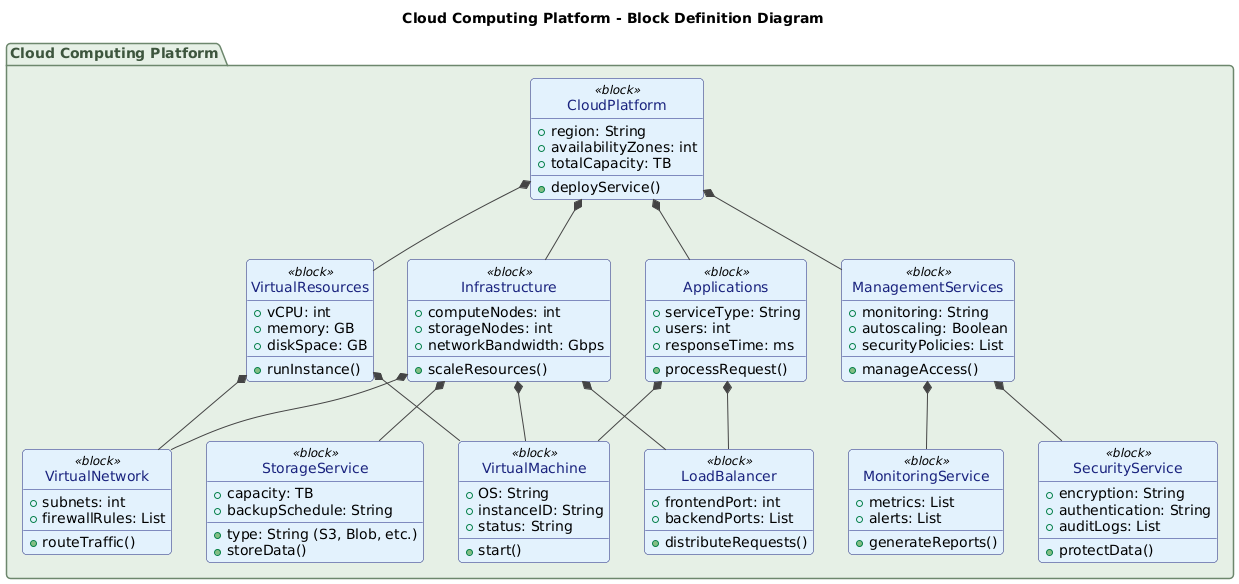
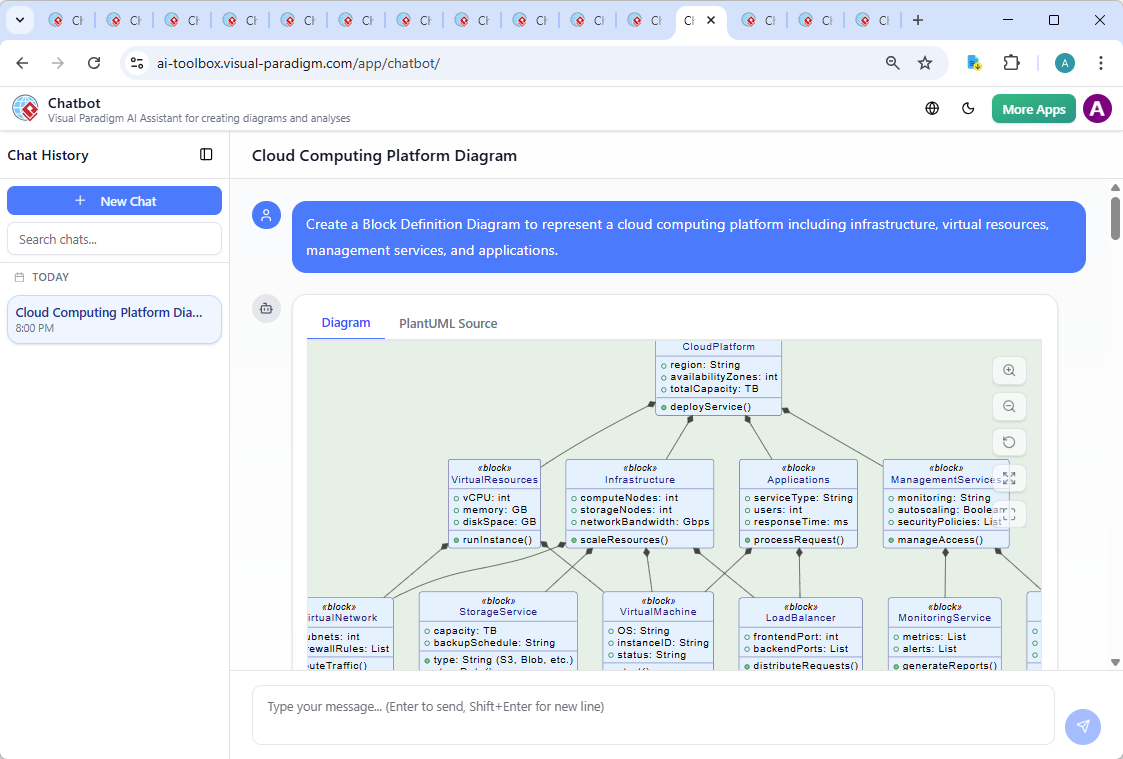
The process began with a clear directive: “Create a Block Definition Diagram to represent a cloud computing platform including infrastructure, virtual resources, management services, and applications.” The AI Chatbot responded instantly, generating a fully valid PlantUML script that rendered a clean, professional BDD.
But the real power emerged in the follow-up. When the user asked, “Explain this diagram,” the AI didn’t just describe the blocks—it contextualized them, breaking down each component’s role, relationships, and strategic significance. For example, it clarified that CloudPlatform acts as the system-of-systems container, while VirtualResources represent the abstraction layer between physical hardware and end-user applications.
Further refinement came when the user requested deeper insight: “Explain this branch,” prompting the AI to unpack the relationship between ManagementServices and its sub-components like MonitoringService and SecurityService. The response highlighted how these services enforce operational resilience and compliance—key concerns in cloud environments.
Each interaction was not a static output but a dynamic collaboration. The AI didn’t just generate a diagram—it guided the user through the logic, offering architectural reasoning, real-world analogies, and suggestions for enhancement. This isn’t automation; it’s intelligent co-design.
Decoding the Logic: Why BDD Matters in Cloud Architecture
The generated Block Definition Diagram follows SysML best practices, using block elements to represent modular, reusable system components. Each block encapsulates structure (attributes) and behavior (operations), enabling precise modeling of complex systems.
Here’s a breakdown of the key components and their roles:
- CloudPlatform: The root block, defining the overall system scope and capabilities like
deployService()andavailabilityZones. - Infrastructure: Represents the physical foundation—compute nodes, storage, and network bandwidth—highlighting scalability and geographic distribution.
- VirtualResources: Abstracts hardware into virtual entities like VMs and networks, enabling resource pooling and dynamic allocation.
- ManagementServices: The operational backbone, housing autoscaling, monitoring, and security policies—critical for cloud reliability.
- Applications: The business-facing layer, modeled with attributes like
responseTimeandusersto reflect performance and user load.
Relationships are modeled using * associations, indicating composition (e.g., CloudPlatform owns Infrastructure), while VirtualResources are linked to VirtualMachine and VirtualNetwork to show how virtualization is implemented.
Choosing a BDD over a simple class diagram was intentional: BDDs in SysML are specifically designed for system architecture, emphasizing structure, composition, and hierarchical decomposition—perfect for cloud platforms where abstraction and modularity are paramount.
Conversational Intelligence in Action
What sets Visual Paradigm apart is not just the diagram output, but the dialogue that shapes it. The AI Chatbot doesn’t just respond—it anticipates, refines, and educates.
For instance, after the initial diagram was generated, the user asked for an explanation. Instead of a dry list of attributes, the AI delivered a layered narrative:
- It mapped each block to a real-world analogy (e.g., the cloud platform as a restaurant).
- It explained the purpose of composition relationships (e.g., why
InfrastructureownsVirtualMachine). - It suggested future enhancements, such as adding color-coding or converting the model to a C4 diagram.
This isn’t a chatbot—it’s a modeling consultant. It understands SysML semantics, anticipates architectural needs, and supports iterative refinement through natural conversation.
More Than BDD: A Unified Modeling Platform
The Visual Paradigm AI Chatbot isn’t limited to SysML. It supports a full spectrum of modeling standards, making it the go-to tool for enterprise architects and technical teams:
- UML: For software design, component and sequence diagrams.
- ArchiMate: For enterprise architecture, modeling business, application, and technology layers.
- C4 Model: For contextualizing software systems in architecture diagrams (context, containers, components, code).
- SWOT, PEST, Org Charts, Mind Maps, PERT Charts: For strategic planning, project management, and organizational modeling.
Whether you’re designing a cloud platform, mapping business processes, or visualizing system dependencies, the AI Chatbot adapts to your language and standard—delivering accurate, consistent, and professional models in seconds.
Conclusion & Call to Action
Modeling complex systems like cloud computing platforms shouldn’t be a bottleneck. With Visual Paradigm’s AI-powered visual modeling platform, you get more than a diagram generator—you get a collaborative partner that thinks like an architect.
Experience the difference for yourself. Try the shared session and see how the AI Chatbot transforms your ideas into structured, standards-compliant models—fast, accurate, and intelligent.
Start building smarter systems today.