


Designing an Airline Reservation System with AI-Powered Precision
Modeling complex systems like an airline reservation platform requires more than just diagramming—it demands structural clarity, real-time responsiveness, and deep domain insight. The challenge lies in representing how core entities—flights, seats, passengers, payments, and notifications—interact dynamically while maintaining system integrity across operations.
Enter the Visual Paradigm AI Chatbot, not as a passive generator, but as a collaborative modeling expert. It transforms natural language prompts into fully structured SysML Block Definition Diagrams, guiding users through architectural decisions with intelligent, context-aware responses. This isn’t about drawing boxes—it’s about building a living model that reflects real-world logic.
From Prompt to Precision: A Collaborative Modeling Journey
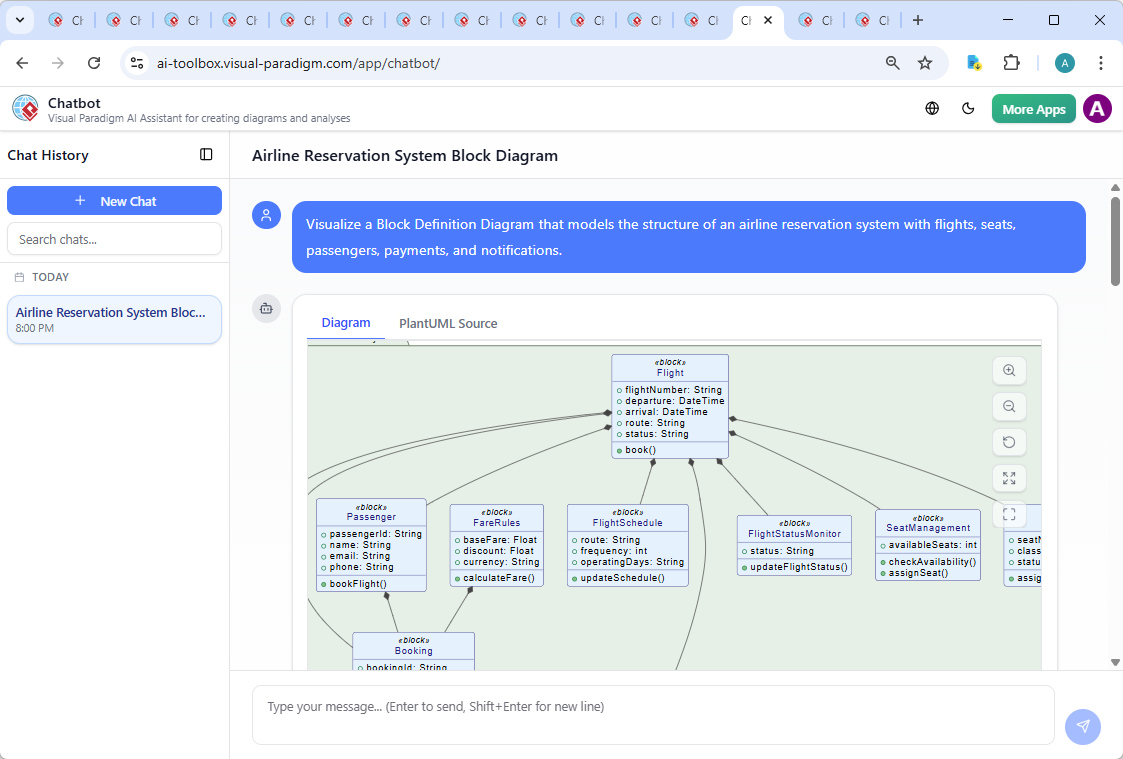
The journey began with a simple request: “Visualize a Block Definition Diagram that models the structure of an airline reservation system with flights, seats, passengers, payments, and notifications.”
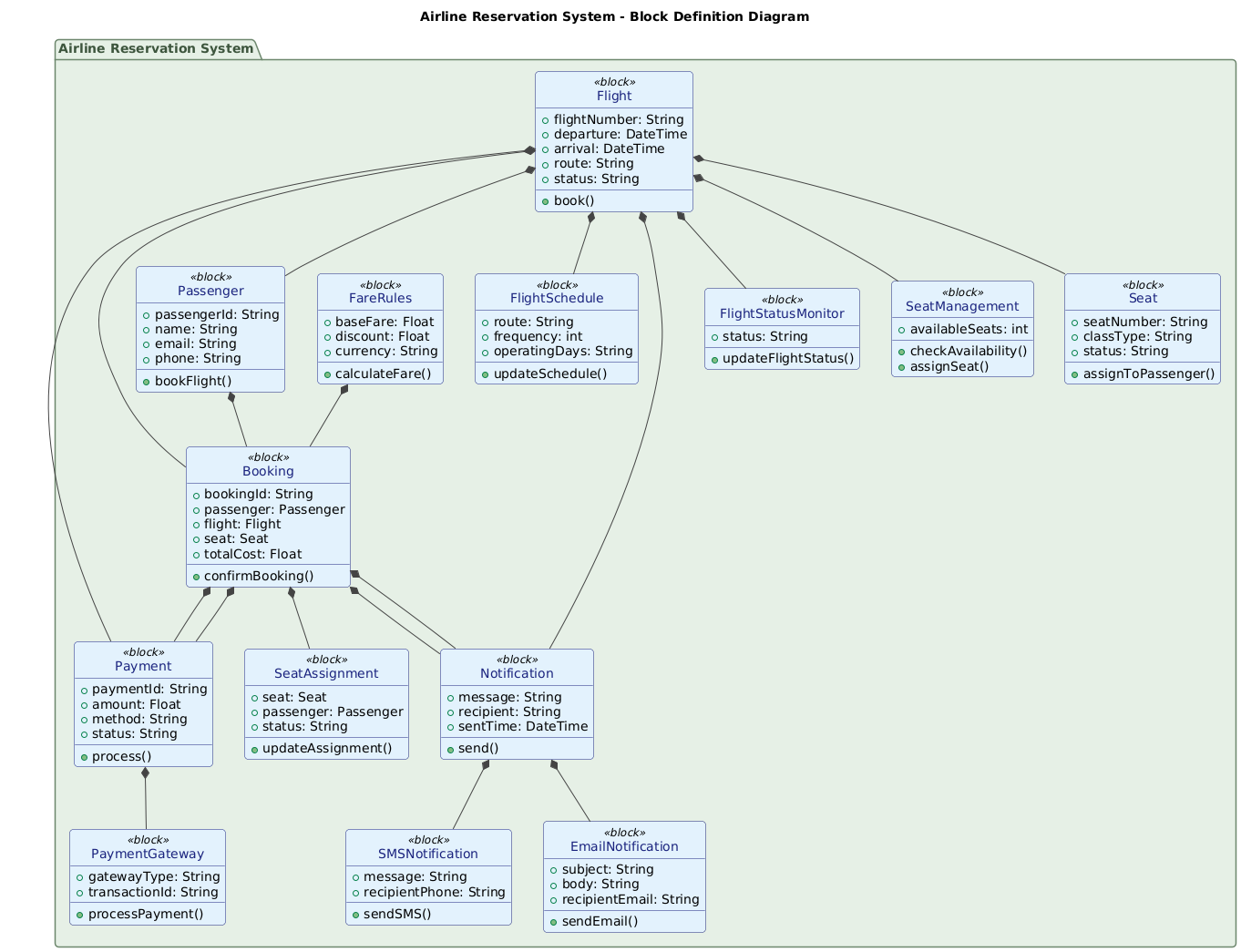
Within seconds, the AI Chatbot delivered a fully rendered PlantUML-based Block Definition Diagram, structured around core system blocks and their relationships. But the real value emerged in the conversation that followed.
When the user asked, “Can you explain how the FlightStatusMonitor block interacts with the Flight block?”, the AI didn’t just describe the link—it unpacked the operational significance. It explained that the FlightStatusMonitor continuously observes flight status, updates the Flight object when changes occur (e.g., delay or cancellation), and triggers notifications to passengers through EmailNotification and SMSNotification.
This wasn’t a static explanation—it was a deep dive into system behavior. The AI then offered to create a sequence diagram of the interaction, demonstrating its ability to evolve the model based on user needs. This level of responsiveness is what makes the AI Chatbot more than a tool—it’s a modeling partner.
Decoding the System Logic: Why This Structure Works
The Block Definition Diagram models the airline reservation system using SysML’s structural modeling language, emphasizing system composition, relationships, and behavior. Here’s how each block contributes:
Core System Blocks
- Flight: The central entity representing a scheduled flight with attributes like
flightNumber,departure,arrival, andstatus. It owns relationships toSeat,Passenger, andBooking. - Seat: Represents physical or virtual seating with attributes like
seatNumberandclassType. It’s linked toSeatAssignmentandSeatManagementfor dynamic allocation. - Passenger: Stores personal and contact data, and initiates bookings via
bookFlight(). - Payment: Handles transaction processing, linked to
PaymentGatewayfor secure execution. - Notification: A parent block that delegates to specialized types like
EmailNotificationandSMSNotification.
Supporting Components
- FlightStatusMonitor: Monitors real-time flight status and triggers updates and alerts.
- FareRules: Calculates dynamic pricing based on base fare, discounts, and currency.
- SeatManagement: Tracks seat availability and handles assignment logic.
- PaymentGateway: External interface for processing payments securely.
These components are not just visual elements—they represent modular, maintainable, and scalable system parts. The use of Block types (not classes) in SysML allows for precise modeling of system architecture, where blocks represent physical or conceptual system elements with defined interfaces and behaviors.
Relationships That Matter
Flight *-- Seat: A flight has multiple seats.Passenger *-- Booking: A passenger can have multiple bookings.Booking *-- PaymentandNotification: Each booking triggers a payment and notification.Flight *-- FlightStatusMonitor: The flight system is monitored for real-time updates.
This structure enables traceability, supports change impact analysis, and lays the foundation for downstream modeling—like sequence diagrams, activity diagrams, or even C4 architecture models.
Conversational Intelligence: The AI That Thinks Like a Designer
What sets Visual Paradigm apart is how the AI Chatbot functions as a modeling consultant. Rather than generating a diagram and stopping, it invites refinement, explains logic, and anticipates next steps.
For example, after the initial diagram was delivered, the user requested clarification on the FlightStatusMonitor interaction. The AI didn’t just restate the diagram—it provided a behavioral narrative, a flow diagram, and even suggested a follow-up sequence diagram. This shows the AI’s ability to:
- Interpret domain semantics (e.g., flight delays trigger notifications).
- Explain the purpose behind architectural choices (e.g., using
Blockvs.Class). - Support iterative design through natural conversation.
These interactions are not scripted—they’re adaptive. The AI learns from context, maintains consistency across the model, and ensures every block serves a purpose. This level of intelligence turns the modeling process into a dialogue, not a one-way output.
More Than Just Block Diagrams: A Full Visual Modeling Suite
The AI Chatbot isn’t limited to SysML. It seamlessly supports UML for software design, ArchiMate for enterprise architecture, C4 Model for software architecture, and even SWOT, PEST, Org Charts, Mind Maps, and PERT Charts.
Whether you’re modeling business processes, IT systems, or digital transformation strategies, the AI Chatbot adapts to your standard and your language. It understands the nuances of each notation—like the difference between a Component in UML and a Block in SysML—ensuring accurate, standards-compliant output.
Conclusion: Build Smarter, Faster, Together
The airline reservation system is a complex, dynamic environment. Modeling it effectively requires more than tools—it demands insight, precision, and collaboration. With Visual Paradigm’s AI Chatbot, you’re not just generating diagrams. You’re co-creating intelligent, maintainable, and extensible system models through a natural, conversational process.
Ready to design your next system with AI-powered clarity? Explore the full shared session and experience how the AI Chatbot turns your ideas into structured, actionable models—complete with logic, relationships, and deep architectural insight.