


Designing a Cybersecurity Monitoring System with AI-Powered Precision
Building a robust cybersecurity monitoring system requires more than just tools—it demands a clear, structured understanding of how components interact. The challenge lies in translating complex security workflows into a coherent, maintainable architecture. Enter the Visual Paradigm AI Chatbot: not just a diagram generator, but a collaborative modeling expert that turns natural language into precise SysML Block Definition Diagrams (BDDs).
From Idea to Diagram: A Collaborative Design Journey
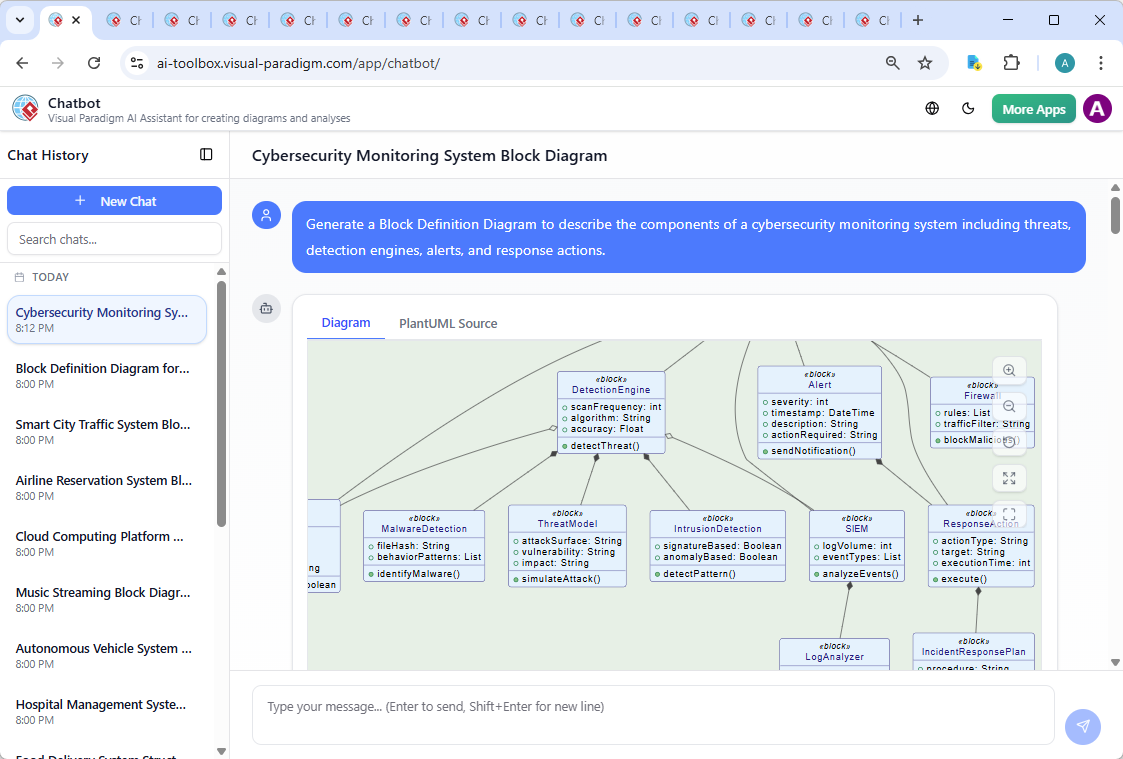
The journey began with a simple prompt: “Generate a Block Definition Diagram to describe the components of a cybersecurity monitoring system including threats, detection engines, alerts, and response actions.” Within seconds, the Visual Paradigm AI Chatbot delivered a fully structured PlantUML representation of the system—complete with blocks, attributes, methods, and relationships.
But the real value emerged in the conversation. When the user asked, “Explain this diagram,” the AI didn’t just list components—it walked through the system’s logic, unpacking the purpose of each block and how they interconnect. For example:
- “Threat” isn’t just a label—it’s a dynamic entity with severity, source, and detection logic.
- “Detection Engine” is broken into specialized sub-components like IntrusionDetection and MalwareDetection, showing how layered intelligence operates.
- “Response Action” ties into an IncidentResponsePlan, demonstrating how automation follows defined procedures.
When the user followed up with “Refine the logic”, the AI adjusted relationships to emphasize data flow from SIEM to detection engines, ensuring architectural accuracy. This back-and-forth wasn’t just clarification—it was collaborative design refinement, with the AI acting as a systems architect in real time.

Decoding the Block Definition Diagram Logic
The generated BDD is not a static illustration—it’s a living blueprint of system structure. Here’s why the choice of Block Definition Diagram matters:
- Component-Centric Design: Each block (e.g., Threat, SIEM, Firewall) represents a system element with defined responsibilities, making it ideal for systems engineering.
- Explicit Relationships: The
*andoassociations clarify ownership and aggregation. For example,DetectionEngine *-- IntrusionDetectionshows that the engine contains these specialized modules. - Behavioral Clarity: Methods like
detectThreat()andexecute()define what each block does—bridging structure and behavior. - Scalability & Reuse: The modular design allows for adding new detection types or response rules without disrupting the core architecture.
By using SysML BDD, the model captures the system’s static structure—what components exist and how they’re organized—while setting the stage for dynamic modeling (e.g., sequence diagrams, activity diagrams) down the line.
AI as a Modeling Consultant: Conversational Intelligence in Action
The true power of Visual Paradigm lies in its AI Chatbot’s ability to function as a conversational design partner. The chat history reveals how it responds to nuanced requests:
- When asked to “Explain this diagram,” the AI didn’t just describe shapes—it contextualized each block, linking it to real-world security workflows.
- Follow-up queries like “Explain this branch” triggered deeper breakdowns, such as how LogAnalyzer extracts patterns from SIEM logs.
- The AI proactively suggested enhancements—like adding ThreatModel for proactive defense planning—showing it understands systems thinking, not just syntax.
This isn’t automation. It’s AI-guided design intelligence, where the model evolves with the user’s intent.
Beyond Block Diagrams: A Multi-Standard AI Modeling Platform
While this example focused on SysML, the Visual Paradigm AI Chatbot is built for multi-standard modeling. It seamlessly supports:
- UML: For software architecture and design.
- ArchiMate: For enterprise architecture and business-IT alignment.
- C4 Model: For software architecture visualization (Context, Containers, Components, Code).
- Mind Maps, Org Charts, PEST, SWOT: For strategic planning and stakeholder communication.
- Charts (column, line, pie, area): For data visualization and reporting.
Whether you’re designing a cloud-native application, mapping enterprise processes, or building a cybersecurity framework, the AI Chatbot adapts to your modeling language of choice—making it a unified platform for all visual modeling needs.
Conclusion: Building Smarter Systems, One Conversation at a Time
The Cybersecurity Monitoring System BDD demonstrates how the Visual Paradigm AI Chatbot transforms abstract ideas into actionable, standards-compliant models—without requiring deep technical expertise. It’s not about generating diagrams; it’s about designing with purpose.
Whether you’re a systems engineer, security architect, or business analyst, this platform empowers you to collaborate with AI to build accurate, scalable, and maintainable models.
Ready to design your next system? Try the shared session and see how the AI Chatbot turns your vision into a structured reality.