


Designing a Scalable Supply Chain with AI-Powered Precision
Designing a robust supply chain management system demands clarity in structure, clarity in relationships, and clarity in responsibility. Traditional modeling approaches often require deep technical expertise and hours of manual diagramming. But with the Visual Paradigm AI Chatbot, this complexity dissolves into a conversational workflow — turning abstract ideas into precise, standards-compliant models in seconds.
When a user requested a Block Definition Diagram (BDD) for a supply chain system, the AI didn’t just generate a static image. It began a dialogue — interpreting intent, refining structure, and explaining logic — all while maintaining full compliance with SysML standards. This isn’t automation; it’s intelligent co-creation.
From Prompt to Precision: The Conversational Design Journey
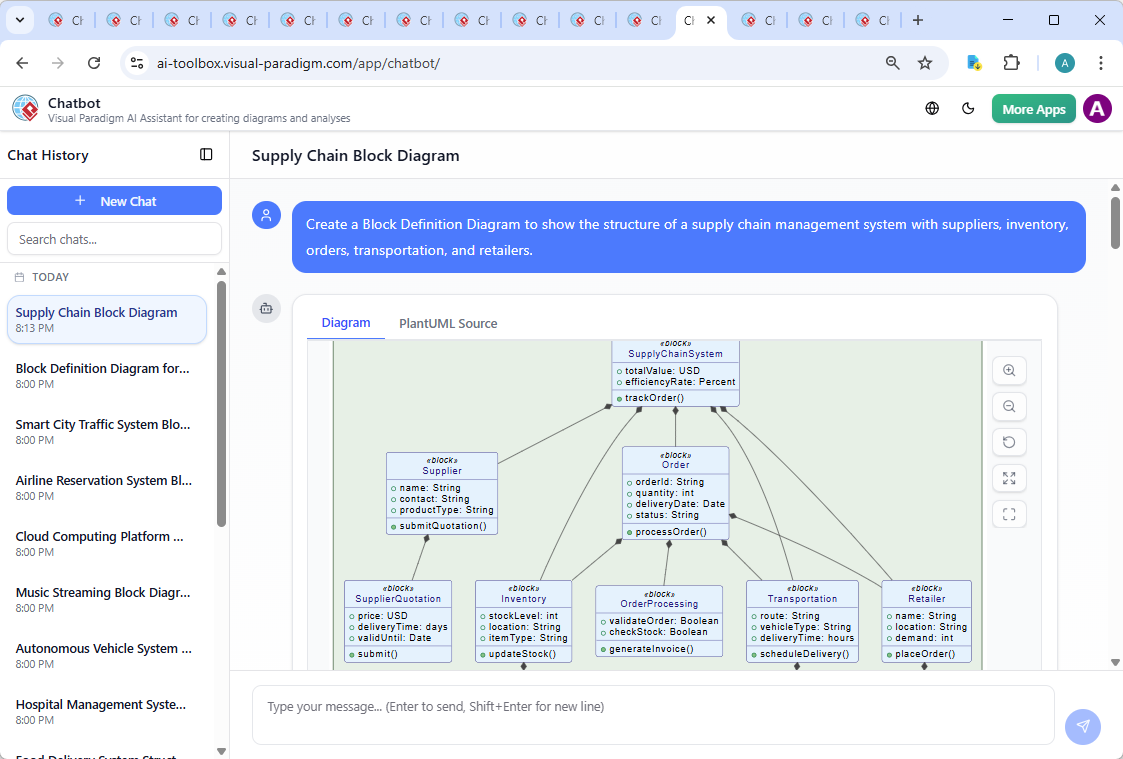
The journey began with a simple request: “Create a Block Definition Diagram to show the structure of a supply chain management system with suppliers, inventory, orders, transportation, and retailers.” The AI responded not with a rushed diagram, but with a structured, semantic PlantUML representation — immediately reflecting the core components and their hierarchical relationships.
But the real value emerged in the follow-up. When the user asked, “Explain this diagram,” the AI didn’t just list elements — it contextualized them. It broke down the system into logical layers: the central SupplyChainSystem as the orchestrator, the five primary blocks, and their supporting sub-components like StockRecord and ReorderRequest.
Each clarification was a refinement. The AI didn’t stop at naming blocks — it explained why certain relationships existed. For instance, it clarified that Order links to both Inventory and Transportation because order fulfillment depends on stock availability and logistics scheduling. This level of insight isn’t just documentation — it’s design guidance.
And when the user asked for deeper understanding, the AI offered actionable next steps: “Let me know if you’d like a sequence diagram of order processing, or a C4 diagram version of this system!” This shows the AI isn’t a one-shot generator — it’s a modeling consultant who anticipates the next phase of system design.
Decoding the Block Definition Diagram Logic
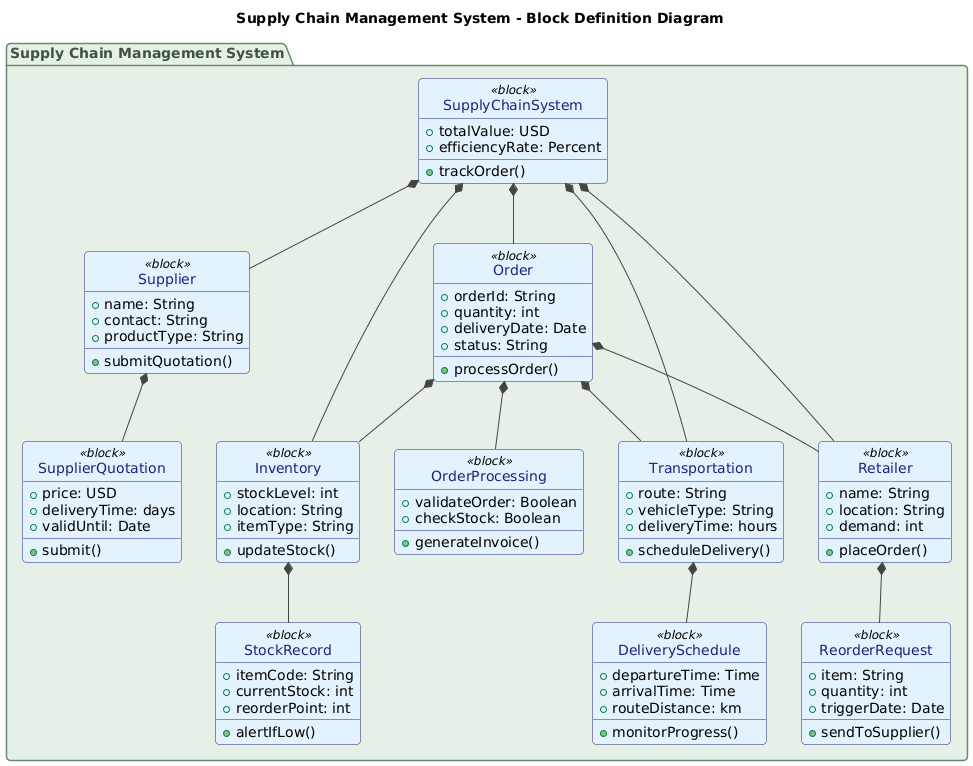
The generated Block Definition Diagram follows SysML best practices, using blocks to represent system components and their structural relationships. Here’s a breakdown of the key design decisions:
Core System: The Central Orchestrator
The SupplyChainSystem block acts as the system boundary — a high-level container that defines the scope. It includes attributes like totalValue and efficiencyRate, which reflect business KPIs. Its operations, such as trackOrder(), show that it’s responsible for monitoring the entire lifecycle.
Key Structural Blocks
- Supplier: Represents external entities providing goods. Its
submitQuotation()method signals the start of procurement. - Inventory: Tracks physical stock. The
updateStock()operation andreorderPointattribute enable automated replenishment logic. - Order: The central transactional unit. Its
statusfield supports lifecycle tracking, andprocessOrder()triggers downstream activities. - Transportation: Manages logistics. Attributes like
routeanddeliveryTimeenable time-bound planning. - Retailer: The final consumer of goods. Its
placeOrder()method initiates the supply chain cycle.
Sub-Components: Enabling Automation & Traceability
These internal blocks add depth and intelligence:
SupplierQuotation: Captures pricing and delivery timelines — critical for cost and time analysis.StockRecord: Tracks item-level inventory and triggersalertIfLow()when thresholds are breached.ReorderRequest: Automatically generated when stock falls belowreorderPoint, closing the loop from inventory to procurement.DeliverySchedule: Enables real-time monitoring of shipments withmonitorProgress().OrderProcessing: Validates orders and checks stock — a key control point before dispatch.
Relationships: Mapping the Flow
Each association reflects a real-world dependency:
SupplyChainSystemcomposes all major blocks — it owns them.Supplierprovides aSupplierQuotation.Orderuses bothTransportationandInventoryfor fulfillment.Retailertriggers aReorderRequestwhen stock is low.
These relationships aren’t arbitrary — they reflect the actual workflow of a supply chain: order → inventory check → procurement → transportation → delivery.
Conversational Intelligence: The AI as Your Modeling Partner
What sets Visual Paradigm apart is not just the output — it’s the conversation. The AI didn’t just respond to a prompt; it engaged in a dialogue that elevated the design from a diagram to a living blueprint.
When the user asked for an explanation, the AI didn’t just list attributes — it explained the purpose behind each block and relationship. It anticipated the need for context: Why is ReorderRequest separate from Order? Because it’s a proactive trigger, not a reactive action. This is the kind of insight that comes from deep modeling experience — now accessible through AI.
And when the user wanted to go further, the AI suggested extending the model — not with generic options, but with specific, relevant next steps: “Sequence diagram of order processing” or “C4 diagram version”. This shows the AI understands the full modeling lifecycle and can guide users through it.
Beyond BDD: A Unified Modeling Platform
While this example focused on a Block Definition Diagram in SysML, the Visual Paradigm AI Chatbot is not limited to one standard. It supports a full spectrum of modeling languages — including UML, ArchiMate, C4 Model, PERT Chart, Org Chart, SWOT, and PEST.
Whether you’re designing enterprise architecture with ArchiMate, mapping software components with C4, or visualizing project timelines with PERT, the AI Chatbot adapts. It understands the semantics of each standard and generates diagrams that are not only visually accurate but also semantically meaningful.
This versatility means you don’t need to switch tools. One platform, one conversation, multiple modeling languages — all powered by AI.
Final Thoughts: Where Design Meets Intelligence
Creating a supply chain management system isn’t just about drawing boxes and lines. It’s about modeling real-world complexity with precision, scalability, and clarity. The Visual Paradigm AI Chatbot turns this challenge into a collaborative journey — where every prompt is a step forward, and every clarification is a leap in understanding.
With the ability to generate, explain, refine, and extend models across multiple standards, Visual Paradigm isn’t just a tool — it’s your AI-powered visual modeling partner.
Ready to design your next system? Start the conversation today — and let the AI build the future, one block at a time.