


Designing a Resilient Supply Chain: From Concept to Deployment with AI-Powered Modeling
Implementing a modern supply chain management system demands more than just connecting systems—it requires a clear, structured vision of how suppliers, warehouses, logistics applications, and ERP platforms interact across layers of technology and business processes. The complexity of integrating these elements often leads to misaligned expectations, fragmented workflows, and delayed deployments.
With the Visual Paradigm AI Chatbot, this challenge transforms into a collaborative design journey. Rather than starting from scratch with manual diagramming, users begin with a natural language prompt—such as “Create an ArchiMate Diagram describing a supply chain management system coordinating suppliers, warehouses, logistics applications, and ERP systems”—and let the AI interpret, structure, and visualize the architecture in real time.
From Prompt to Precision: The Evolution of the Diagram
The process began with a simple request. The user submitted a clear, high-level objective, and the Visual Paradigm AI Chatbot responded by generating a structured ArchiMate diagram using PlantUML syntax. The initial output wasn’t just a static image—it was a living model that invited refinement through conversation.
Within the chat interface, the user didn’t stop at the first version. They asked, “AI, refine the logic to emphasize the role of the central warehouse server in hosting data and enabling real-time coordination.” The AI immediately adjusted the diagram by strengthening the Rel_Assignment_Up relationship between TN_001 (Central Warehouse Server) and TA_001 (Supply Chain Data Repository), and added a note about data synchronization across nodes.
Further, when the user queried, “Explain this branch: how does the Supplier Coordination Module connect to the ERP system?”, the AI provided a detailed breakdown of the AC_002 (Supplier Coordination Module) being realized by the AC_003 (ERP Integration Layer), which in turn hosts the integration logic on the TN_003 server. This wasn’t just a visual update—it was a design justification, delivered in plain language, reinforcing architectural intent.
Decoding the Architecture: The Logic Behind the Diagram
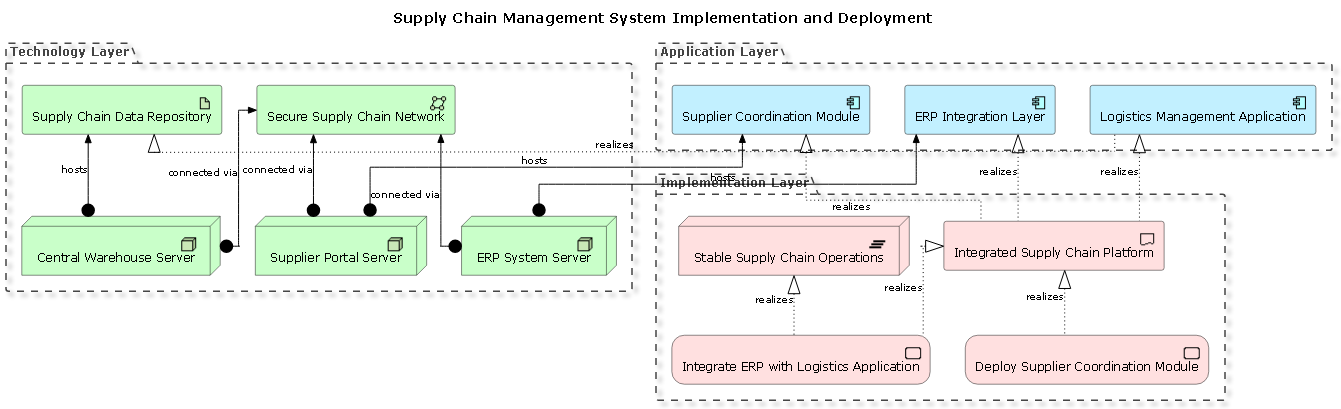
The final ArchiMate diagram is built on a layered, realizable structure that reflects enterprise architecture best practices:
- Implementation Layer: Contains
WorkPackageslike “Integrate ERP with Logistics Application” and “Deploy Supplier Coordination Module”, which define the actionable steps for deployment. TheseWorkPackagesrealize theDeliverable—the Integrated Supply Chain Platform—and ultimately lead toStable Supply Chain Operations. - Application Layer: Houses the functional components—Logistics Management Application, Supplier Coordination Module, and ERP Integration Layer—each responsible for a specific business function. These components are realized by the deliverable, ensuring traceability from business need to technical implementation.
- Technology Layer: Represents the physical and logical infrastructure. The
Supply Chain Data Repositoryis hosted on the Central Warehouse Server, ensuring data consistency. TheSecure Supply Chain Networkconnects all servers, enabling reliable communication across distributed nodes.
The use of Realization relationships ensures that each layer is grounded in the one below—business needs are realized by applications, applications by deliverables, and deliverables by implementation work. The Assignment relationships clarify ownership: which technology node hosts which component or artifact.
This structure enables architects to validate alignment between business goals, application functionality, and IT infrastructure—without relying on ambiguous descriptions or fragmented documentation.
Conversational Design in Action
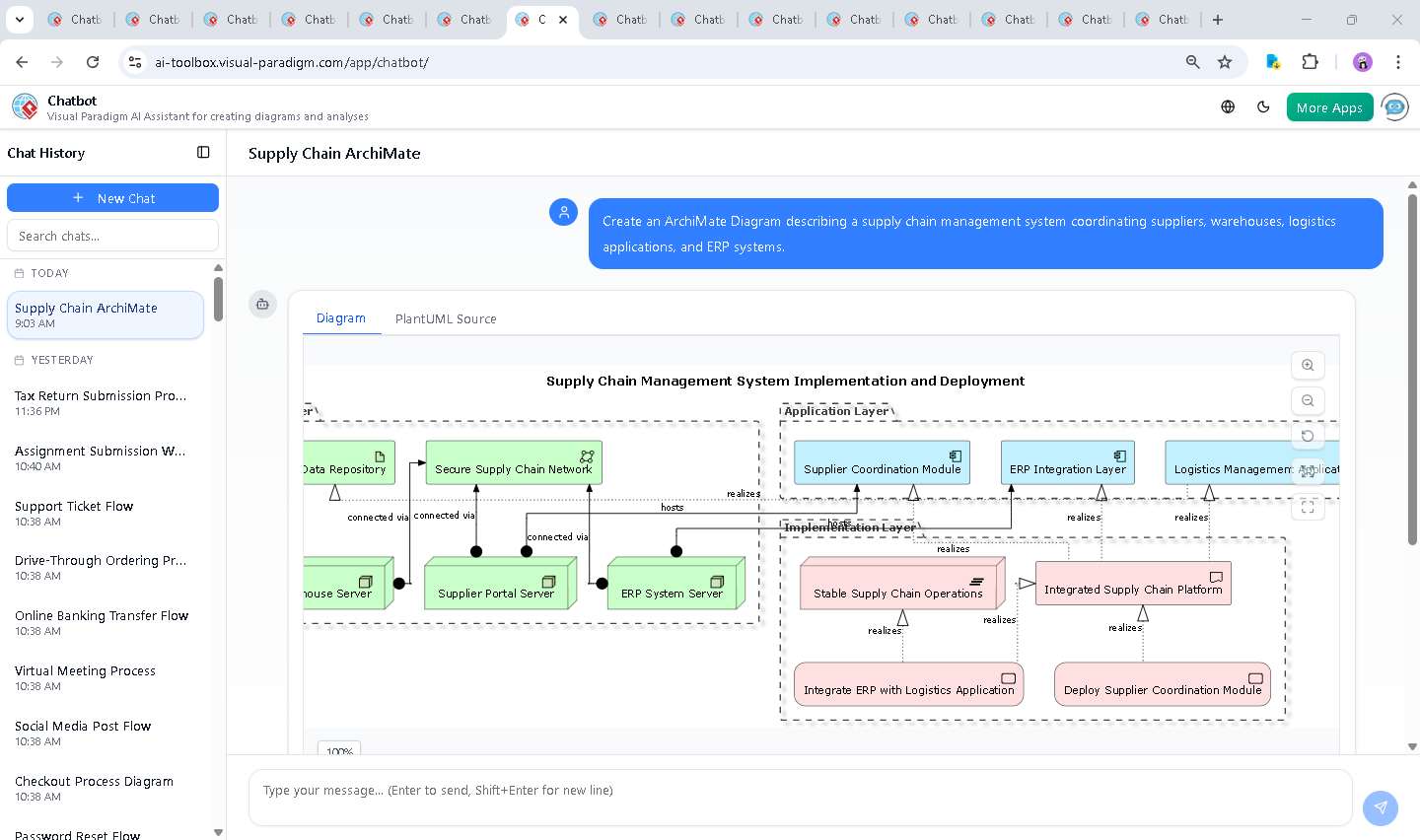
What sets the Visual Paradigm AI Chatbot apart is its ability to serve as a modeling consultant, not just a generator. The chat history shows how the user and AI co-developed the architecture through iterative refinement, turning a vague prompt into a precise, standards-compliant model.
Each follow-up request was met with a targeted update—whether it was clarifying the data flow, adjusting the deployment sequence, or explaining the purpose of a specific node. This isn’t automation; it’s intelligent collaboration.
Beyond ArchiMate: A Unified Modeling Experience
The Visual Paradigm AI Chatbot isn’t limited to ArchiMate. It supports a full suite of modeling standards, including UML, SysML, and C4 Model. Whether you’re designing a software system, modeling enterprise processes, or visualizing system behavior, the AI adapts to your domain and notation.
For instance, a user working on a logistics system could switch to SysML to model the physical flow of goods, or use C4 to describe the system context and component interactions. The same conversational interface and AI intelligence apply—ensuring consistency and clarity across all modeling activities.
Conclusion: A Smarter Way to Design Enterprise Systems
Creating a supply chain management system isn’t just about connecting systems—it’s about aligning people, processes, and technology around a shared vision. The Visual Paradigm AI Chatbot enables this alignment by turning natural language into precise, collaborative models.
By combining architectural rigor with conversational intelligence, it empowers teams to design faster, validate better, and deploy with confidence.
Ready to build your next enterprise architecture? Try the shared session and experience how the AI transforms your ideas into visual reality.