


Visualizing Intelligence: A Real-Time Fraud Detection System with AI-Powered Modeling
Designing a robust fraud detection system requires clarity in structure, precision in component definition, and scalability for evolving threats. Traditional modeling approaches often slow down innovation, especially when teams must manually draft diagrams that reflect complex, dynamic interactions between transactions, rules, models, and investigations.
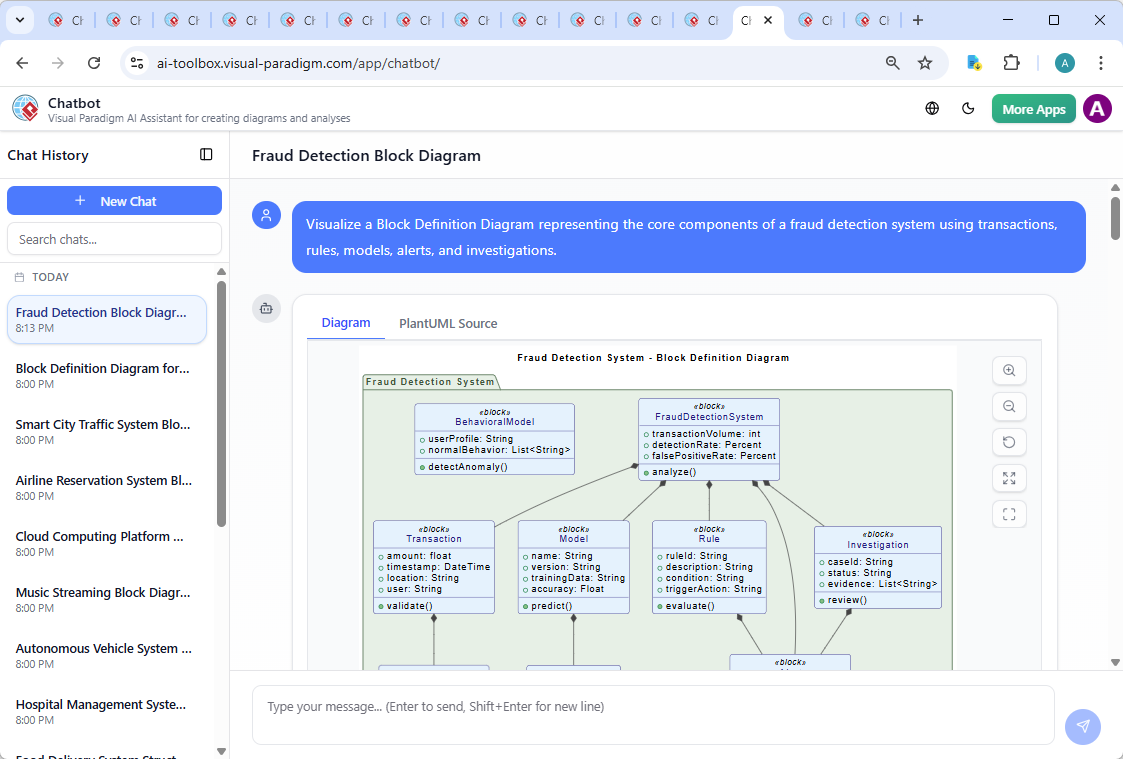
With Visual Paradigm’s AI Chatbot, this challenge transforms into a collaborative design journey. Instead of starting from scratch, users begin with a simple prompt—like “Visualize a Block Definition Diagram representing the core components of a fraud detection system using transactions, rules, models, alerts, and investigations”—and let the AI guide the process. The result? A fully structured, standards-compliant SysML Block Definition Diagram, crafted using the Visual Paradigm AI Chatbot, that reflects both technical rigor and real-world operational logic.
From Prompt to Precision: The Interactive Journey
The evolution of the fraud detection system diagram began with a clear user request. The AI Chatbot interpreted the intent and generated a detailed PlantUML representation of the system’s core blocks—each defined with attributes, operations, and meaningful relationships.
But the conversation didn’t stop there. When the user asked, “Explain this diagram,” the AI didn’t just restate the structure. It delivered a layered, context-rich breakdown—highlighting how each block contributes to the detection lifecycle, from transaction intake to investigation closure.
What followed was a true dialogue. The user requested clarification on specific branches: “Explain this branch,” and “AI, refine the logic.” In response, the AI adjusted the diagram’s hierarchy, clarified the role of supporting blocks like BehavioralModel and RiskScore, and emphasized the feedback loop between investigations and model improvement. These iterations weren’t just edits—they were expert-level design suggestions, demonstrating the AI’s ability to act as a modeling consultant, not just a diagram generator.
Decoding the Logic: Why Block Definition Diagrams Matter
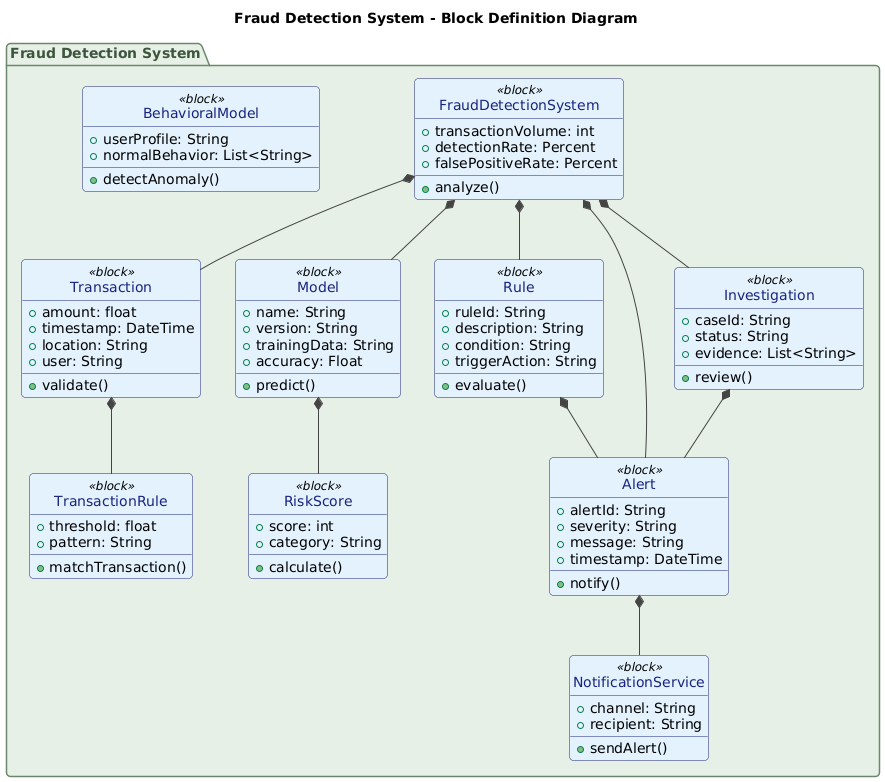
Block Definition Diagrams (BDDs) in SysML are ideal for defining the structural components of a system before diving into behavior or interactions. In this fraud detection context, the BDD serves as the foundation for all subsequent modeling—whether it’s a sequence diagram for alert processing or a C4 model for system context.
Here’s how the logic was built:
- FraudDetectionSystem is the top-level block, acting as the orchestrator. It contains and coordinates all other components.
- Transaction is the primary data source—each event is evaluated against rules and models.
- Rule and Model represent two detection strategies: rule-based (fast, deterministic) and model-based (adaptive, intelligent).
- Alert is the output of detection logic, triggered by either a rule or model. It carries severity and message data.
- Investigation is the response mechanism, allowing human or automated review to validate alerts.
- Supporting blocks like
TransactionRule,BehavioralModel, andNotificationServiceadd depth—enabling granular control and extensibility.
Relationships are not just visual—they reflect real-world dependencies. For example, the Rule block triggers an Alert, which then activates the NotificationService. Similarly, an Investigation is linked to an Alert, closing the loop between detection and response.
Choosing BDD over other diagrams was strategic: it establishes a clear, reusable component model that can be referenced across architecture views, ensuring consistency from design to implementation.
Conversational Intelligence: The AI Chatbot as a Modeling Partner
What sets Visual Paradigm apart is that the AI Chatbot doesn’t just generate diagrams—it engages in a dialogue to refine them. The user didn’t just receive a static image; they got a living model that evolved through questioning and refinement.
For instance, when the user asked for clarification on the BehavioralModel block, the AI explained its role in learning normal user behavior and flagging anomalies—adding value beyond syntax. Later, when the user requested a deeper explanation of the Alert → Investigation link, the AI highlighted how this supports continuous improvement: every investigation feeds back into model training and rule tuning.
These interactions prove that the AI is not a passive tool. It understands modeling principles, applies domain knowledge, and responds with context-aware insights—making it an intelligent collaborator in system design.
Beyond SysML: A Unified Modeling Platform
While this example focuses on SysML’s Block Definition Diagram, the Visual Paradigm AI Chatbot is built to support a full spectrum of modeling standards. Whether you’re designing enterprise architecture with ArchiMate, modeling complex systems with UML, or visualizing software context with C4, the AI adapts to your needs.
For example, the same fraud detection system could be extended into a C4 Model to show the system’s context and containers, or into an ArchiMate diagram to represent business, application, and technology layers. The AI Chatbot handles these transitions seamlessly—ensuring consistency across models and reducing the risk of misalignment.
From mind maps to PERT charts, org charts to SWOT analysis, the platform offers a complete suite of visual modeling tools—all enhanced by AI intelligence.
Conclusion: Design with Confidence, Scale with Ease
Creating a fraud detection system isn’t just about technology—it’s about designing a system that’s clear, maintainable, and ready for evolution. With Visual Paradigm’s AI Chatbot, you’re not just generating diagrams. You’re engaging in a dynamic design process where every prompt, question, and refinement leads to a smarter, more accurate model.
Whether you’re an architect, developer, or risk analyst, the ability to turn ideas into structured, standards-compliant models through natural conversation is a game-changer. The fraud detection system you envisioned? Now it’s a living blueprint—ready to be extended, shared, and implemented.
Ready to start your next modeling journey? Explore the shared session and experience how the Visual Paradigm AI Chatbot transforms ideas into intelligent visual models.