


Designing Real-Time Logistics Tracking with AI-Powered Precision
Building a robust logistics tracking system demands more than just mapping out components—it requires a clear, scalable, and intelligent architecture. The challenge lies in visualizing how functional blocks like shipments, tracking devices, status updates, and dashboards interconnect to deliver real-time visibility across supply chains. This is where the Visual Paradigm AI Chatbot becomes a collaborative modeling expert, transforming abstract requirements into structured, executable designs through natural conversation.
From Idea to Diagram: A Conversational Design Journey
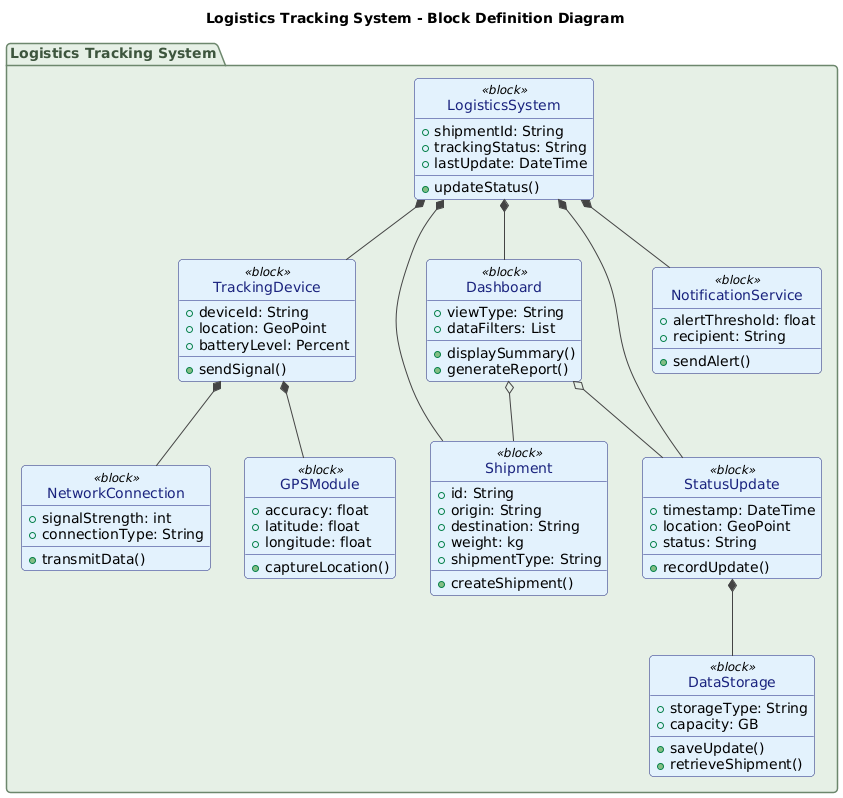
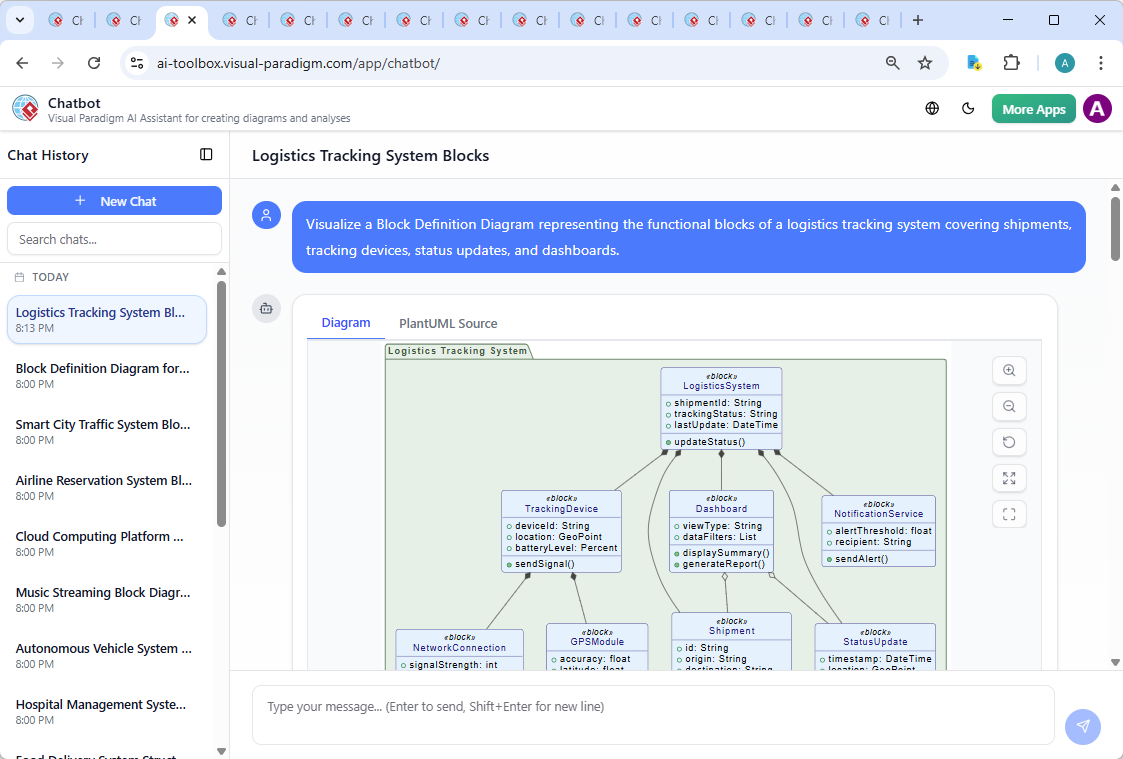
The journey began with a simple prompt: “Visualize a Block Definition Diagram representing the functional blocks of a logistics tracking system covering shipments, tracking devices, status updates, and dashboards.” The AI Chatbot responded instantly with a fully rendered PlantUML diagram—complete with semantic block definitions, relationships, and styling that aligns with SysML best practices.
But the real value emerged in the follow-up. When asked to explain how the GPSModule and NetworkConnection blocks interact within the TrackingDevice to ensure real-time location updates, the AI didn’t just restate the diagram—it delivered a detailed, architectural explanation. It clarified the data flow, error handling, and resilience mechanisms, demonstrating an understanding of both technical function and system behavior.
Each query was treated as a refinement opportunity. For example, after the initial diagram was generated, the user requested deeper insight into the interaction logic. The AI responded with a structured breakdown of the real-time workflow, including how location data is captured, transmitted, cached during outages, and ultimately used to update dashboards and trigger alerts.
Decoding the Block Definition Diagram Logic
The generated Block Definition Diagram is more than a visual map—it’s a functional blueprint. Here’s how each block contributes to the system’s real-time tracking capability:
Core Functional Blocks
- LogisticsSystem: The root container that orchestrates all other blocks. It represents the overarching system boundary.
- Shipment: Encapsulates key shipment metadata such as origin, destination, weight, and type. This block is linked to the system and serves as the primary data source for tracking.
- TrackingDevice: The physical or virtual entity that monitors the shipment. It integrates two critical subsystems:
GPSModulefor location andNetworkConnectionfor data transmission. - StatusUpdate: Represents each location and status event. It stores timestamp, location, and status, and is linked to
DataStoragefor persistence. - Dashboard: Consumes data from
StatusUpdateandShipmentto display real-time insights, routes, and anomalies. - NotificationService: Monitors thresholds (e.g., delay, deviation) and sends alerts when conditions are met.
Subsystems Within the TrackingDevice
The TrackingDevice block is not a monolithic unit—it’s composed of specialized subsystems:
- GPSModule: Responsible for capturing precise geolocation data. It includes accuracy metrics and periodic capture logic.
- NetworkConnection: Manages data transmission. It ensures signal strength, handles retries, and supports fallback mechanisms during outages.
This decomposition follows SysML’s principle of modular functional abstraction, allowing teams to design, test, and scale individual components independently.
Why Block Definition Diagram?
Block Definition Diagrams (BDDs) are ideal for this use case because they define the static structure of a system in terms of its functional blocks and their relationships. Unlike class diagrams, BDDs emphasize what the system is made of—its architecture—rather than how it behaves. This makes BDDs perfect for enterprise-level logistics systems where clarity, scalability, and stakeholder alignment are critical.
Conversational Intelligence in Action
The AI Chatbot didn’t stop at generating the diagram. It acted as a modeling consultant, responding to follow-up questions with architectural depth. When asked to explain the interaction between GPSModule and NetworkConnection, it provided:
- A step-by-step data flow from capture to transmission.
- Resilience strategies (e.g., local caching during signal loss).
- Behavioral insights (e.g., dead reckoning fallback).
- Clear mapping of data to downstream components (e.g.,
StatusUpdate,Dashboard).
This level of insight isn’t just descriptive—it’s prescriptive. It helps architects anticipate failure modes, optimize performance, and design for reliability.
More Than a Diagram Tool: A Multi-Standard AI Modeling Suite
While this example focused on a SysML Block Definition Diagram, the Visual Paradigm AI Chatbot is not limited to one standard. It supports a full suite of modeling languages, including:
- UML: For software design, component, and sequence modeling.
- ArchiMate: For enterprise architecture, defining business, application, and technology layers.
- C4 Model: For software architecture visualization, including Context, Containers, Components, and Code.
- Mind Maps, Org Charts, SWOT, PEST, PERT Charts: For strategic planning, team structure, and project management.
- Charts (column, area, pie, line): For data visualization and reporting.
This versatility means that the same AI assistant can support everything from technical design to executive decision-making—making Visual Paradigm the only platform where AI-powered modeling is truly end-to-end.
Conclusion: Design Smarter, Collaborate Faster
The logistics tracking system example shows how the Visual Paradigm AI Chatbot turns conceptual ideas into precise, production-ready models through natural conversation. It doesn’t just generate diagrams—it guides, explains, and refines, acting as a co-designer throughout the process.
Whether you’re modeling a real-time tracking system, designing a cloud-native application, or mapping enterprise strategy, the AI Chatbot delivers intelligent, accurate, and adaptable visualizations—no coding, no steep learning curve.
Ready to see how the AI can transform your next project? Explore the live session and experience the future of visual modeling.