


Designing a Food Delivery System with AI-Powered Precision
Creating a robust, scalable architecture for a food delivery service requires more than just listing components — it demands a structured, intelligent approach to modeling. The challenge lies in clearly defining how restaurants, menus, orders, couriers, and customers interact within a dynamic ecosystem. Enter the Visual Paradigm AI Chatbot: not just a diagram generator, but a collaborative modeling expert that transforms natural language into precise SysML Block Definition Diagrams (BDDs).
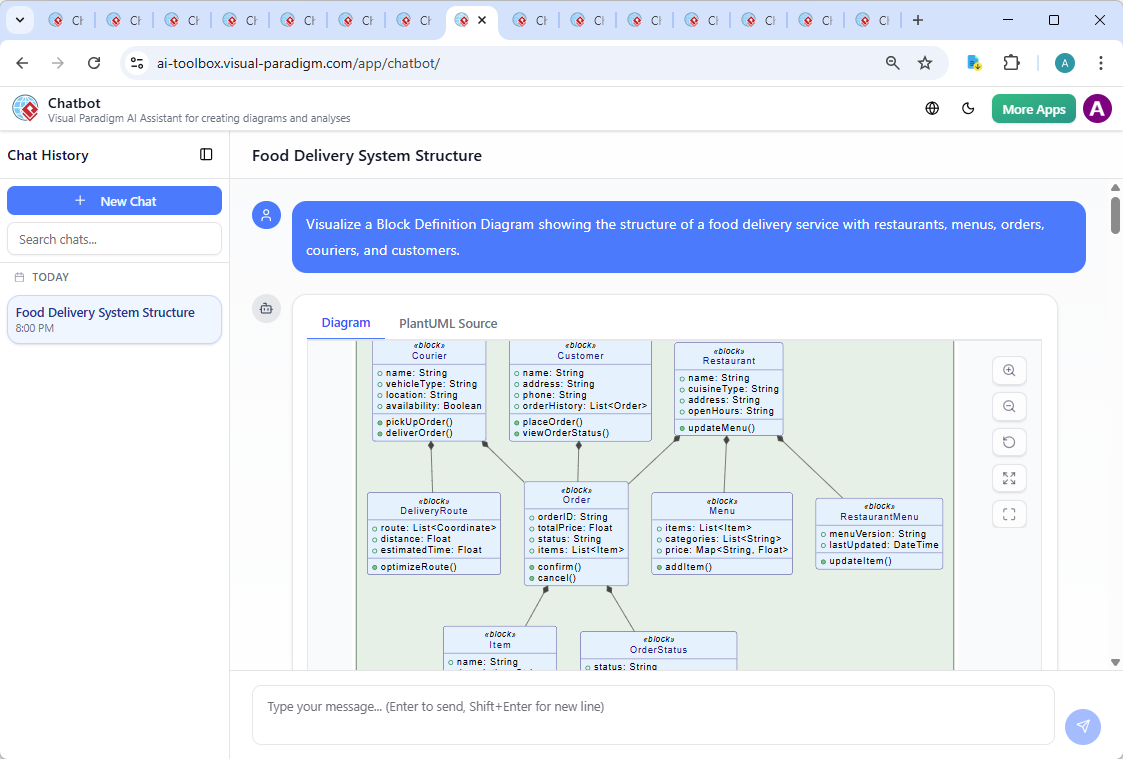
When the user prompted, “Visualize a Block Definition Diagram showing the structure of a food delivery service with restaurants, menus, orders, couriers, and customers,” the AI didn’t just render a static image. It initiated a conversational design process — interpreting intent, suggesting structure, and refining logic in real time.
From Prompt to Precision: The Interactive Journey
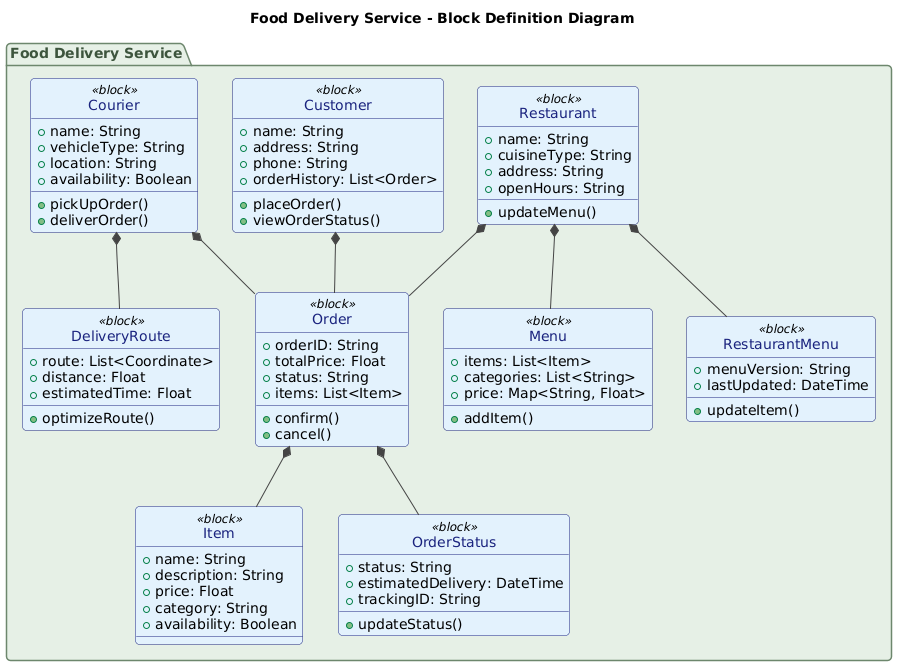
The evolution of this model was deeply conversational. The initial request was broad, but the AI responded with a fully formed PlantUML-based Block Definition Diagram that captured the core entities and their relationships. But the real value emerged in the follow-up:
- “Explain this diagram” — The user asked for clarity, triggering a detailed breakdown of each block, its attributes, behaviors, and relationships.
- Upon request, the AI didn’t just describe the diagram — it contextualized it, explaining why certain relationships (like
Restaurant --> MenuorCourier --> DeliveryRoute) are essential for system integrity. - It introduced sub-blocks like
OrderStatusandDeliveryRoutenot as afterthoughts, but as logical extensions that enhance traceability and operational insight.
This wasn’t a one-way output. The AI acted as a modeling consultant — refining structure, clarifying intent, and anticipating future needs. For example, when the user asked for an explanation, the AI didn’t just list attributes. It mapped each block to real-world functionality: RestaurantMenu tracks versioning, OrderStatus supports real-time tracking, and DeliveryRoute enables optimization — all critical for a live delivery system.
Decoding the System Logic: Why BDDs Matter
The chosen Block Definition Diagram (BDD) is the ideal starting point for system architecture because it defines what the system is — not how it behaves. In SysML, BDDs establish the structural foundation for all other models.
Here’s how each block contributes:
- Restaurant: The source of food, with its own menu and operational logic.
- Menu: Not just a list — it’s a dynamic entity with categories, pricing, and version control via
RestaurantMenu. - Order: The central transactional unit, linking customers, items, and couriers.
- Courier: A mobile actor with location, availability, and routing logic.
- Customer: The end-user with a history and active engagement.
- Item: The atomic unit of consumption — priced, categorized, and trackable.
The relationships are not arbitrary:
Restaurant --> Menu: A restaurant owns its menu.Order --> Item: An order is composed of specific food items.Courier --> Order: A courier is assigned to deliver a specific order.Order --> OrderStatus: Status tracking enables real-time updates.Courier --> DeliveryRoute: Route optimization is critical for delivery speed.
These relationships form a cohesive, scalable architecture — one that can evolve into sequence diagrams for order flow, activity diagrams for delivery logic, or even C4 models for system context.
AI-Powered Insight: Beyond Diagramming
The true power of the Visual Paradigm AI Chatbot lies in its ability to act as a modeling partner. When the user asked to “explain this diagram,” the AI didn’t default to a dry definition. Instead, it:
- Explained the purpose of each block in business and technical terms.
- Highlighted how sub-blocks like
DeliveryRoutesupport operational efficiency. - Anticipated next steps: suggesting extensions like payment systems or AI recommendations.
This isn’t just visualization — it’s design intelligence. The AI doesn’t just generate diagrams; it understands the system, the user’s intent, and the implications of each modeling choice.
One Platform, Infinite Standards
While this example focused on SysML’s Block Definition Diagram, the Visual Paradigm AI Chatbot is not limited to one standard. It seamlessly supports:
- UML (for object-oriented design and system behavior)
- ArchiMate (for enterprise architecture and business-IT alignment)
- C4 Model (for software architecture context and container diagrams)
- Mind Maps, PERT Charts, Org Charts, SWOT, PEST (for strategy, planning, and project management)
Whether you’re modeling a startup’s tech stack, a government service workflow, or a supply chain logistics network, the AI Chatbot adapts to your domain and standard — always maintaining precision, clarity, and conversational depth.
Final Thoughts: Design with Intelligence
The food delivery service model is more than a diagram — it’s a blueprint for real-world systems. By using the Visual Paradigm AI Chatbot, users get more than a visual output: they gain a collaborative design environment where every interaction refines the architecture.
From the first prompt to the final explanation, the process was iterative, intelligent, and deeply user-centric. The AI didn’t just draw a diagram — it helped build a system.
Ready to model your next architecture with AI-powered clarity? Explore the live session and experience the future of visual modeling.