


Designing an Online Learning Platform with AI-Powered Precision
Architecting a scalable, user-centric online learning platform demands more than visual diagrams—it requires a deep understanding of how components interact, evolve, and serve diverse stakeholders. The challenge lies in translating abstract educational workflows into a structured, maintainable model that supports both technical implementation and strategic decision-making.
Enter the Visual Paradigm AI Chatbot, not just a diagram generator but a collaborative modeling expert. By engaging in natural conversation, it transforms high-level ideas into precise, standards-compliant models—starting with a Block Definition Diagram (BDD) for an online learning platform.
From Prompt to Architecture: A Collaborative Modeling Journey
The journey began with a simple request: “Generate a Block Definition Diagram to describe the architecture of an online learning platform with courses, learners, instructors, content delivery, and assessments.”
Within seconds, the AI Chatbot delivered a fully rendered PlantUML-based BDD with clearly defined blocks and relationships. But the real value emerged not in the initial output—but in the conversation that followed.
When the user asked, “Can you explain how the FeedbackSystem block interacts with both Learner and Instructor in the context of course evaluations?”, the AI didn’t just restate the diagram—it contextualized it. It unpacked the role of the FeedbackSystem as a feedback loop between learners and instructors, detailing how:
- Learners submit structured ratings and comments after course completion.
- Instructors receive aggregated analytics to refine teaching methods.
- Data from both sides fuels continuous course improvement.
This wasn’t a static diagram—it was a living model shaped by iterative dialogue. The AI didn’t just answer; it guided, explained, and deepened the design rationale, proving its role as a modeling consultant.
Visualizing the Architecture
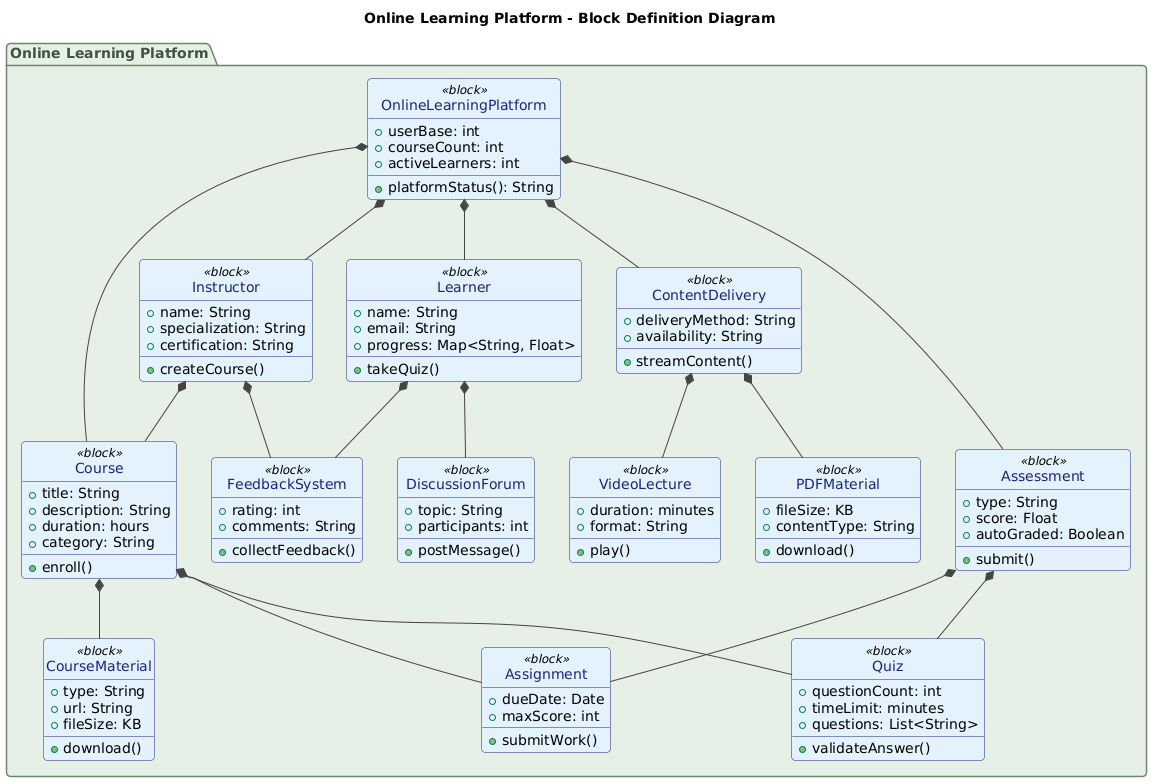
The resulting Block Definition Diagram captures the core structural elements of the platform:
- OnlineLearningPlatform serves as the root container, aggregating all key components.
- Course is the central entity, composed of
CourseMaterial,Quiz, andAssignmentblocks. - ContentDelivery handles media delivery via
VideoLectureandPDFMaterial. - Assessment supports both automated (e.g.,
Quiz) and manual (e.g.,Assignment) evaluation. - FeedbackSystem acts as a bridge between
LearnerandInstructor, enabling course evaluation and improvement.
Why Block Definition Diagram? The Design Logic
The choice of Block Definition Diagram (BDD) is strategic. Unlike class diagrams that focus on implementation details, BDDs emphasize structural modeling at the system level. They define the building blocks of a system and how they relate—perfect for architecture planning.
Here’s how the BDD logic aligns with real-world platform design:
- Blocks represent domain entities:
Learner,Instructor,Course—each with responsibilities and data. - Associations model relationships: A
Learnerenrolls in aCourse; anInstructorcreates aCourse; aCoursecontainsContentMaterial. - Composition hierarchy:
CoursecontainsQuizandAssignment, which are internal parts—reflecting how content is structured. - Extensibility:
VideoLectureandPDFMaterialare subtypes ofContentDelivery, allowing future expansion without disrupting the model.
This structure ensures that the platform’s architecture is both comprehensible and evolvable.
Conversational Intelligence in Action
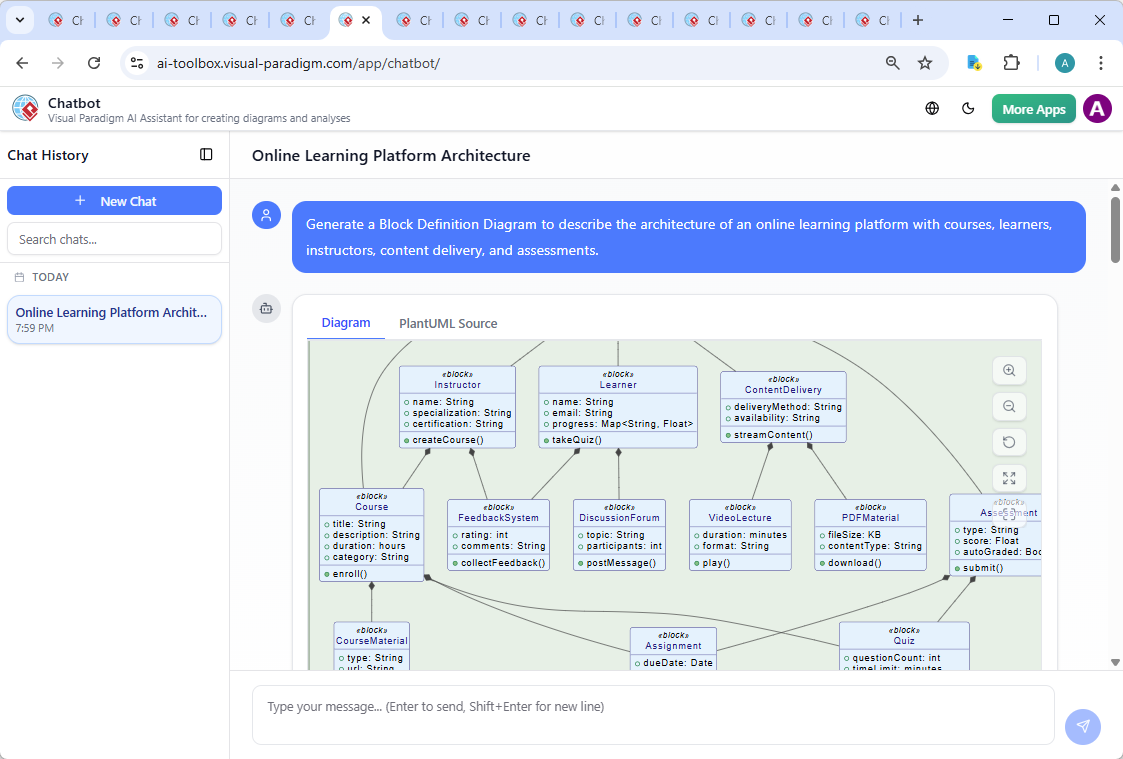
The AI Chatbot’s role extended beyond diagram generation. It responded to follow-up questions with expert-level clarity—transforming the BDD from a static image into a dynamic design artifact.
For example, when asked to explain the FeedbackSystem interaction, the AI:
- Clarified the bidirectional flow: learners provide input, instructors receive insights.
- Highlighted use cases: identifying poor content, improving teaching style.
- Provided real-world examples to ground the abstraction.
- Offered next-step suggestions: “Let me know if you’d like a sequence diagram to visualize this flow!”
This level of contextual understanding—where the AI acts as a domain-aware collaborator—demonstrates why Visual Paradigm’s AI Chatbot isn’t just a tool, but a modeling partner.
Beyond BDD: A Full Suite of Modeling Standards
While this example focused on Block Definition Diagrams, the Visual Paradigm AI Chatbot is built to support a full spectrum of modeling standards:
- UML: Class, Sequence, Activity, State diagrams.
- ArchiMate: Enterprise architecture modeling (business, application, technology layers).
- SysML: Requirements, parametric, and internal block diagrams for complex systems.
- C4 Model: Context, containers, components, and code views for software architecture.
- Visual Thinking Tools: Mind maps, PERT charts, org charts, SWOT, PEST, and data visualization (column, area, pie, line charts).
Whether you’re designing a cloud-native platform, mapping enterprise processes, or visualizing a product roadmap, the AI Chatbot adapts—offering intelligent suggestions across standards.
Conclusion: Build Smarter, Faster, Together
The AI-generated Block Definition Diagram for the online learning platform isn’t just a visual—it’s a strategic blueprint, co-created through intelligent conversation. With the Visual Paradigm AI Chatbot, you’re not just designing systems; you’re collaborating with an expert that understands your domain, your constraints, and your goals.
Ready to turn your next idea into a structured, scalable model?
Start your session now and experience the future of visual modeling—where AI doesn’t replace you, but elevates your design process.