


Designing a Smart City’s Pulse: The AI-Powered Block Definition Diagram for Traffic Management
Designing a resilient, adaptive smart city traffic system demands more than static blueprints—it requires a dynamic, intelligent modeling approach. The complexity of integrating signals, sensors, control centers, and data analytics into a cohesive architecture is daunting. Yet, with the Visual Paradigm AI Chatbot, this challenge transforms into a collaborative design journey.
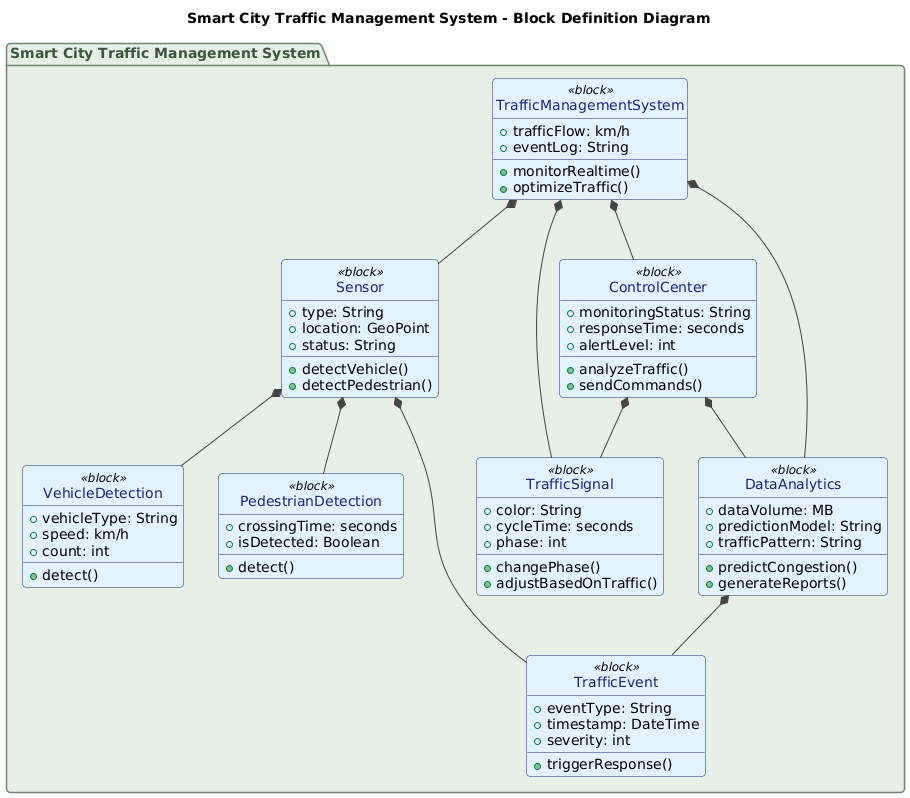
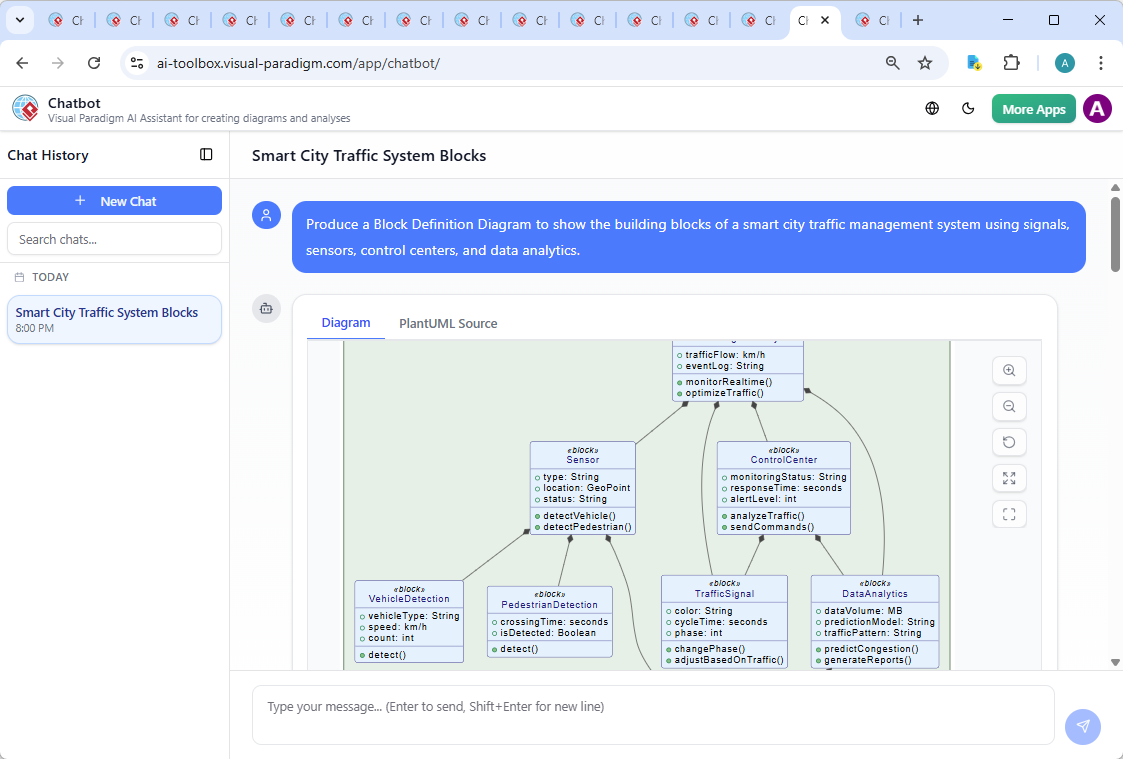
Instead of manually drafting every block and relationship, the user simply described the vision: “Produce a Block Definition Diagram to show the building blocks of a smart city traffic management system using signals, sensors, control centers, and data analytics.” The AI Chatbot responded instantly with a fully structured, semantically accurate PlantUML representation—complete with classes, attributes, operations, and relationships. This wasn’t a diagram generator; it was a modeling partner.
From Prompt to Precision: The Evolution of the Block Definition Diagram
The journey began with a high-level request. Within seconds, the AI delivered a clean, standards-compliant Block Definition Diagram (BDD) using SysML notation. But the real intelligence emerged in the conversation.
When the user asked, “Can you explain how the TrafficSignal block adjusts its phase based on real-time data from the Sensor block?” the AI didn’t just restate the diagram. It delivered a layered, technical explanation that clarified the system’s behavior:
- Sensors continuously collect vehicle and pedestrian data.
- Control Center analyzes inputs and determines optimal signal timing.
- TrafficSignal dynamically adjusts its phase—extending green for congestion, adding crosswalk time for pedestrians.
- Feedback loops allow the system to learn and improve over time.
This wasn’t a one-way explanation. It was a dialogue. The AI responded to follow-up questions with precision, turning abstract blocks into a living system. When the user requested clarification on the logic, the AI provided a real-world scenario—7:00 AM rush hour—illustrating how the system adapts in real time.
Decoding the Logic: Why Block Definition Diagrams Matter
The Block Definition Diagram is the foundational layer of SysML modeling. It defines the structural components of a system—what exists, what it contains, and how it’s organized. In this case, the diagram establishes the core building blocks of the smart city traffic system:
- TrafficManagementSystem (the system as a whole)
- TrafficSignal (the control unit at intersections)
- Sensor (data collection points)
- ControlCenter (central intelligence)
- DataAnalytics (predictive engine)
Each block is defined with:
- Attributes (e.g.,
cycleTime: seconds,status: String) - Operations (e.g.,
adjustBasedOnTraffic(),predictCongestion()) - Relationships (e.g.,
ControlCenter *-- TrafficSignal)
These relationships aren’t arbitrary. They reflect real-world dependencies:
- Sensors feed data to the Control Center and DataAnalytics.
- The Control Center sends commands to TrafficSignal blocks.
- DataAnalytics uses TrafficEvent data to refine predictions.
The diagram uses < stereotypes to emphasize that these are structural components—not behavioral ones. This distinction is critical in SysML, ensuring the model remains focused on architecture, not process flow.
Conversational Intelligence: The AI Chatbot as a Modeling Consultant
What sets Visual Paradigm apart isn’t just the diagram output—it’s the ability to engage in a natural, technical dialogue. The AI doesn’t just generate diagrams; it explains them, refines them, and adapts them based on user intent.
For example, after the initial diagram, the user asked for a deeper dive into the signal adjustment logic. The AI didn’t just repeat the diagram. It provided:
- A step-by-step behavioral narrative
- A real-world use case (7:00 AM rush hour)
- Clear cause-and-effect reasoning
- Performance and safety benefits
This level of contextual insight turns the AI into a modeling expert—someone who understands not just syntax, but system dynamics.
More Than a Diagram Tool: A Full-Stack Visual Modeling Platform
While this example focused on SysML Block Definition Diagrams, the Visual Paradigm AI Chatbot is built to support a full spectrum of modeling standards. Whether you’re designing enterprise architectures with ArchiMate, modeling complex systems with SysML, visualizing software architecture with C4 Model, or mapping strategic initiatives with SWOT or PEST, the AI Chatbot adapts to your needs.
It handles:
- UML diagrams (class, sequence, activity)
- ArchiMate for enterprise architecture
- SysML for systems engineering
- C4 Model for software architecture
- Org. Chart, Mind Maps, PERT Charts, and more
Every diagram type is supported through the same conversational interface. You don’t need to switch tools or learn multiple syntaxes. The AI understands context, intent, and domain-specific language—making it a unified platform for all visual modeling needs.
Conclusion: Build Smarter Systems, Faster
The smart city traffic management system isn’t just a collection of hardware and software—it’s a living, responsive ecosystem. The Block Definition Diagram is the blueprint that defines its structure. With Visual Paradigm’s AI Chatbot, that blueprint is no longer a static document. It’s a living conversation, evolving with every question, refinement, and insight.
Whether you’re a systems engineer, architect, or city planner, the AI Chatbot turns complex design challenges into collaborative design sessions. It doesn’t just generate diagrams—it helps you think through them.
Ready to model your next smart system? Try it today at Visual Paradigm AI Toolbox.