


Designing a Smart Home System with AI: A Block Definition Diagram Journey
Creating a structured, scalable model for a smart home system requires more than just drawing boxes and lines. It demands a deep understanding of component relationships, data flows, and system boundaries—especially when integrating sensors, controllers, appliances, and cloud services. This is where the Visual Paradigm AI Chatbot transforms the process from manual drafting to a collaborative design conversation.
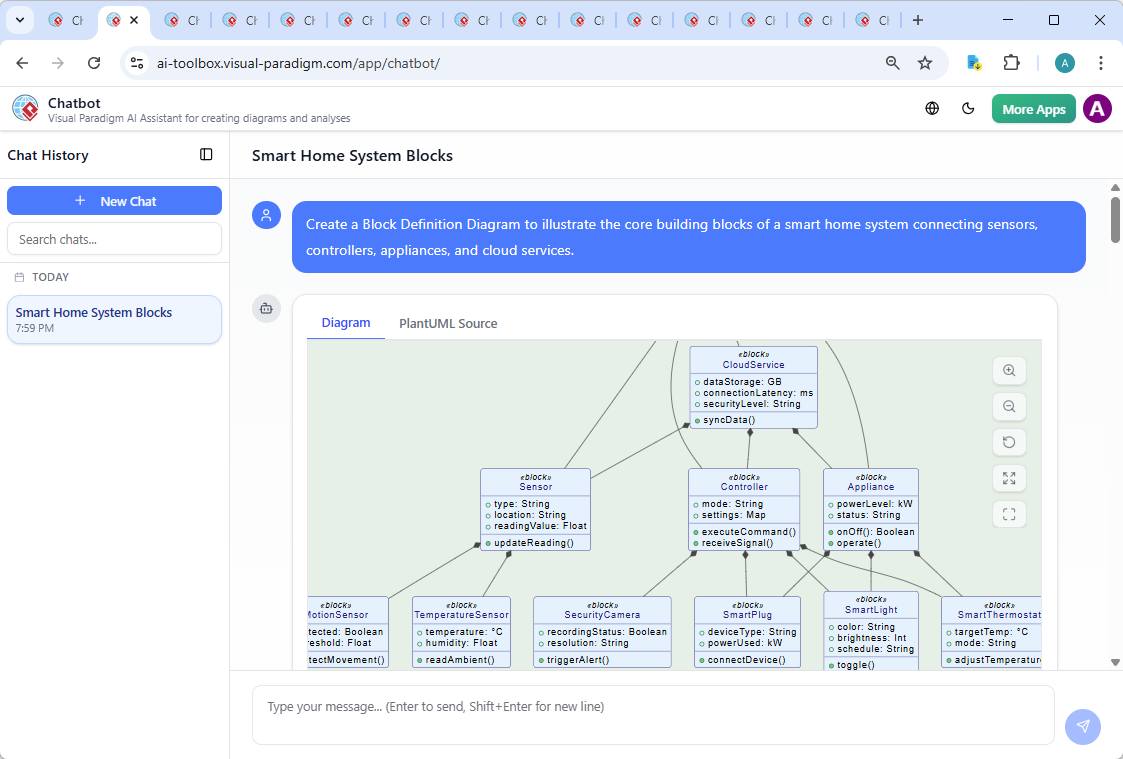
Instead of starting from scratch with abstract notation, the user simply described their intent: “Create a Block Definition Diagram to illustrate the core building blocks of a smart home system connecting sensors, controllers, appliances, and cloud services.” Within seconds, the AI generated a fully valid PlantUML script—complete with hierarchical blocks, properties, operations, and clear associations. This isn’t just diagram generation; it’s architectural co-creation.
From Prompt to Precision: The Interactive Design Journey
The journey began with a simple request, but the real value emerged through back-and-forth refinement. After the initial diagram was generated, the user asked: “Explain this diagram.” The AI responded not with a dry list of definitions, but with a narrative breakdown that contextualized each block, its role, and how it fits into the larger ecosystem.
What followed was a natural flow of inquiry: the user asked for clarification on specific branches—like the inheritance between Sensor and its subtypes (MotionSensor, TemperatureSensor), or how the CloudService interacts with devices. Each follow-up was met with a precise, technically accurate explanation—complete with real-world use cases (e.g., motion detection triggering lights, data syncing to the cloud).
This iterative dialogue demonstrates the AI Chatbot’s role as a modeling consultant. It doesn’t just respond—it anticipates questions, explains intent, and reinforces design principles. When the user requested a deeper dive into the relationships, the AI delivered a comparative table of connections and their purpose, turning a static diagram into a living design document.

Decoding the Block Definition Diagram Logic
The generated Block Definition Diagram (BDD) is built on SysML standards, which are ideal for modeling complex systems with clear structural hierarchies. Here’s why this structure works:
- Blocks as Reusable Components: Each entity—
SmartHome,Controller,Appliance,CloudService—is defined as ablock, representing a physical or logical system component with properties and behaviors. - Encapsulation & Inheritance: The
Sensorblock acts as a base class for specialized types likeMotionSensorandTemperatureSensor. This supports code reuse and consistent behavior across similar devices. - Clear System Boundaries: The
SmartHomeblock serves as the system boundary, aggregating all components. This makes it easier to reason about system-level behavior, such as monitoring total devices or energy consumption. - Interoperability via Relationships: The
*associations (composition) show ownership and lifecycle dependency—e.g., theSmartHomeowns its sensors and controllers. TheCloudServiceconnects to all components, highlighting its role as a central data hub. - Behavioral Context: Each block includes methods like
executeCommand(),syncData(), andadjustTemperature(), which define what the component can do—critical for system integration and testing.
This structure isn’t arbitrary. It’s rooted in SysML best practices: defining what exists before modeling how it behaves. This ensures that system architects, developers, and stakeholders all share a common understanding of the system’s architecture before diving into sequences or state diagrams.
Conversational Intelligence: The AI Chatbot as Your Modeling Partner
What sets Visual Paradigm apart isn’t just the ability to generate diagrams—it’s the depth of intelligence behind the generation. The AI Chatbot doesn’t just output code; it interprets intent, suggests improvements, and explains design decisions in plain language.
For example, when the user asked to explain the diagram, the AI didn’t just list attributes—it framed the system as a feedback loop: sensor input → controller decision → appliance action → cloud logging. This narrative approach makes complex systems accessible to non-technical stakeholders.
Moreover, the chat history shows the AI adapting to follow-up requests—such as clarifying inheritance, explaining relationships, and even suggesting future extensions (e.g., adding a voice assistant or AI analytics layer).
Beyond BDD: A Multi-Standard AI Modeling Platform
While this example focused on a Block Definition Diagram, the Visual Paradigm AI Chatbot is not limited to SysML. It seamlessly supports a full spectrum of modeling standards, including:
- UML: For software design, class diagrams, sequence diagrams, and use case modeling.
- ArchiMate: For enterprise architecture, visualizing business, application, and technology layers.
- C4 Model: For software architecture, providing context, containers, components, and code views.
- SWOT, PEST, Org Charts, Mind Maps, PERT Charts: For strategic planning, project management, and organizational modeling.
This versatility means the same AI assistant can support architects designing a smart home system, enterprise strategists mapping business capabilities, or developers modeling a microservices backend—all using the same intuitive, conversational interface.
Conclusion: Design with Confidence, Powered by AI
Building a smart home system requires more than technical skills—it demands a clear, shared vision of how components interact. With Visual Paradigm’s AI Chatbot, that vision becomes reality through a natural, intelligent conversation.
From the initial prompt to the final explanation, every step was guided by AI-driven insight, ensuring accuracy, clarity, and scalability. Whether you’re modeling a home automation system, a cloud-native application, or a multi-layered enterprise architecture, Visual Paradigm delivers a unified, intelligent environment where ideas become models—and models become systems.
Ready to design your next system with AI? Start your session now and experience the future of visual modeling.