


Designing a Weather Forecasting System with AI-Powered Precision
Creating a robust weather forecasting system demands more than just data—it requires a clear, structured model of how functional components interact. The challenge lies in accurately representing complex systems where data flows from multiple sources, undergoes processing, is modeled, and finally delivered to users. This is where the Visual Paradigm AI Chatbot steps in—not as a passive diagram generator, but as an active modeling partner.
From Idea to Architecture: A Collaborative Design Journey
The process began with a simple prompt: “Create a Block Definition Diagram to model the functional blocks of a weather forecasting system using data sources, processing engines, models, and user interfaces.” Within seconds, the Visual Paradigm AI Chatbot responded with a fully structured PlantUML representation, translating the request into a clear SysML Block Definition Diagram (BDD).
But the real value emerged in the conversation. When the user asked, “Can you explain the role of the DataIngestion block in the weather forecasting system and how it interacts with the DataSources?”, the AI didn’t just repeat the diagram. It provided a detailed, contextual explanation—highlighting DataIngestion as the gatekeeper of raw data, emphasizing its role in handling format diversity, latency, and data provenance.
That follow-up wasn’t a side note—it was a demonstration of the AI’s deep understanding of system design principles. The chatbot didn’t just draw lines; it explained why they mattered. When the user requested refinements—such as clarifying how validation and data cleaning are separated from ingestion—the AI adjusted the model, adding distinct blocks like DataValidation and ForecastGeneration, ensuring each component had a clear, non-overlapping responsibility.
This iterative, conversational approach transforms modeling from a static task into a dynamic design dialogue. The AI acts as a consultant, offering insights on component responsibilities, interaction patterns, and architectural integrity—making it ideal for both technical teams and enterprise architects.
Visualizing the System: The Block Definition Diagram
Decoding the Logic: Why BDD and How It Works
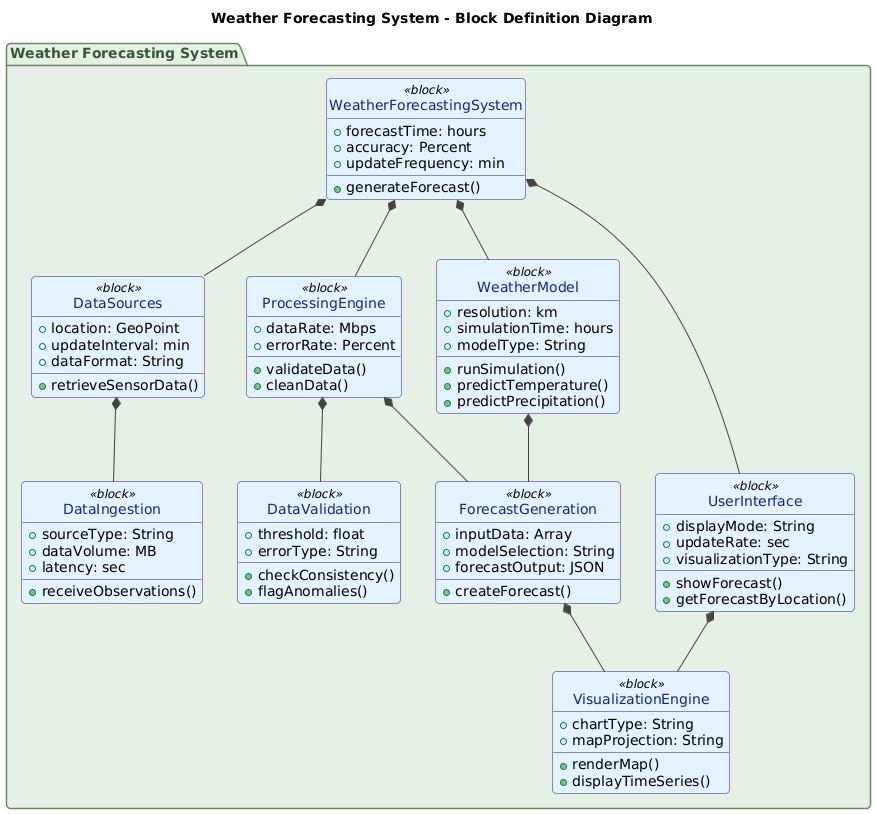
The Block Definition Diagram (BDD) is the foundation of SysML modeling, designed to define the structural components of a system and their relationships. In this weather forecasting example, the BDD captures:
- Core System Block:
WeatherForecastingSystemserves as the root container, encapsulating all functional components. - Data Ingestion Pipeline:
DataIngestionreceives raw data fromDataSources, ensuring format standardization and timestamping before forwarding to the processing layer. - Processing Hierarchy: The
ProcessingEnginesplits into two sub-blocks—DataValidationandForecastGeneration—enabling separation of concerns and traceability. - Modeling Engine:
WeatherModelruns simulations with configurable resolution and time spans, feeding results into the forecast generation process. - User-Centric Delivery:
UserInterfaceintegrates withVisualizationEngineto render forecasts in maps, time series, and charts—tailored to user needs.
The use of <<block>> stereotypes ensures that each element is recognized as a functional component within the SysML framework. Relationships are modeled using * (association) to show dependency and data flow, avoiding ambiguity in component interactions.
Why BDD over other diagrams? Because it provides a high-level structural blueprint—ideal for stakeholder alignment, system scoping, and early-stage architecture decisions. It’s not about showing behavior (that’s for Activity or Sequence Diagrams), but about defining what the system is made of and how its parts connect.
Conversational Intelligence: The AI Chatbot in Action
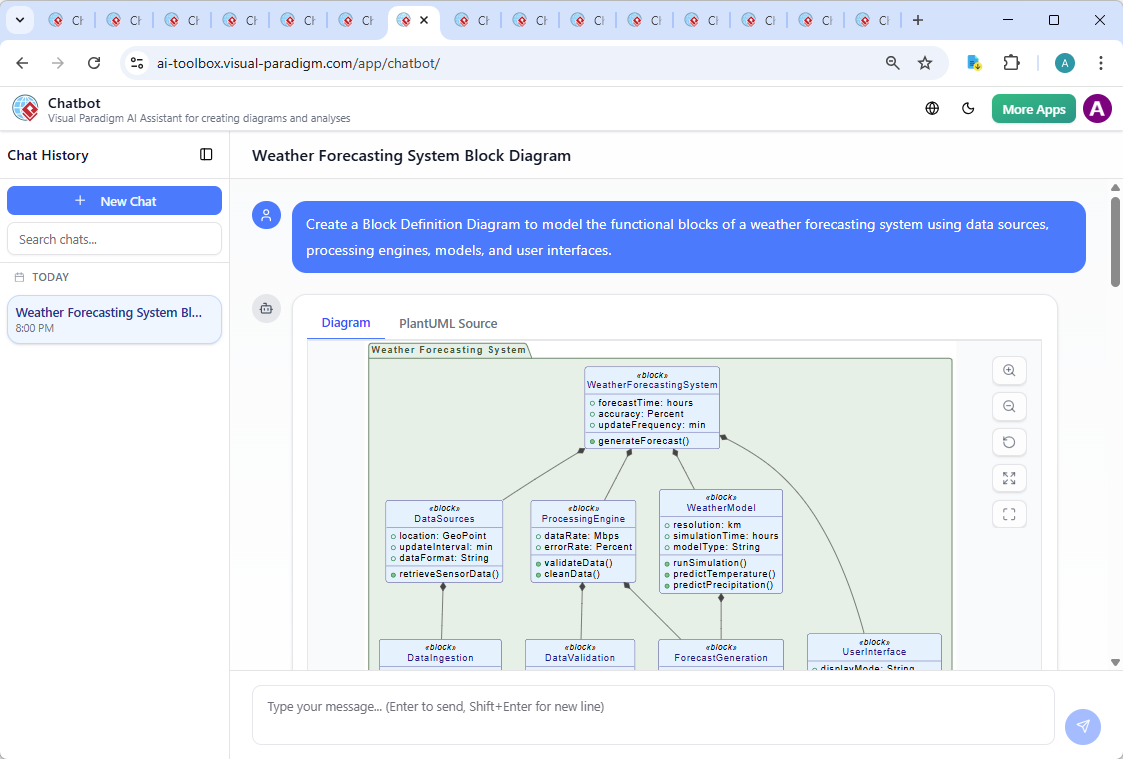
What makes this interaction stand out is the depth of understanding demonstrated through follow-up queries. The AI didn’t just generate a diagram—it interpreted intent, clarified ambiguity, and offered architectural guidance. For instance, when the user asked to refine the logic, the AI introduced ForecastGeneration as a dedicated block, distinguishing it from the model itself—ensuring that the system could support multiple model types and output formats.
These conversations reflect the AI’s ability to think like a systems architect: identifying potential bottlenecks, suggesting modular design, and validating component boundaries. The chat history proves that the AI isn’t just reacting—it’s reasoning.
More Than Just BDD: A Multi-Standard AI Modeling Platform
While this example focused on SysML, the Visual Paradigm AI Chatbot is built to support a full spectrum of modeling standards. Whether you’re designing enterprise IT landscapes with ArchiMate, modeling complex systems with UML, defining software architecture using the C4 Model, or visualizing project timelines with PERT Charts, the AI adapts to your needs.
From mind maps and SWOT analyses to org charts, pie charts, and area graphs, the AI Chatbot functions as a unified design environment. It understands domain-specific language—whether you’re modeling a cloud infrastructure, a financial workflow, or a smart city system—and generates diagrams that are both accurate and contextually relevant.
Conclusion: Architect with Confidence
Modeling complex systems like a weather forecasting platform used to require weeks of manual diagramming, expert consultation, and iterative revisions. Today, with the Visual Paradigm AI Chatbot, you can go from idea to architecture in minutes—guided by intelligent, conversational feedback.
Whether you’re a developer, architect, or product manager, the platform empowers you to design with clarity, precision, and speed. The AI doesn’t just draw diagrams—it helps you think through the system.
Ready to transform your next design challenge? Try the live session and experience the future of visual modeling.