


Designing Secure Digital Banking: An AI-Powered Component Diagram Journey
Creating a clear, accurate, and scalable architecture for an online banking system demands more than just diagramming—it requires deep technical insight and architectural foresight. The challenge lies in visualizing how critical components like the Customer Portal, Transaction Processing, Fraud Detection, Account Management, and Core Banking Systems interact without introducing ambiguity or architectural debt. That’s where the Visual Paradigm AI Chatbot steps in—not as a passive tool, but as a collaborative modeling expert.
From Idea to Insight: The Interactive Design Journey
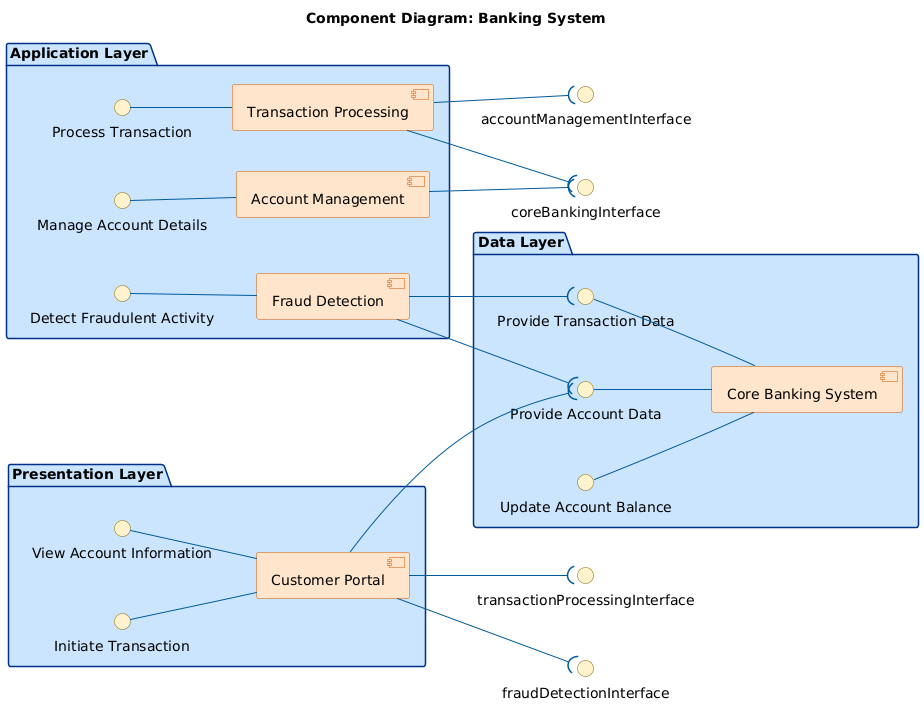
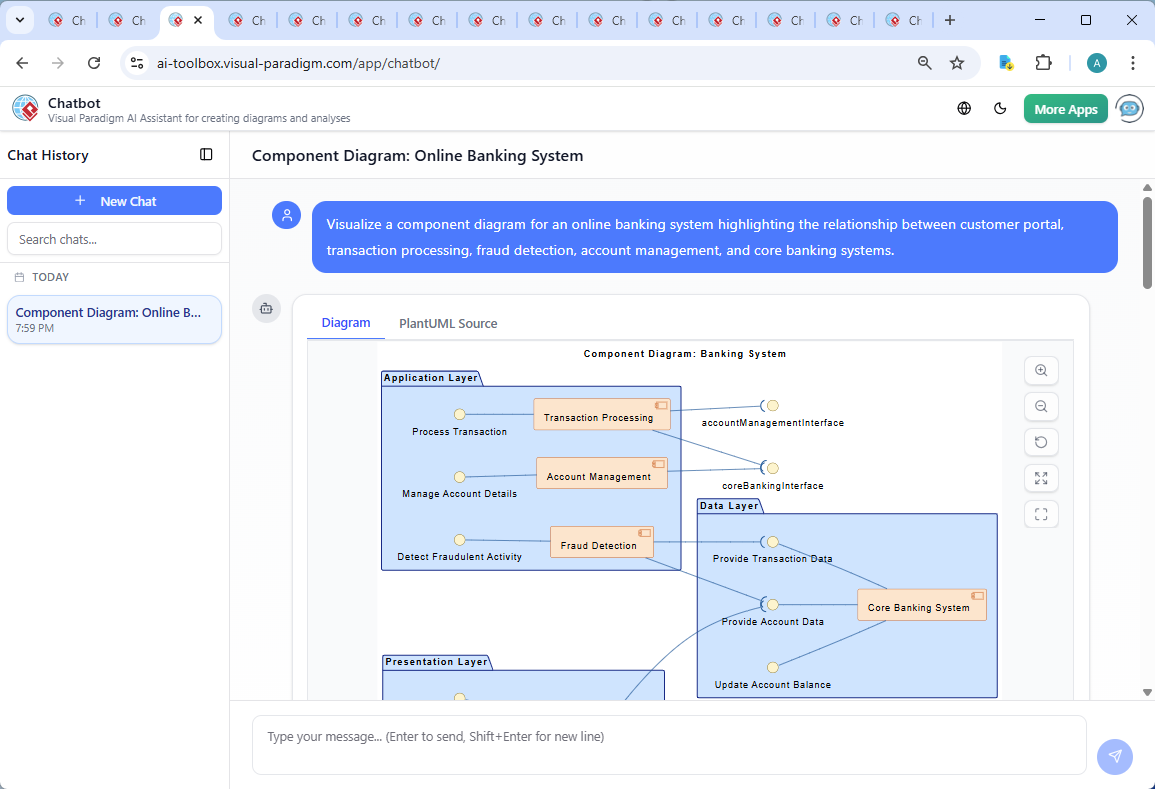
The journey began with a simple request: “Visualize a component diagram for an online banking system highlighting the relationship between customer portal, transaction processing, fraud detection, account management, and core banking systems.” Within seconds, the AI Chatbot delivered a fully rendered UML Component Diagram using PlantUML syntax, complete with layered architecture, interface definitions, and directional flow.
But the real value emerged in the conversation. When the user asked, “Can you explain how the Fraud Detection component interacts with the Transaction Processing component?”, the AI didn’t just restate the diagram—it provided a structured, technical breakdown of the real-time data exchange, decision-making loop, and security implications.
This wasn’t a static output. It was a dialogue. The AI responded with a detailed explanation of:
- How transaction data is captured and sent to Fraud Detection
- The role of risk scoring and rule-based detection
- Feedback mechanisms that halt or verify transactions
- Integration with user-facing alerts via the Customer Portal
Each follow-up request—like “Explain this branch” or “Refine the logic”—was met with precise, context-aware guidance. The AI didn’t just draw a diagram; it taught the user how to think about system interactions at scale.
Decoding the Component Diagram: Structure and Logic
The final component diagram is built on a layered architecture, reflecting industry best practices in enterprise software design. Here’s how each layer contributes:
1. Presentation Layer: Customer Portal
Acts as the user-facing interface. It exposes two key interfaces:
- View Account Information – Retrieves account balance, transaction history.
- Initiate Transaction – Sends transaction requests to the application layer.
These interfaces are connected to the Customer Portal component, ensuring a clean separation between UI and logic.
2. Application Layer: Core Business Logic
This layer hosts the system’s critical operations:
- Transaction Processing – Handles the flow of transactions, coordinates with other components.
- Fraud Detection – Analyzes transaction patterns in real time using rules or AI models.
- Account Management – Manages account creation, updates, and status.
Each component exposes interfaces to communicate with others, ensuring loose coupling and maintainability.
3. Data Layer: Core Banking System
Represents the persistent data store and financial ledger. It provides:
- Provide Account Data – Supplies account details for display and validation.
- Provide Transaction Data – Offers historical records for audit and analysis.
- Update Account Balance – Executes final balance adjustments after transaction approval.
This layer is the single source of truth for financial data.
Interaction Logic
Key relationships include:
- Customer Portal → Transaction Processing: Initiates transactions.
- Transaction Processing → Fraud Detection: Sends data for real-time analysis.
- Fraud Detection → Transaction Processing: Returns risk status (approve/block/verify).
- Transaction Processing → Core Banking: Finalizes transactions after approval.
- Account Management → Core Banking: Updates account state.
The use of interfaces instead of direct dependencies ensures that components can evolve independently. For example, the Fraud Detection engine could be replaced with an AI-driven model without affecting the Transaction Processing logic.
Conversational Intelligence: The AI Chatbot as Your Modeling Partner
What sets Visual Paradigm apart isn’t just the diagram—it’s the intelligence behind it. The AI Chatbot doesn’t generate diagrams in isolation. It learns from the conversation, adapts to feedback, and elevates the design through iterative refinement.
When the user asked for clarification on the Fraud Detection interaction, the AI didn’t default to a generic response. Instead, it:
- Explained the data flow and decision loop
- Highlighted the importance of real-time monitoring
- Suggested future enhancements (e.g., AI models, OTP verification)
This level of contextual understanding turns the AI into a true modeling consultant—one that anticipates questions before they’re asked.
Beyond Component Diagrams: A Full-Spectrum Modeling Platform
The Visual Paradigm AI Chatbot isn’t limited to UML Component Diagrams. It supports a full suite of modeling standards, making it the go-to platform for enterprise architects and software engineers:
- UML: For detailed system design (use case, class, sequence, activity diagrams). Explore the Package Diagram Tutorial and Package Diagram Examples & Templates.
- ArchiMate: For enterprise architecture modeling, showing business, application, and technology layers. Learn more in the Comprehensive Tutorial: AI-Powered ArchiMate Diagram Generation.
- SysML: For complex systems engineering and requirements modeling. Use the SysML Requirement Diagram Tool and Block Definition Diagram Tool for advanced modeling.
- C4 Model: For clear, scalable software architecture visualization (context, containers, components, code). Try the Interactive Overview Diagram Example.
- Mind Maps, Org Charts, SWOT, PEST, PERT: For strategic planning and stakeholder alignment.
Whether you’re designing a banking system, a healthcare platform, or a smart city infrastructure, the AI Chatbot adapts to your domain, your language, and your workflow.
Conclusion: Design Smarter, Faster, with AI
The AI-generated component diagram for the online banking system isn’t just a visual. It’s a living blueprint shaped by conversation, insight, and architectural rigor. With Visual Paradigm’s AI Chatbot, you’re not just creating diagrams—you’re co-designing systems with an intelligent partner that understands the why behind every line and connection.
Ready to transform your next architecture project? Try the AI Chatbot today and experience the future of visual modeling.
Related Links
- Component Diagram – Wikipedia: A UML diagram that illustrates the organization and dependencies of components in a software system.
- What is a Component Diagram? – Visual Paradigm: A detailed guide on UML component diagrams, showing how components interact and are structured in software design.
- Component Diagram Tutorial: Component Diagram Tutorial. Component diagrams provide a simplified, high-order view of a large system. Classifying groups of classes into components supports the interchangeability…