


Designing a Resilient Cloud File Storage System with AI-Powered Precision
Deploying a cloud-based file storage service requires more than just infrastructure—it demands a clear, scalable, and maintainable architectural vision. The challenge lies in visualizing how desktop clients, sync services, and distributed storage nodes interact under real-world conditions, especially when handling concurrent modifications and ensuring data consistency.
Enter the Visual Paradigm AI Chatbot—not just a diagram generator, but a collaborative modeling expert. By engaging in a natural conversation, users can evolve their ideas into detailed, standards-compliant diagrams with minimal effort. This article walks through the creation of a Deployment Diagram for a cloud-based file storage system, illustrating how the AI Chatbot functions as a design partner throughout the process.
From Concept to Diagram: A Collaborative Design Journey
The journey began with a simple prompt: “Produce a deployment diagram showing the deployment setup of a cloud-based file storage service with desktop clients, sync services, and distributed storage nodes.” Within seconds, the AI Chatbot responded with a fully structured PlantUML script, rendering a clear deployment model that captured the core components and their interactions.
But the real value emerged in the follow-up conversation. When asked to explain how the Conflict Resolution Policy in the Sync Service handles simultaneous file edits, the AI didn’t just provide a definition—it delivered a comprehensive breakdown of three conflict resolution strategies: optimistic concurrency with versioning, last-write-wins, and automated diff-based merging. Each was contextualized with real-world trade-offs, use cases, and architectural implications.
Even more impressively, the AI proactively offered to extend the model: “Would you like me to generate a sequence diagram showing the conflict resolution process step-by-step? Or a mind map of the conflict resolution workflow?” This level of contextual awareness—anticipating the next logical step in the design process—demonstrates the AI’s role as a true modeling consultant, not just a tool.
Visualizing the Cloud Infrastructure
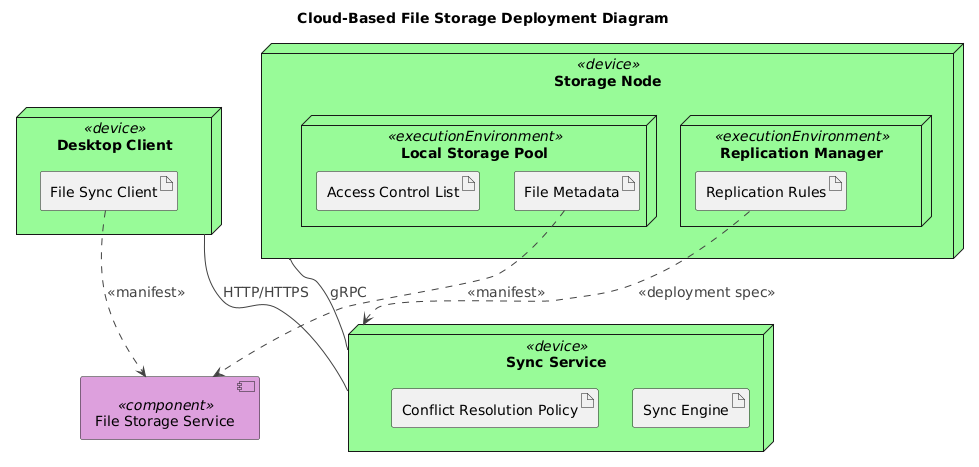
The final Deployment Diagram captures a resilient, scalable architecture where:
- Desktop Clients run on user devices and host the File Sync Client artifact, which communicates with the Sync Service via HTTP/HTTPS.
- The Sync Service acts as the central coordination layer, using gRPC to communicate with storage nodes. It houses the Sync Engine and Conflict Resolution Policy.
- Storage Nodes are distributed across regions, each containing a Local Storage Pool (for file metadata and ACLs) and a Replication Manager that enforces data consistency via replication rules.
These components are interconnected with clear deployment semantics: artifact ..> component shows manifest dependencies, while node -- node relationships represent communication channels. The use of node for physical execution environments and component for logical software units ensures the diagram aligns with UML standards.
Understanding the Logic Behind the Design
The diagram’s structure reflects real-world engineering decisions:
- Versioning and Timestamps are embedded in the Conflict Resolution Policy, ensuring traceability and consistency.
- gRPC between Sync Service and Storage Nodes enables high-performance, low-latency communication—ideal for real-time sync operations.
- Replication Rules are deployed as artifacts within the Replication Manager, ensuring data durability across nodes.
- Access Control Lists (ACLs) are stored alongside file metadata, enforcing security at the storage layer.
By placing the Sync Engine and Conflict Resolution Policy inside the Sync Service node, the design emphasizes operational cohesion. This reflects a microservices-style architecture where the sync logic is tightly coupled with its execution environment, enabling faster response times and easier maintenance.
Conversational Intelligence in Action
The AI’s ability to respond to follow-up questions with depth and clarity is what sets it apart. When asked to explain conflict resolution, the AI didn’t default to a textbook answer—it delivered a structured, comparative analysis with practical implications, including pros, cons, and real-world examples.
This interaction exemplifies the AI Chatbot’s intelligence: it doesn’t just generate diagrams, it understands the architectural intent behind them. The chat history proves that the AI can handle complex, layered questions and refine the model iteratively—whether by clarifying logic, suggesting improvements, or expanding the design into other diagram types.
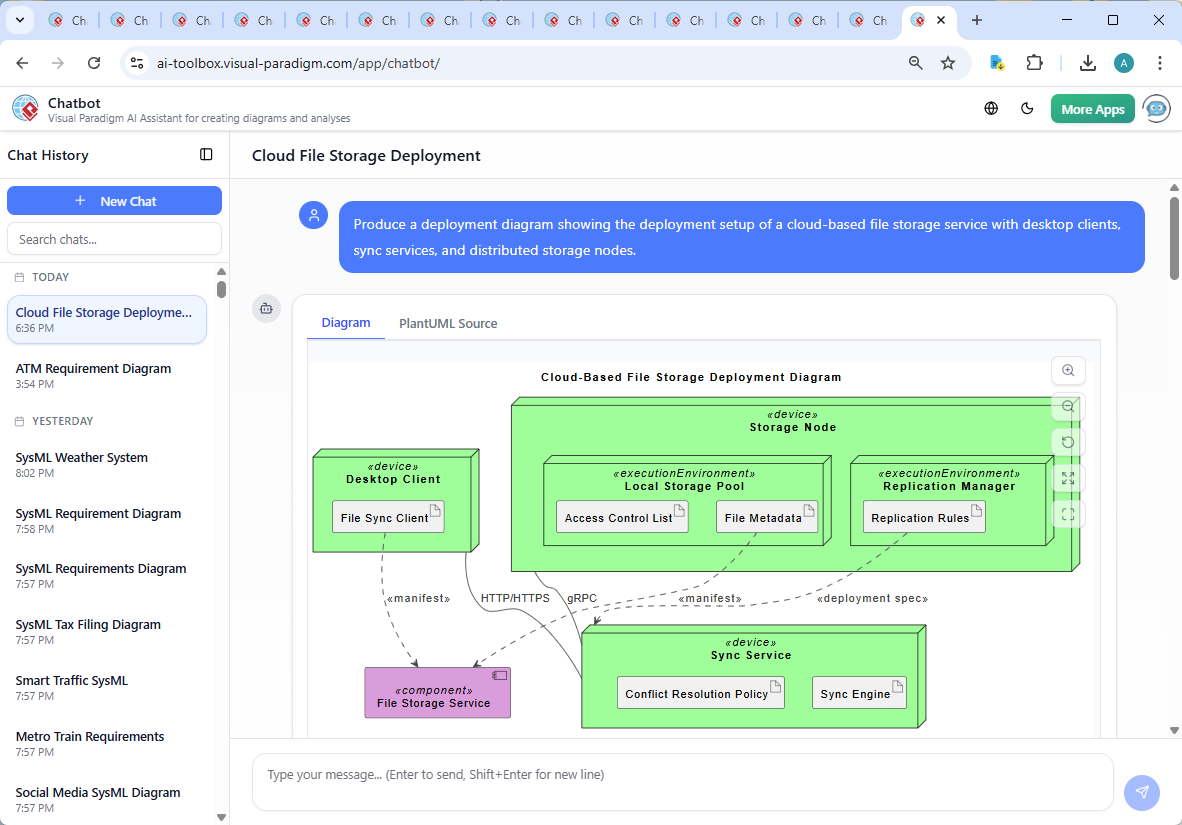
The screenshot of the chat interface shows the natural flow of the conversation: user prompts, AI responses with rich content, and the ability to pivot between diagram types. This is not a static tool—it’s a dynamic design collaborator.
More Than Just Deployment Diagrams: A Full Modeling Suite
While this example focused on a Deployment Diagram, the Visual Paradigm AI Chatbot supports a full spectrum of modeling standards. Whether you’re designing enterprise systems with ArchiMate, modeling complex systems with SysML, visualizing software architecture using the C4 Model, or mapping out business strategies with Mind Maps, SWOT, PEST, or PERT Charts, the AI adapts to your needs.
This versatility makes Visual Paradigm the only AI-powered visual modeling platform that unifies strategy, design, and implementation across domains—without requiring users to switch tools or learn multiple syntaxes.
Conclusion: Design Smarter, Together
Building a cloud-based file storage system isn’t just about technology—it’s about clarity, consistency, and collaboration. The Visual Paradigm AI Chatbot turns abstract ideas into precise, standards-compliant models through natural conversation, guiding users from concept to deployment with intelligent, context-aware support.
Whether you’re a developer, architect, or product manager, the ability to refine your design through dialogue—asking for explanations, requesting refinements, or exploring related diagrams—transforms the modeling process into a dynamic, shared journey.
Ready to design your next system with AI-powered precision? Explore Visual Paradigm today and experience the future of visual modeling.