


Designing a Secure Cloud-Hosted Social Media App with AI-Powered Precision
Building a robust, scalable deployment architecture for a cloud-hosted social media application demands more than just visual clarity—it requires intelligent modeling that anticipates real-world runtime behavior. The challenge lies in accurately representing the dynamic interactions between mobile clients, API gateways, microservices, and distributed storage, while ensuring security, scalability, and maintainability.
Enter the Visual Paradigm AI Chatbot—not just a diagram generator, but a conversational design partner. It transforms abstract requirements into a fully structured deployment diagram through natural dialogue, guiding the user step by step while embedding architectural best practices. This isn’t automation; it’s intelligent co-creation.
From Idea to Architecture: A Collaborative Design Journey
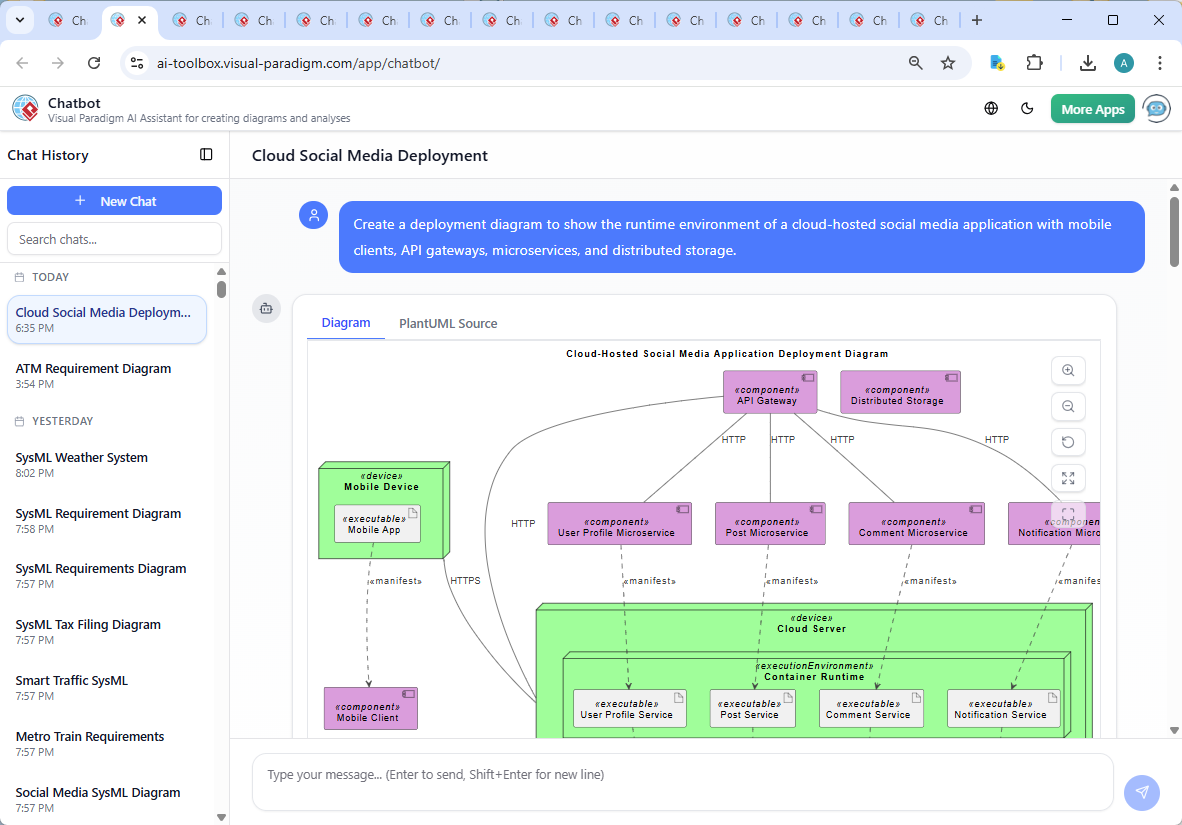
The journey began with a simple prompt: “Create a deployment diagram to show the runtime environment of a cloud-hosted social media application with mobile clients, API gateways, microservices, and distributed storage.”
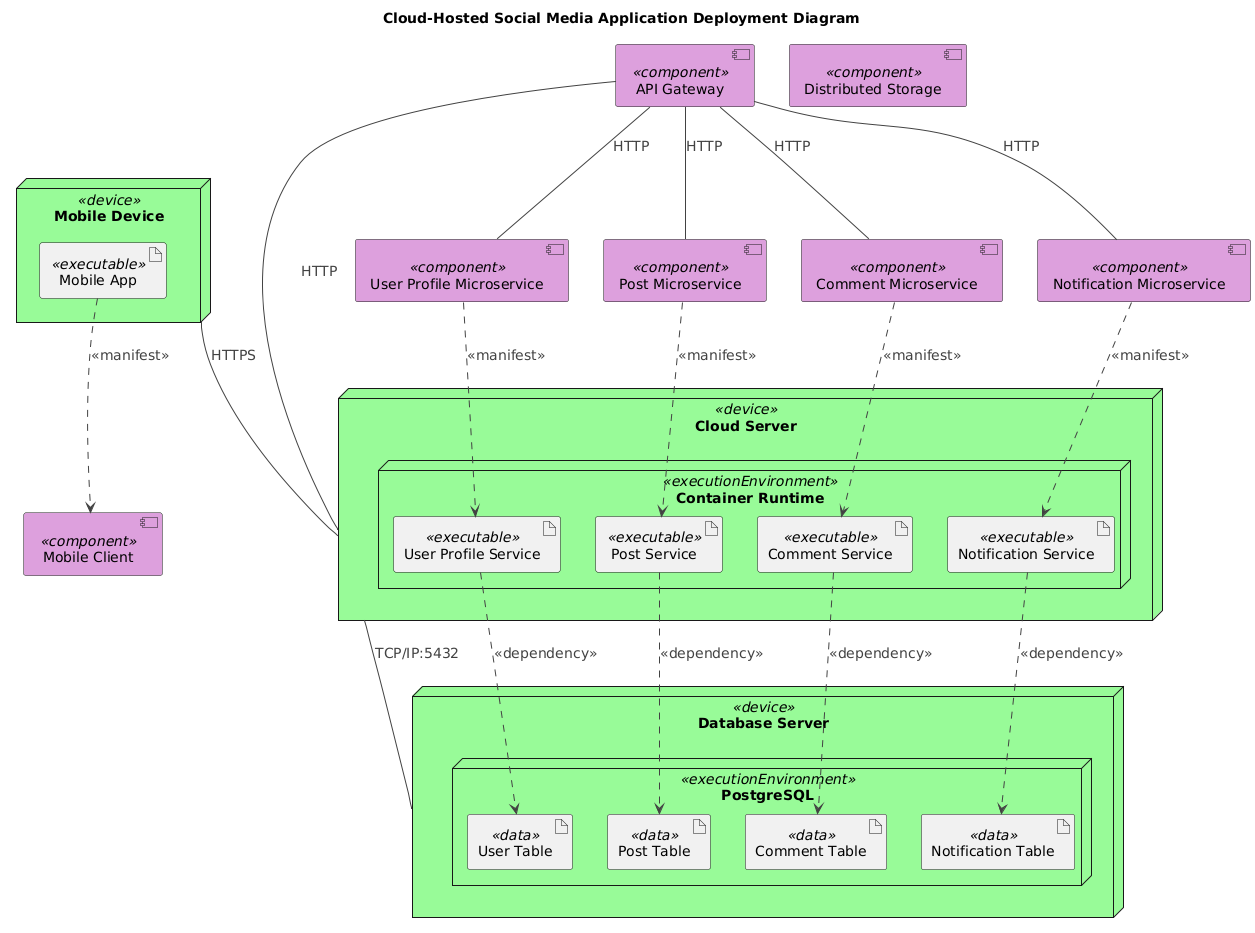
Within seconds, the AI Chatbot responded with a fully rendered PlantUML script, generating a precise deployment diagram that included:
- Mobile clients and cloud servers as execution environments
- API gateway as a central entry point
- Decoupled microservices (User Profile, Post, Comment, Notification)
- Distributed storage via PostgreSQL on a dedicated database server
- Clear dependencies and communication protocols
But the real value emerged in the conversation that followed. When the user asked, “Can you explain how the mobile app communicates with the API gateway using HTTPS, and what security measures should be implemented?”, the AI didn’t just answer—it deepened the design’s intelligence.
It delivered a structured breakdown of the HTTPS communication flow, explained the role of TLS 1.2/1.3, and detailed critical security controls like certificate pinning, rate limiting, OAuth 2.0, and WAF integration. This wasn’t a static diagram; it was a living model enriched by expert insight.
Each follow-up—like requesting a security flow diagram or refining the dependency logic—was met with precision. The AI didn’t just generate more lines; it enhanced the model’s fidelity and business relevance. This is how the Visual Paradigm AI Chatbot operates: as a modeling consultant, not a tool.
Decoding the Deployment Logic: Why This Structure Works
The diagram reflects a modern, cloud-native architecture optimized for scalability and resilience. Let’s break down the key elements and their architectural significance:
1. Mobile Client & Mobile Device
The mobile app is modeled as an artifact on a mobile device, emphasizing that the app runs on user devices (iOS/Android) and communicates over HTTPS. This separation ensures clarity: the app is a runtime component, not a server.
2. API Gateway as the Central Hub
Instead of exposing microservices directly, the API gateway acts as a secure, unified entry point. It handles authentication, routing, throttling, and protocol translation—critical for managing high-volume, distributed traffic.
3. Microservices in Containerized Execution Environments
Each microservice (User Profile, Post, Comment, Notification) is deployed within a Container Runtime on the cloud server. This reflects Kubernetes-style orchestration and enables independent scaling, updates, and isolation.
4. Distributed Storage on Dedicated Database Server
PostgreSQL runs on a separate database server, decoupled from the application layer. This separation ensures performance, security, and failover readiness—critical for handling large volumes of user data and content.
5. Communication Protocols & Dependencies
HTTPSbetween mobile device and cloud server (secure, encrypted communication)TCP/IP:5432between cloud and database servers (standard PostgreSQL port)HTTPfrom API gateway to microservices (standard RESTful communication)<<manifest>>and<<dependency>>stereotypes clarify how components are deployed and related
This notation isn’t arbitrary—it’s based on UML deployment semantics, ensuring the diagram is both visually intuitive and technically accurate.
Conversational Intelligence: Where the AI Adds Real Value
What sets Visual Paradigm apart is how the AI Chatbot evolves with the user. The conversation wasn’t a one-way response—it was a dialogue. When the user asked for an explanation of the HTTPS flow, the AI didn’t just restate the obvious. It:
- Explained the role of TLS in encryption and authentication
- Highlighted risks of weak or outdated protocols
- Provided a comparative table of security measures with clear justifications
- Offered actionable best practices (e.g., token storage in secure keychain)
- Anticipated follow-up needs by offering to add security annotations
This is the power of an AI-powered visual modeling platform: it doesn’t just draw diagrams—it teaches, advises, and strengthens the design process.
Beyond Deployment: A Unified Modeling Suite
The Visual Paradigm AI Chatbot isn’t limited to deployment diagrams. It supports a full spectrum of modeling standards, making it a true enterprise architecture companion:
- UML: For detailed component, sequence, and activity modeling
- ArchiMate: For enterprise architecture views (business, application, technology layers)
- SysML: For systems engineering and complex requirements modeling
- C4 Model: For software architecture documentation (Context, Containers, Components, Code)
- Visual Diagrams: Mind maps, PERT charts, org charts, SWOT, PEST, and data visualizations (column, area, pie, line charts)
Whether you’re designing a microservices backend, a cloud migration strategy, or a business process flow, the AI Chatbot adapts to your standard and your intent—always with architectural rigor.
Conclusion: Build Smarter, Faster, Together
Creating a secure, scalable deployment for a cloud-hosted social media app isn’t just about drawing boxes and lines. It’s about making intelligent, informed decisions at every layer—security, performance, scalability, and maintainability.
With the Visual Paradigm AI Chatbot, you’re not just building a diagram—you’re co-designing a resilient system with a smart, knowledgeable partner. From the initial prompt to the final security review, the AI guides, explains, and refines—turning ideas into enterprise-grade models with confidence.
Ready to transform your next architecture project? Start your session now and experience the future of visual modeling.