


Designing a Secure Enterprise Email System with AI-Powered Precision
Deploying a robust enterprise email system involves more than just setting up servers—it requires a clear understanding of how components interact across devices, networks, and cloud services. The challenge lies in visualizing these complex relationships in a way that’s both accurate and accessible to stakeholders across IT, security, and business teams.
Enter the Visual Paradigm AI Chatbot: not just a diagram generator, but a collaborative modeling expert. When prompted to create a deployment diagram for an enterprise email system, it didn’t just produce a static image—it engaged in a dialogue to refine the design, clarify interactions, and ensure technical accuracy. This isn’t automation; it’s intelligent co-design.
From Prompt to Precision: The Interactive Design Journey
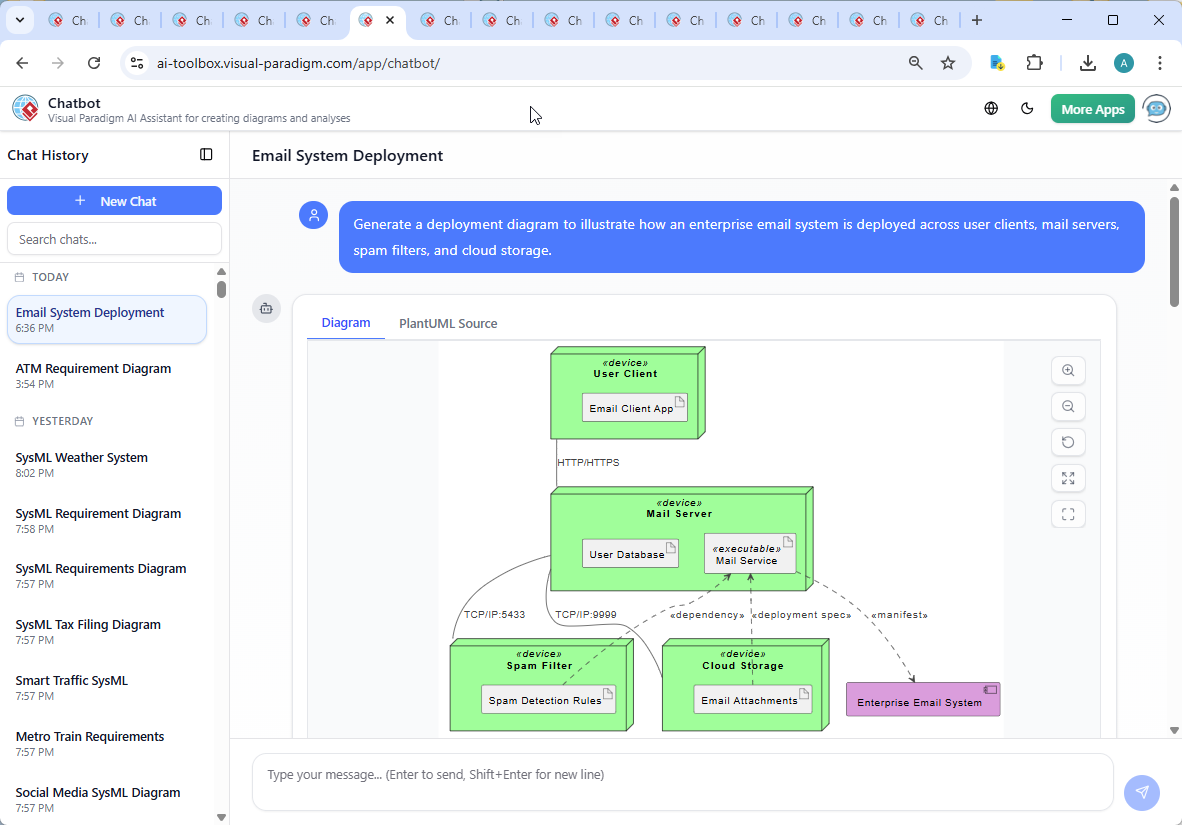
The process began with a simple request: “Generate a deployment diagram to illustrate how an enterprise email system is deployed across user clients, mail servers, spam filters, and cloud storage.”
Within seconds, the AI Chatbot delivered a fully formed PlantUML script, complete with proper node and component notation. But the real value emerged in the conversation that followed.
When the user asked, “Can you explain how the Spam Detection Rules artifact interacts with the Mail Service to filter incoming emails?”, the AI didn’t default to a generic response. Instead, it broke down the interaction into a structured, real-world workflow:
- How emails are parsed upon arrival
- How rules are triggered based on content, sender, and behavior
- How spam scores are calculated and used to determine delivery
- How the system adapts over time using user feedback and machine learning
This wasn’t just documentation—it was a deep technical explanation that informed the diagram’s structure. The AI didn’t just answer the question; it enhanced the model by validating the logic behind the artifact dependencies.
Later, the user requested a sequence diagram to visualize the flow. The AI responded with a detailed plan, showing how the AI Chatbot acts as a continuous design partner—refining, clarifying, and extending the model based on user needs.
Decoding the Deployment Diagram Logic
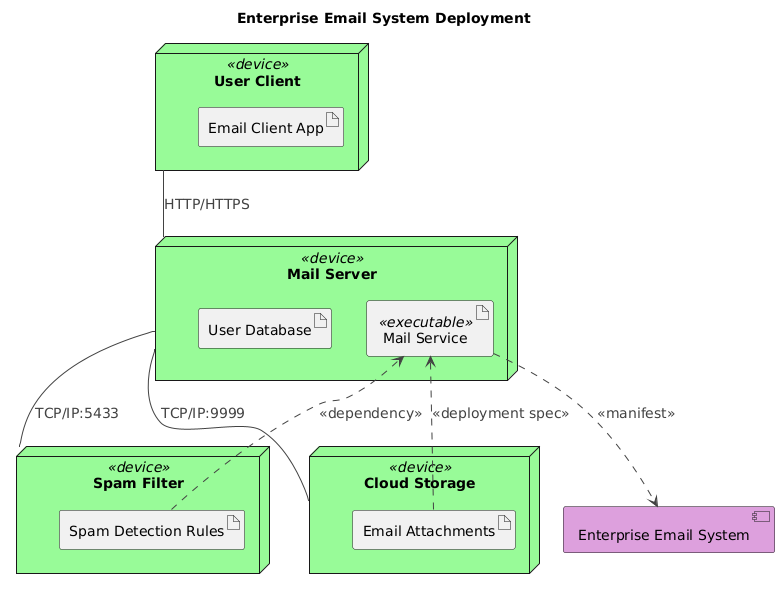
The final deployment diagram reflects a production-grade architecture, with each element carefully placed to represent real-world deployment constraints and interactions:
- User Client (Device): Represents end-user devices (laptops, mobiles) running email client apps (e.g., Outlook, Gmail app).
- Mail Server (Device): Hosts the core mail service and user database. It handles email receipt, storage, and routing.
- Spam Filter (Device): A dedicated system that analyzes incoming emails before they reach the inbox. It operates as a middleware layer.
- Cloud Storage (Device): Offloads large attachments to scalable cloud infrastructure, reducing server load.
The connections between these components reflect actual network protocols:
- HTTP/HTTPS between user clients and mail servers (secure email access)
- TCP/IP:5433 between mail server and spam filter (internal communication for filtering)
- TCP/IP:9999 between mail server and cloud storage (secure attachment upload/download)
Artifacts are used to represent logical components:
- Spam Detection Rules are shown as an artifact dependent on the Mail Service—indicating they are loaded and executed at runtime.
- Attachments are deployed via the cloud storage, with a deployment specification pointing to the storage system.
- Mail Service is declared as a component manifest, emphasizing it’s the central service that integrates all other elements.
These choices aren’t arbitrary. The AI selected PlantUML syntax that aligns with UML standards, ensuring the diagram is both visually intuitive and technically valid.
Conversational Intelligence in Action
What makes this process exceptional is the AI’s ability to evolve the model through conversation. The user’s follow-up questions didn’t interrupt the flow—they enriched it. Each clarification led to a deeper layer of insight:
- “Explain this branch” → led to a detailed breakdown of spam filtering logic
- “Refine the logic” → prompted the AI to strengthen the dependency between rules and mail service
- “Show the sequence” → triggered the suggestion of a complementary sequence diagram
This isn’t a chatbot that answers questions—it’s a modeling consultant that learns from context, anticipates needs, and improves the design iteratively.
More Than Deployment: A Full Modeling Suite
While this example focuses on a Deployment Diagram, the Visual Paradigm AI Chatbot is not limited to one standard. It supports a full spectrum of modeling languages, including:
- UML: For software architecture, use cases, and class designs
- ArchiMate: For enterprise architecture, business process modeling, and IT governance
- SysML: For systems engineering, requirements modeling, and behavior analysis
- C4 Model: For software architecture visualization at multiple abstraction levels
- Mind Maps, PERT Charts, Org Charts, SWOT, PEST, and Data Charts: For strategic planning, project management, and business analysis
This versatility means that whether you’re designing a microservices architecture, mapping a digital transformation roadmap, or visualizing a business strategy, the AI Chatbot serves as a unified, intelligent design partner.
Conclusion: Design with Intelligence, Not Just Tools
Creating a deployment diagram for an enterprise email system is more than drawing boxes and lines. It’s about modeling real-world interactions, ensuring security, scalability, and maintainability.
Visual Paradigm’s AI Chatbot transforms this process into a collaborative dialogue—where every question leads to a more accurate, insightful, and production-ready model. It’s not just a tool; it’s a modeling expert that understands your domain, anticipates your needs, and evolves with your vision.
Ready to design your next system with AI-powered precision? Try the shared session and experience the future of visual modeling.