


Designing Scalable Gaming Infrastructure with AI-Powered Precision
Building a robust online gaming platform demands more than just code—it requires a clear, scalable infrastructure that supports real-time interactions, consistent game states, and seamless player experiences. The challenge lies in visualizing complex systems where player clients, game servers, matchmaking engines, and data services must communicate efficiently and reliably.
Enter the Visual Paradigm AI Chatbot, not just a diagram generator but a collaborative modeling partner. It transforms high-level ideas into precise, standardized deployment models through natural conversation—making it easier to design, refine, and validate system architecture in real time.
From Concept to Diagram: A Collaborative Design Journey
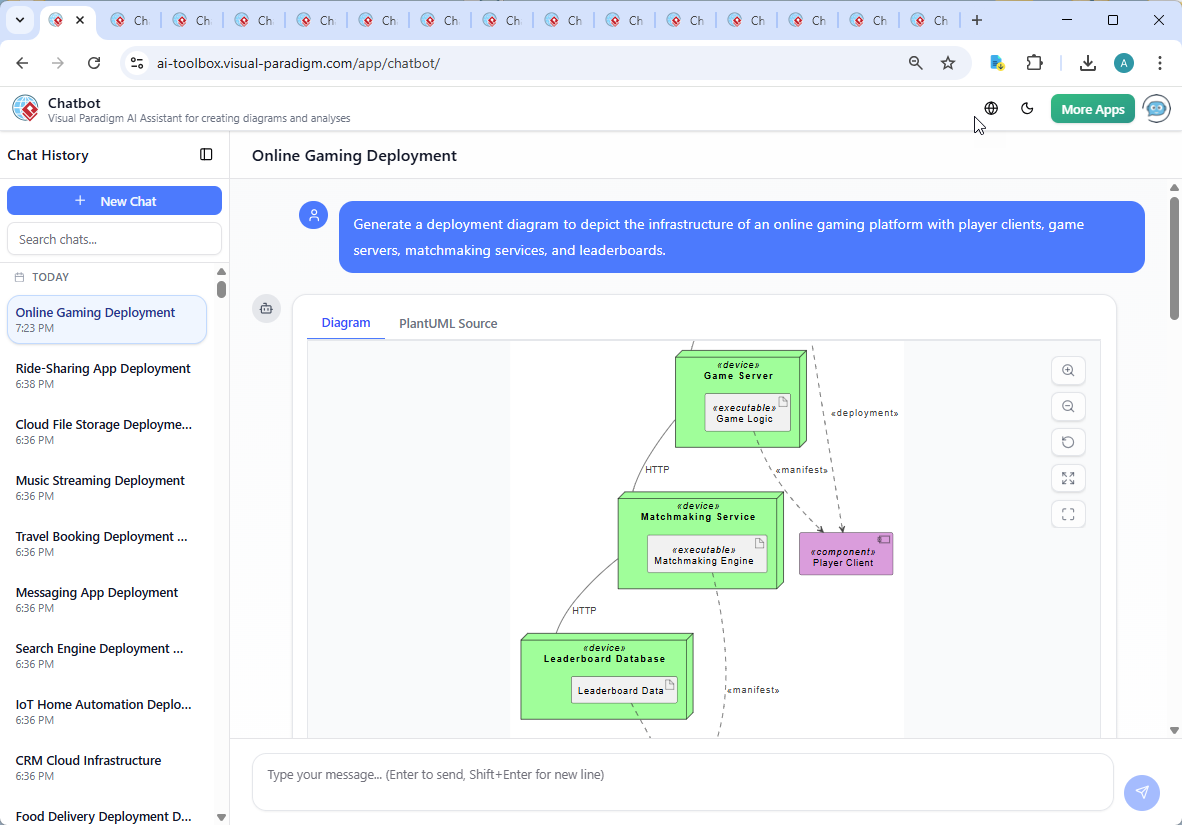
The journey began with a simple prompt: “Generate a deployment diagram to depict the infrastructure of an online gaming platform with player clients, game servers, matchmaking services, and leaderboards.”
Within seconds, the AI Chatbot delivered a fully rendered PlantUML script, automatically translated into a clean, standardized Deployment Diagram. The output wasn’t just a static image—it was a living model, structured with proper node and component semantics, and annotated with clear communication paths.
But the real value emerged in the conversation. When asked, “Can you explain how the Game Logic artifact on the Game Server interacts with the Player Client during gameplay?”, the AI didn’t default to a generic answer. Instead, it clarified the scope of the deployment diagram—highlighting that interaction details belong in sequence or activity diagrams—then provided a detailed, real-world explanation of the data flow between components.
It didn’t stop there. The AI offered a structured breakdown of the gameplay loop: player input → server validation → state update → broadcast → client rendering—complete with a table summarizing roles. This level of insight turned the chat into a design review session, where the AI acted as a senior architect, guiding the user through system behavior.
Further refinements followed naturally. The user requested clarification on a specific branch of the diagram, prompting the AI to re-explain the communication protocol between the matchmaking service and the leaderboard database. Each follow-up wasn’t just an answer—it was a deeper layer of architectural validation.
Decoding the Deployment Diagram Logic
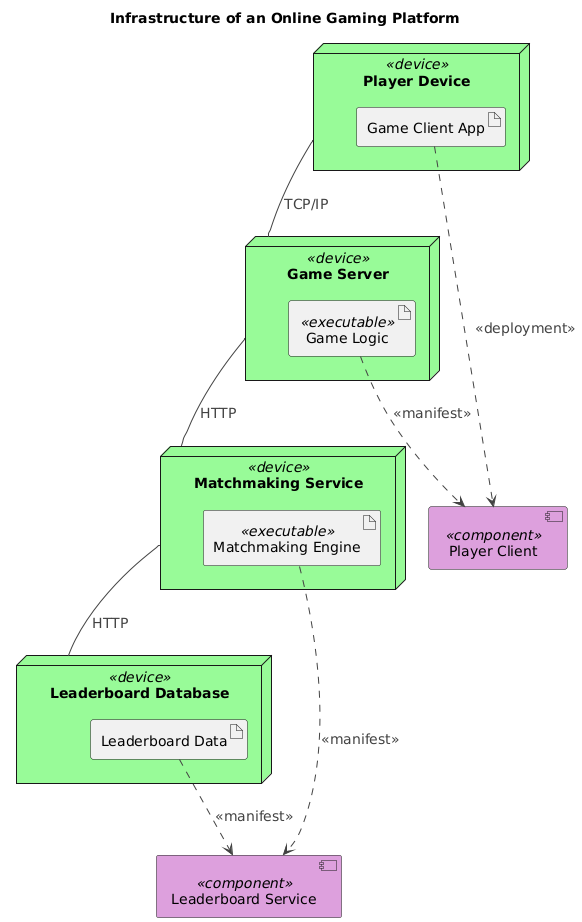
The final deployment model reflects a well-structured, production-ready infrastructure. Let’s break down the key elements:
Nodes: Physical and Logical Hosting Environments
- Player Device: Represents the client-side hardware (mobile, PC, console). It hosts the Game Client App as an artifact, which communicates via TCP/IP with the Game Server.
- Game Server: A dedicated node hosting the Game Logic executable. This is the core of the game state engine, responsible for rule enforcement and synchronization.
- Matchmaking Service: A separate node running the Matchmaking Engine, which uses HTTP to coordinate player pairings.
- Leaderboard Database: A persistent data store hosting Leaderboard Data, accessed via HTTP by the matchmaking service to update rankings.
Communication Paths: Protocol-Driven Interactions
- TCP/IP between Player Device and Game Server: Ensures reliable, ordered transmission of game actions—critical for real-time gameplay.
- HTTP between Game Server and Matchmaking Service: Used for lightweight, stateless coordination of player sessions.
- HTTP between Matchmaking Service and Leaderboard Database: Enables secure, scalable updates to player rankings after matches.
Deployment Relationships: Artifacts and Components
- Game Logic artifact ..> Player Client component: Indicates that the game logic is deployed and executed within the client context, though not owned by it.
- Matchmaking Engine artifact ..> Leaderboard Service component: Shows the service dependency for ranking updates.
- Game Client App artifact ..> Player Client component: Confirms deployment of the client app to the player’s device.
- Leaderboard Data artifact ..> Leaderboard Service component: Reflects data persistence and service integration.
This notation follows UML Deployment Diagram standards, ensuring clarity, consistency, and interoperability with enterprise modeling practices.
Conversational Intelligence in Action
What sets Visual Paradigm apart isn’t just the diagram output—it’s the depth of understanding the AI brings to the conversation. The chat history proves the AI doesn’t just generate visuals; it interprets intent, clarifies scope, and delivers expert-level insight.
When the user asked for a deeper explanation of the Game Logic interaction, the AI didn’t just restate the diagram—it contextualized it, explaining why the game state must be server-controlled, how network protocols ensure consistency, and why client-side logic alone would lead to cheating or desynchronization.
These exchanges reflect the AI Chatbot’s role as a modeling consultant—proactive, precise, and always aligned with architectural best practices.
Beyond Deployment: A Full-Spectrum Modeling Platform
While this example focused on a Deployment Diagram, the Visual Paradigm AI Chatbot is not limited to one standard. It seamlessly supports a full suite of modeling languages:
- UML: For class, sequence, state, and activity diagrams.
- ArchiMate: For enterprise architecture modeling, including business, application, and technology layers.
- SysML: For systems engineering, including requirements, parametric, and internal block diagrams.
- C4 Model: For software architecture, with Context, Containers, Components, and Code views.
- SWOT, PEST, Org Charts, Mind Maps, PERT Charts: For strategic planning and organizational modeling.
Whether you’re designing a cloud-native gaming platform, mapping enterprise workflows, or visualizing a product roadmap, the AI Chatbot adapts to your needs—delivering accurate, context-aware diagrams in seconds.
Conclusion: Build Smarter, Faster, Together
Designing complex systems like an online gaming platform no longer requires weeks of manual modeling or deep technical expertise. With the Visual Paradigm AI Chatbot, you get a collaborative environment where ideas become precise models through natural conversation.
From the initial prompt to the final diagram, every step was guided by intelligence, clarity, and architectural rigor. The result? A deployment diagram that’s not just visually appealing—but functionally sound and ready for implementation.
Ready to design your next system with AI-powered precision? Try the AI Chatbot now and see how it transforms your design process.