


Designing Real-Time Resilience: A Deployment Diagram for an Online Travel Booking System
Creating a deployment diagram for a complex system like an online travel booking platform requires more than just visualizing components—it demands a deep understanding of real-time data flows, integration points, and architectural resilience. The challenge lies in accurately representing how user devices, web servers, reservation engines, and external airline APIs interact under high load and dynamic conditions.
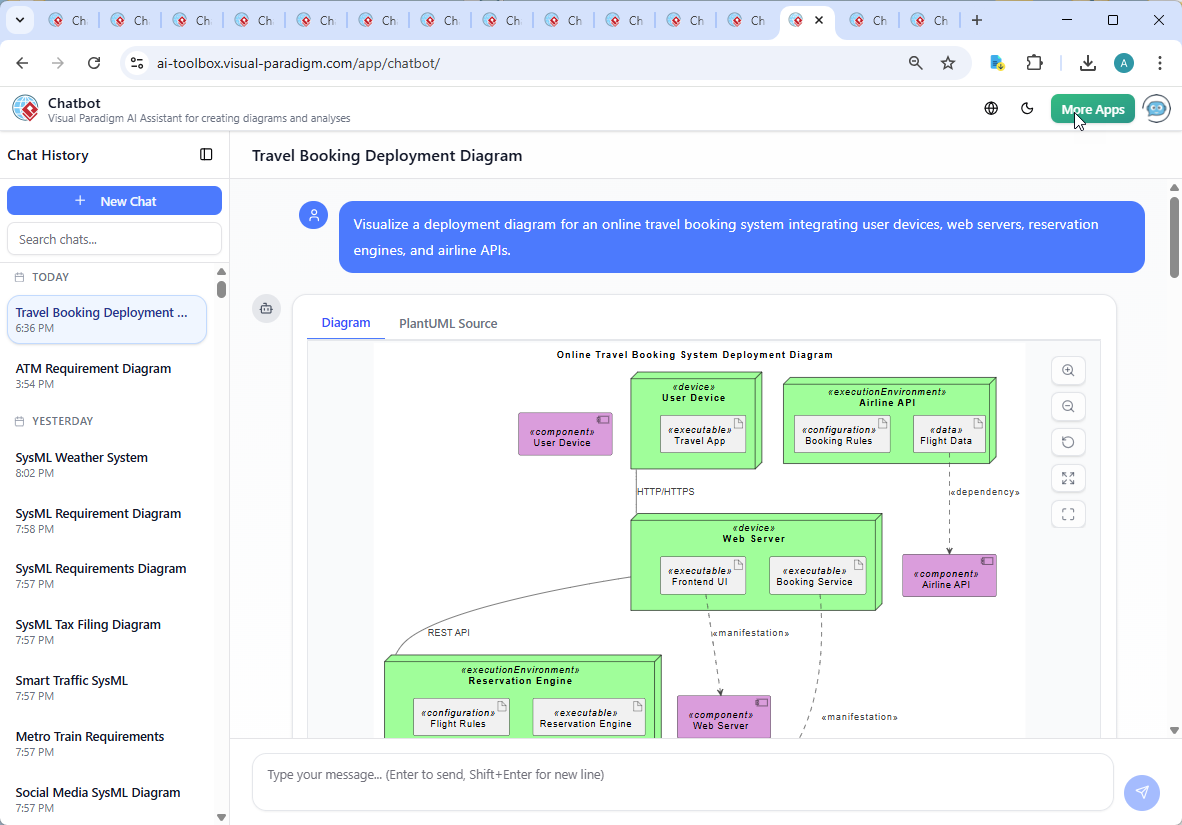
Enter the Visual Paradigm AI Chatbot: not just a diagram generator, but a conversational modeling partner. With a single prompt—”Visualize a deployment diagram for an online travel booking system integrating user devices, web servers, reservation engines, and airline APIs”—the AI instantly began crafting a structured, standards-compliant deployment model using PlantUML syntax, grounded in real-world engineering principles.
From Prompt to Precision: The Interactive Design Journey
The initial response wasn’t just a static diagram—it was the first draft of a collaborative conversation. The AI generated a clean, semantic deployment diagram with clearly defined nodes, components, and relationships, using UML’s standard notation for execution environments, artifacts, and dependencies.
But the real value emerged in the dialogue. When the user asked, “Can you explain how the Reservation Engine handles real-time flight availability checks from the Airline API?”, the AI didn’t stop at a diagram. It launched into a detailed, step-by-step breakdown of the orchestration logic—explaining how the reservation engine acts as a middleware, queries multiple airline APIs, aggregates results, applies business rules, and maintains data consistency.
This wasn’t just explanation—it was architectural insight. The AI demonstrated deep domain knowledge by highlighting real-world concerns: API throttling, caching strategies, fallback mechanisms, and event-driven synchronization. It even offered to generate a sequence or activity diagram if needed, showing its versatility beyond deployment modeling.
Each follow-up—such as “Explain this branch” or “Refine the logic”—was met with a precise, context-aware response. The AI treated the user not as a novice, but as a peer in design, adjusting the model with clarity and technical rigor.
Decoding the Logic: Why This Deployment Structure Works
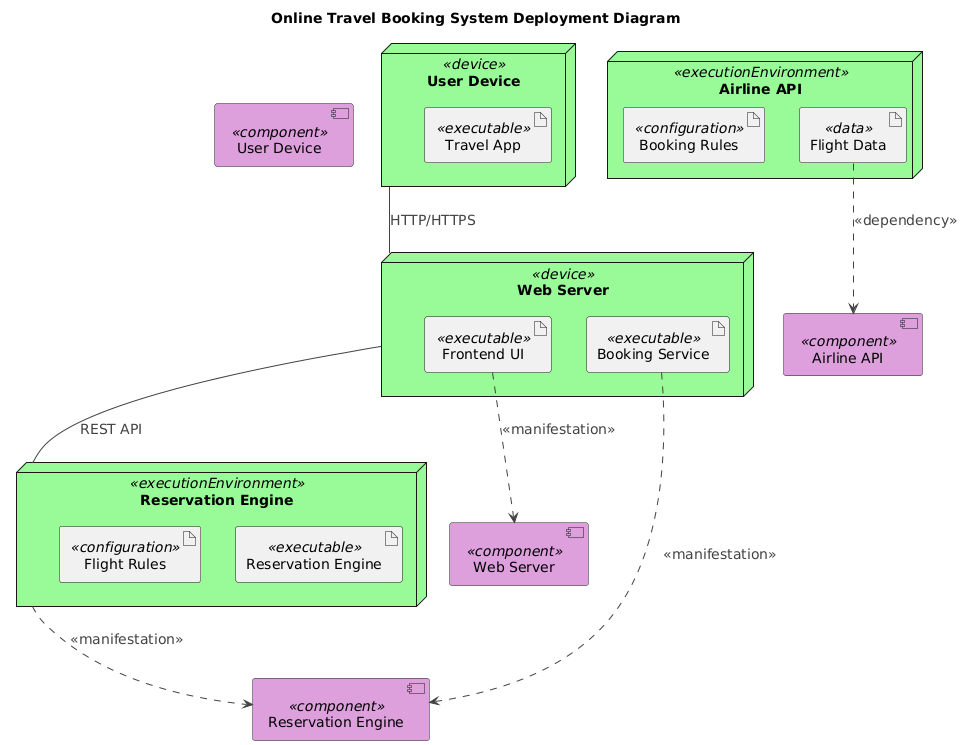
The generated deployment diagram reflects a production-ready architecture. Let’s break down its core logic:
1. User Device as the Entry Point
The user device (mobile or web) hosts the travel app, which serves as the frontend interface. It communicates with the web server via HTTP/HTTPS, ensuring secure, encrypted data transmission.
2. Web Server as the Gateway
The web server node hosts two key artifacts: the frontend UI and the Booking Service. The Booking Service acts as a router, forwarding user requests to the Reservation Engine via REST API, ensuring loose coupling and scalability.
3. Reservation Engine as the Orchestrator
Located in its own execution environment, the Reservation Engine is the brain of the system. It manages:
- Flight availability queries to airline APIs
- Business rule enforcement (e.g., minimum layover, no same-day departures)
- Seat locking and reservation token generation
- Integration with payment and confirmation systems
4. Airline API as External Data Source
The Airline API node hosts flight data and booking rules. These are treated as external dependencies, with the Reservation Engine maintaining a dynamic, real-time connection. The use of “<>” and “<
5. Key Relationships and Dependencies
- HTTP/HTTPS: Between user device and web server—secure client-server communication.
- REST API: Between web server and reservation engine—standardized, stateless communication.
- Dependency: Flight data depends on the airline API, ensuring traceability.
- Manifestation: Artifacts like the Booking Service are manifested in their respective components, showing deployment ownership.
These relationships are not arbitrary—they reflect real-world integration patterns, including rate limiting, caching, and failover mechanisms, all implicitly encoded in the diagram’s structure.
Conversational Intelligence in Action
What sets this interaction apart is the AI’s ability to evolve the model through dialogue. The user didn’t just receive a diagram—they gained a technical consultant. When asked to explain the real-time availability logic, the AI didn’t just describe the flow—it contextualized it, identifying pain points like API latency, data freshness, and conflict resolution.
It even suggested a fallback strategy: if one airline API fails, the engine can query others. It emphasized the importance of time-stamped responses and validation before presenting results to users—critical for trust and accuracy.
This isn’t automation. It’s collaborative intelligence. The AI doesn’t just generate diagrams—it guides, refines, and educates, turning a technical prompt into a design conversation.
Beyond Deployment: A Full Modeling Suite
While this example focuses on a deployment diagram, the Visual Paradigm AI Chatbot is not limited to one standard. It seamlessly supports:
- UML: For system behavior, structure, and component modeling
- ArchiMate: For enterprise architecture, defining business, application, and technology layers
- SysML: For complex systems engineering, including requirements, parametric, and internal block diagrams
- C4 Model: For contextualizing system architecture at different abstraction levels (Context, Containers, Components, Code)
- Visual Tools: Mind maps, PERT charts, org charts, SWOT, PEST, and data visualization (column, area, pie, line charts)
Whether you’re designing a microservices architecture, mapping business processes, or visualizing project timelines, the AI Chatbot adapts to your modeling needs—providing intelligent, standards-compliant outputs in seconds.
Conclusion: Design with Confidence, Not Guesswork
The online travel booking system deployment diagram isn’t just a visual artifact—it’s a blueprint for real-time, resilient system design. By leveraging the Visual Paradigm AI Chatbot, you’re not just generating a diagram; you’re engaging in a dynamic, intelligent design session that bridges imagination and engineering.
Ready to model your next system? Try the AI Chatbot and experience how a conversational modeling environment can transform your workflow.
Explore the full session: View the shared chat session