


Designing a High-Performance Search Engine: How AI Powers the Deployment Diagram
Building a scalable, low-latency search engine demands more than just code—it requires a clear architectural vision. The challenge lies in visualizing how components like user browsers, indexing services, query processors, and distributed data centers interact under real-world load. This is where the Visual Paradigm AI Chatbot transforms abstract ideas into precise, production-ready diagrams—through natural conversation.
From Idea to Diagram: A Collaborative Design Journey
The journey began with a simple prompt: “Generate a deployment diagram to visualize the deployment of a search engine with user browsers, indexing services, query processors, and data centers.” Within seconds, the AI Chatbot responded with a fully rendered PlantUML script, generating a clean, standards-compliant deployment diagram.
But the conversation didn’t stop there. The user asked: “Can you explain how the Query Processor interacts with the Cache Layer in the data center to improve search response times?” Instead of a static explanation, the AI delivered a detailed technical breakdown—complete with performance metrics, failure modes, and real-world scenarios—demonstrating its role as a modeling consultant, not just a diagram generator.
Each follow-up request was treated as a design refinement. When the user requested clarification on the interaction logic, the AI didn’t just restate the diagram—it explained the why behind the architecture: why cache hits reduce latency, how TTL policies prevent stale data, and how the system balances speed with consistency.
Visualizing the Search Engine Deployment
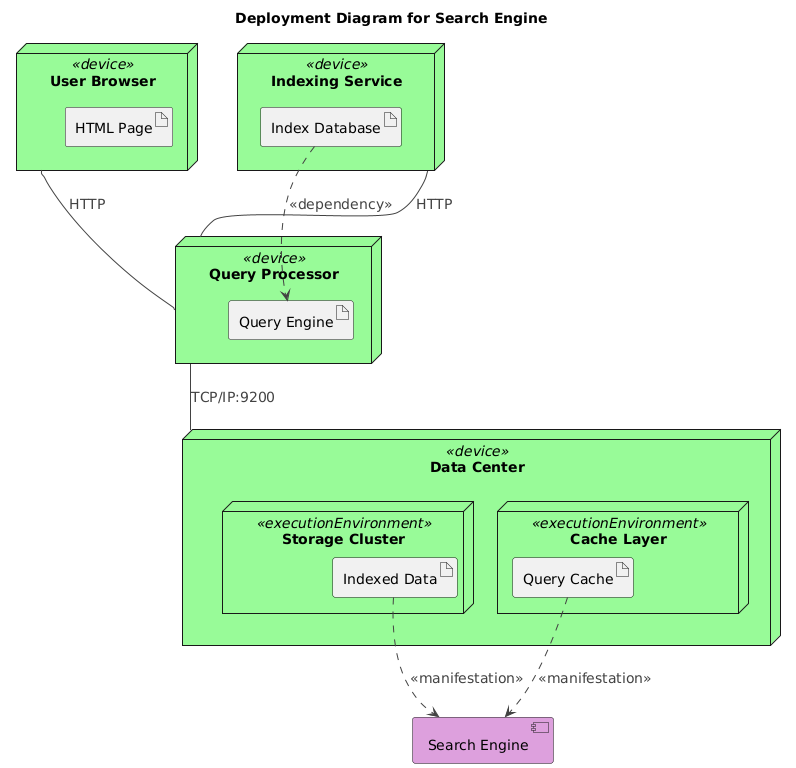
The final deployment diagram captures a modern search engine’s layered architecture:
- User Browser (as a
device) sends HTTP requests to the Query Processor. - The Query Processor first checks the Cache Layer (in-memory or SSD-backed) for a pre-computed result.
- If no match is found, it queries the Indexing Service and the Data Center’s Storage Cluster via TCP/IP (port 9200).
- Results are returned to the user, while the system updates the cache for future requests.
Decoding the Logic: Why This Architecture Works
Every element in the diagram is purpose-built:
- Node elements represent physical or logical execution environments (e.g.,
datacenter_device,storagecluster_executionenvironment). - Component and artifact elements define software modules and data stores, such as
Query EngineandIndexed Data. - Dependencies and manifestations clarify relationships: the
Query Enginedepends on theIndex Database, while theSearch Enginecomponent manifests from cached and indexed data. - The
HTTPandTCP/IP:9200labels specify communication protocols, ensuring clarity on data flow.
By using PlantUML syntax and UML deployment notation, the diagram aligns with industry standards while remaining intuitive. The AI didn’t just draw lines—it engineered a system where performance, scalability, and maintainability are baked into the design.
Conversational Intelligence: AI as Your Modeling Partner
What sets Visual Paradigm apart is the depth of insight the AI Chatbot provides during the design process. The follow-up request to explain the cache interaction wasn’t met with a generic answer—it triggered a detailed analysis of:
- Cache hit vs. miss behavior
- Impact on response time (from ~1.5s to ~200ms)
- Cache invalidation strategies (TTL, event-driven signals)
- Trade-offs between freshness and speed
This level of technical depth is only possible because the AI understands both the modeling language and the underlying system dynamics.
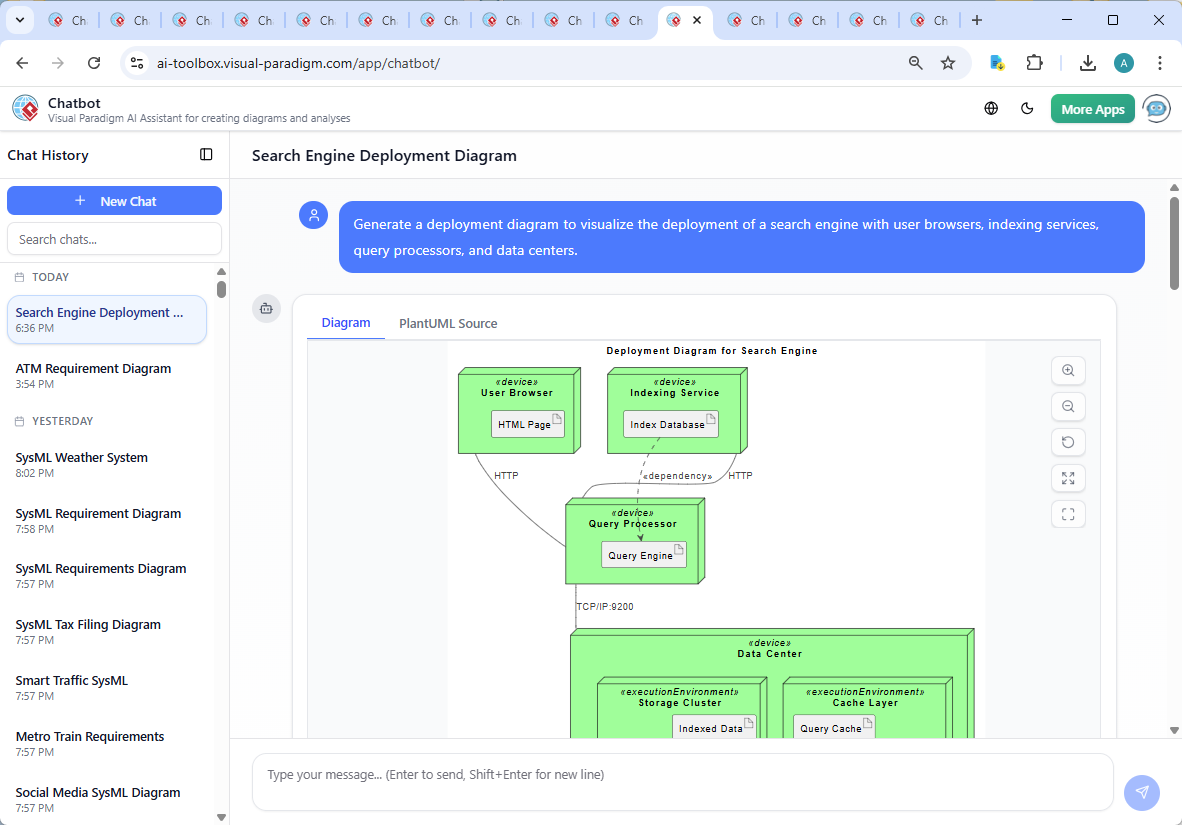
The chat interface shows the full dialogue—proof that the AI is not a one-off generator, but a persistent, intelligent collaborator. You can refine, question, and iterate—just like working with a senior architect.
More Than Deployment: A Full Modeling Suite
While this example focuses on a Deployment Diagram, the Visual Paradigm AI Chatbot is built to support a full spectrum of modeling standards:
- UML (Class, Sequence, Use Case, Activity)
- ArchiMate (Enterprise Architecture modeling)
- SysML (Systems Engineering)
- C4 Model (Context, Containers, Components, Code)
- Plus: Mind Maps, Org Charts, SWOT, PEST, and data visualization charts (bar, pie, line, area)
Whether you’re designing a cloud-native microservice, mapping business processes, or visualizing a product roadmap, the AI Chatbot adapts to your needs—understanding context, suggesting improvements, and generating diagrams in seconds.
Conclusion: Build Faster, Think Smarter
The deployment of a search engine isn’t just about technology—it’s about architecture, performance, and user experience. With Visual Paradigm’s AI Chatbot, you don’t need to be a modeling expert to create professional-grade diagrams. The platform turns natural conversation into precise, standards-compliant designs—accelerating development, improving collaboration, and reducing errors.
Ready to build your next system with AI-powered clarity? Try the Visual Paradigm AI Chatbot and turn your ideas into visual reality—fast, smart, and precise.