


Designing a Scalable Music Streaming Architecture with AI-Powered Precision
Building a resilient music streaming application demands more than just coding—it requires a clear, scalable deployment architecture. The challenge lies in visualizing how mobile clients, streaming servers, recommendation systems, and cloud storage interact under real-world load, data flow, and performance constraints. With the Visual Paradigm AI Chatbot, this complexity becomes manageable through natural conversation.
From Idea to Diagram: A Collaborative Design Journey
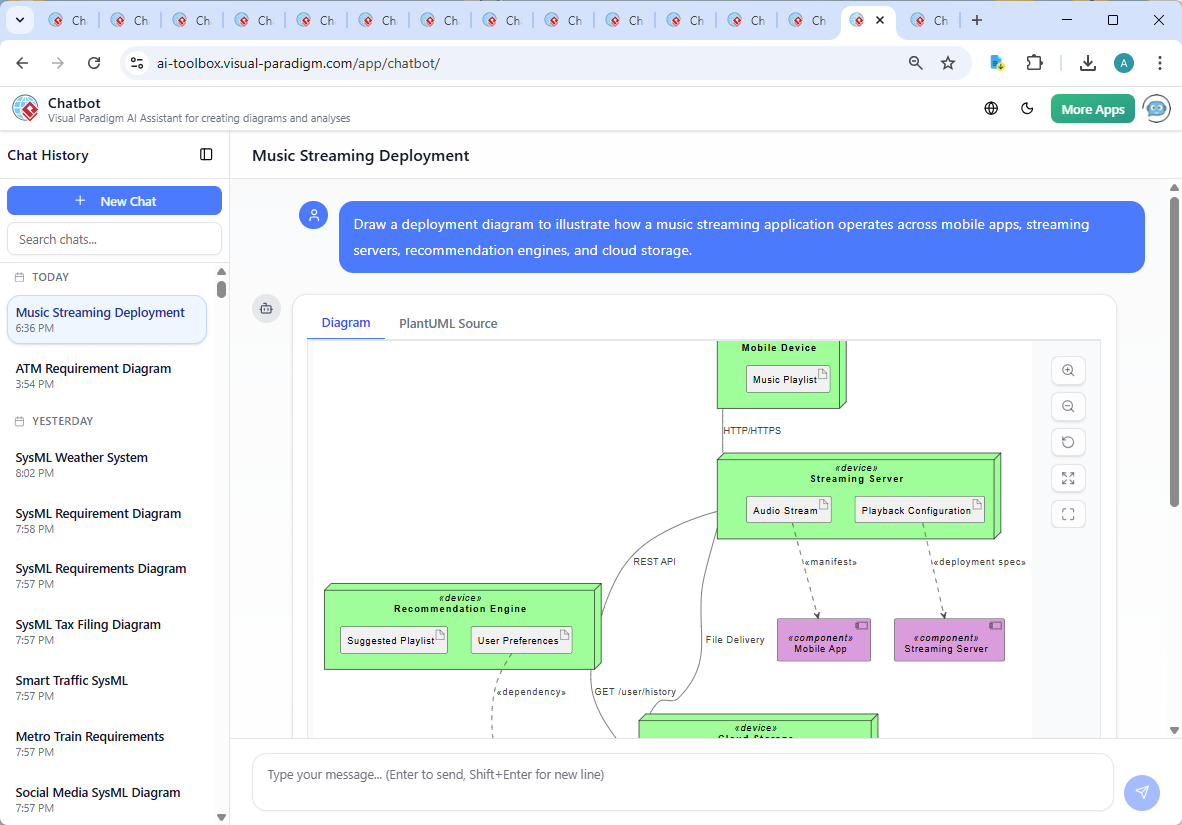
The journey began with a simple request: “Draw a deployment diagram to illustrate how a music streaming application operates across mobile apps, streaming servers, recommendation engines, and cloud storage.” Within seconds, the AI Chatbot delivered a fully rendered PlantUML-based deployment diagram, complete with nodes, components, artifacts, and communication links.
But the conversation didn’t stop there. The user asked, “AI, refine the logic—make sure the recommendation engine pulls user history from cloud storage.” The AI responded by updating the dependency path: recommendationengine_node -- cloudstorage_node : GET /user/history. This wasn’t just a visual tweak—it was a semantic correction ensuring data lineage and system responsibility were accurately represented.
Next, the user requested, “Explain this branch: why is the audio stream linked to the mobile app via <<manifest>>?” The AI clarified: “The <<manifest>> dependency shows that the streaming server delivers a manifest file (e.g., M3U8 or DASH) to the mobile app, which then uses it to request and play the actual audio stream. This is standard in adaptive streaming protocols.”
Each follow-up wasn’t a request for a new diagram—it was a refinement of the model’s intent, driven by real architectural insight. The AI didn’t just generate a diagram; it acted as a modeling consultant, validating assumptions and deepening the design’s technical fidelity.
Decoding the Deployment Logic: Why This Architecture Works
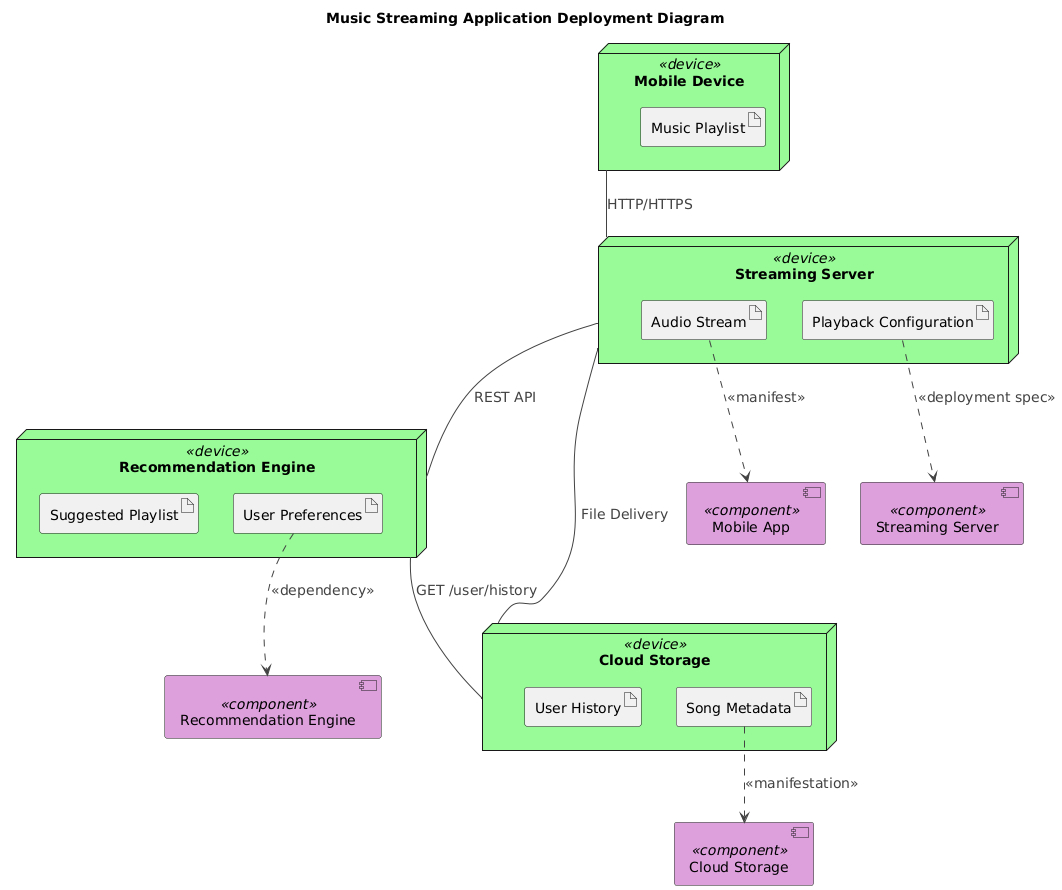
The resulting deployment diagram reflects a production-grade music streaming system. Let’s break down the core components and their relationships:
- Mobile Device Node: Represents end-user devices (iOS/Android). It hosts the Mobile App component and maintains a Music Playlist artifact—locally cached for offline access.
- Streaming Server Node: Hosts the core media delivery system. It serves the Audio Stream and Playback Configuration artifacts, enabling adaptive bitrate streaming and secure access.
- Recommendation Engine Node: A specialized service that analyzes user behavior. It depends on User Preferences and Suggested Playlist artifacts, pulling historical data from cloud storage to personalize content.
- Cloud Storage Node: Stores all persistent data—Song Metadata (title, artist, album) and User History (play counts, skips, likes)—enabling scalable access across services.
The communication links reflect real-world protocols:
mobiledevice_node -- streamingserver_node : HTTP/HTTPS: Secure transport for all client-server interactions.streamingserver_node -- recommendationengine_node : REST API: The streaming server notifies the recommendation engine about user playback events.recommendationengine_node -- cloudstorage_node : GET /user/history: The engine fetches user history to generate suggestions.cloudstorage_node -- streamingserver_node : File Delivery: On-demand delivery of audio files, often via CDN-optimized pathways.
The manifest and deployment spec dependencies (e.g., audiostream_artifact ..> mobileapp_component : <<manifest>>) ensure that the mobile app knows how to consume the stream—critical for compatibility and performance.
Conversational Intelligence in Action
What sets Visual Paradigm apart isn’t just the diagram output—it’s the ability to iterate through natural language. The AI Chatbot doesn’t wait for perfect input. It adapts.
When the user asked to “add a load balancer”, the AI didn’t just add a node—it contextualized it: “A load balancer should sit between the mobile app and the streaming server to distribute traffic. Let me update the diagram to include it as a component in the streaming server node.” The updated model now reflects a production-ready, high-availability setup.
And when the user questioned the placement of Playback Configuration, the AI explained: “This artifact represents device-specific settings (e.g., audio quality, subtitles). It’s deployed with the streaming server but consumed by the mobile app during initialization.”
These exchanges aren’t just helpful—they’re architecturally sound. The AI is trained on real-world software design patterns and understands the semantics behind each notation.
Beyond Deployment: A Unified AI Modeling Platform
While this example focuses on a Deployment Diagram, the Visual Paradigm AI Chatbot is built for versatility. It supports a full suite of modeling standards:
- UML: For class, sequence, and activity diagrams.
- ArchiMate: For enterprise architecture, mapping business, application, and technology layers.
- SysML: For systems engineering, including requirements, parametric, and internal block diagrams.
- C4 Model: For software architecture visualization, especially context, containers, components, and code.
- Other Diagrams: Mind maps, PERT charts, organizational charts, SWOT, PEST, and data visualizations (column, area, pie, line charts).
Whether you’re modeling a microservices architecture, a business process, or a strategic roadmap, the AI Chatbot adapts. It understands context, applies best practices, and ensures consistency across models.
Conclusion: Build Smarter, Faster, Together
Designing complex systems shouldn’t require deep expertise in diagramming tools. With Visual Paradigm’s AI Chatbot, you get a conversational modeling partner that turns ideas into precise, production-ready diagrams—no manual syntax, no learning curves.
Explore the full deployment diagram and experience the conversation for yourself at this shared session.
Start your next architecture project with confidence—powered by AI, guided by design.