


Designing a Scalable Retail POS System with Real-Time Inventory Sync
Deploying a retail point-of-sale (POS) system across multiple locations demands more than just hardware and software—it requires a clear, maintainable architecture that ensures real-time data consistency, security, and scalability. The challenge lies in modeling how in-store devices interact with centralized backend systems, especially when inventory levels must be synchronized instantly during transactions.
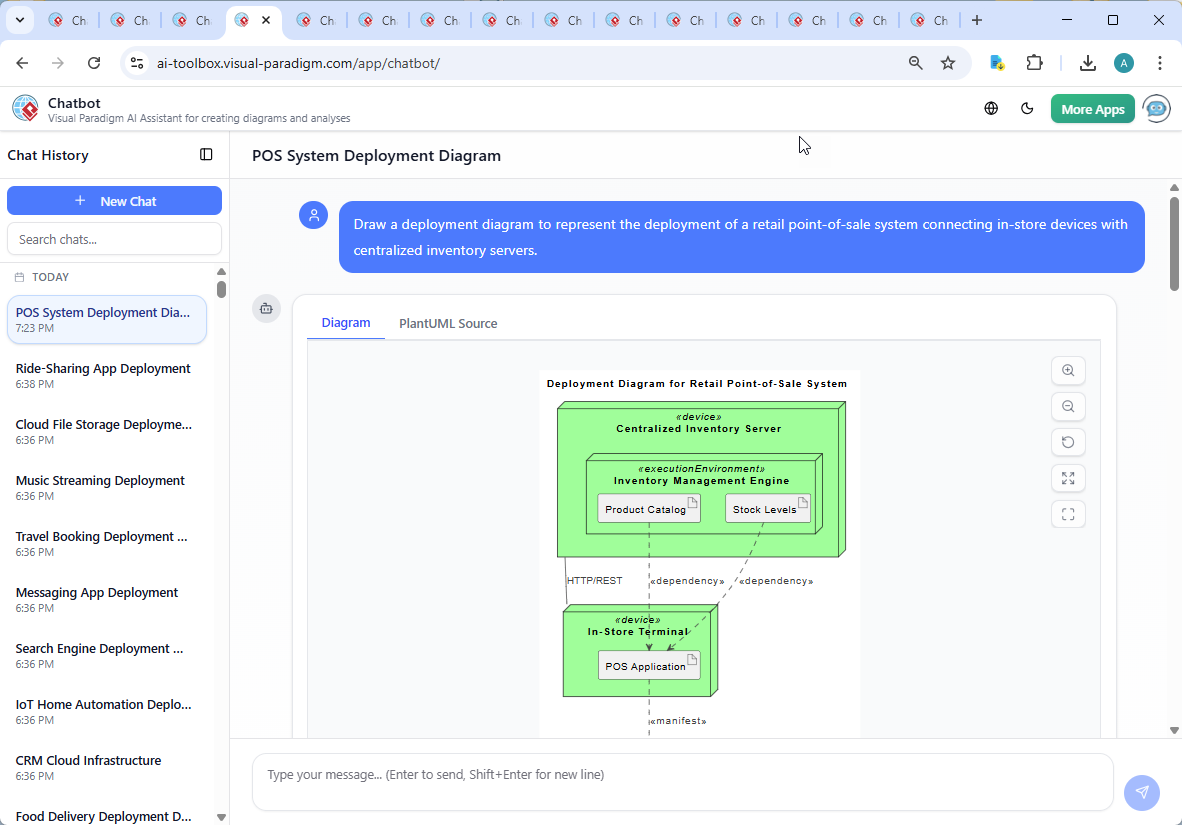
With Visual Paradigm’s AI Chatbot, this challenge transforms into a collaborative design journey. Instead of starting from scratch or wrestling with diagramming syntax, users can express their intent in natural language—like, “Draw a deployment diagram to represent the deployment of a retail point-of-sale system connecting in-store devices with centralized inventory servers”—and receive a fully rendered, standards-compliant diagram in seconds.
From Prompt to Precision: A Collaborative Modeling Journey
The process began with a simple request. The user described the desired system: in-store terminals interacting with a central inventory server. Within moments, the Visual Paradigm AI Chatbot generated a complete DeploymentDiagram using PlantUML syntax, complete with nodes, components, artifacts, and communication paths.
But the real value emerged in the conversation that followed. When the user asked, “Can you explain how the ‘Stock Levels’ artifact communicates with the POS Application during a transaction?”, the AI didn’t just restate the diagram—it provided a detailed, real-world narrative of the interaction flow, breaking down each step:
- POS application sends a real-time REST request to check stock availability.
- Centralized server responds with current stock data.
- System updates the UI and triggers a stock decrement upon sale confirmation.
This wasn’t a static diagram. It was a living model shaped by dialogue. The user then asked for refinements—”AI, refine the logic around error handling”—and the chatbot responded with enhanced details on timeout protocols, encryption (HTTPS), and caching strategies, demonstrating its deep understanding of deployment-level concerns.
Understanding the Deployment Diagram Logic
The diagram is built on core principles of deployment modeling, using UML’s standard notation to represent physical components and their interactions:
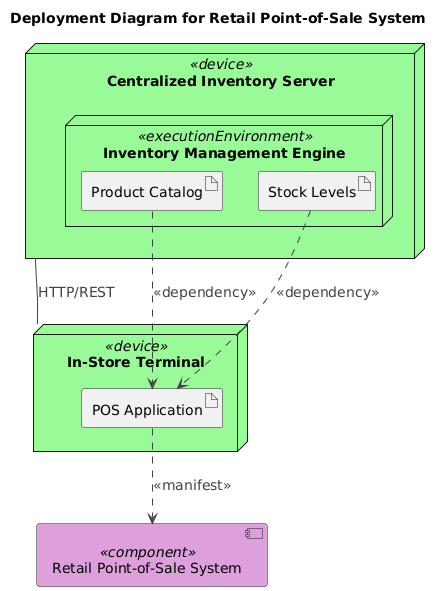
- Node: In-Store Terminal – Represents a physical device where the POS application runs. It hosts the POS Application artifact, which is responsible for transaction processing.
- Node: Centralized Inventory Server – A dedicated server hosting the inventory management engine and persistent data. This node contains two key artifacts: Product Catalog and Stock Levels.
- Communication Path – The
HTTP/RESTlink between the in-store terminal and the server ensures lightweight, scalable, and secure communication. - Dependency Arrows – The
..>notation shows that the POS Application depends on the Product Catalog and Stock Levels for data, but does not store them locally. - Manifest Relationship – The POS Application artifact is a component of the Retail Point-of-Sale System, indicating it is part of a larger software suite.
Why use this structure? Because it reflects real-world deployment patterns: decentralized front-ends (terminals), centralized data (inventory), and a clear separation of concerns. This design supports high availability, auditability, and scalability—critical for retail operations with hundreds of locations.
Conversational Intelligence: Where AI Meets Architectural Insight
What sets Visual Paradigm apart isn’t just diagram generation—it’s the depth of insight the AI Chatbot provides during the design process. Each follow-up question was treated as a modeling opportunity, not a technical query.
For example, when the user asked for clarification on the stock update mechanism, the AI didn’t just describe the flow—it explained the implications: real-time consistency prevents over-selling, HTTPS ensures data privacy, and caching reduces latency during peak hours.
This level of contextual understanding is powered by Visual Paradigm’s AI, trained on decades of modeling best practices across UML, ArchiMate, SysML, and C4 Model standards. The chatbot doesn’t just generate diagrams—it acts as a modeling consultant, guiding users through trade-offs, performance considerations, and architectural patterns.
More Than Just Deployment: A Unified Modeling Platform
The Visual Paradigm AI Chatbot isn’t limited to deployment diagrams. It supports a full suite of modeling standards, making it a complete solution for IT and enterprise architects:
- UML – For detailed system design, use case modeling, and class diagrams.
- ArchiMate – For enterprise architecture, modeling business, application, and technology layers.
- SysML – For complex system engineering, including requirements, behavior, and parametric modeling.
- C4 Model – For clear, scalable software architecture documentation using context, containers, components, and code.
- Visual Tools – Mind maps, PERT charts, org charts, SWOT, and data visualization (column, area, pie, line charts).
Whether you’re designing a cloud-native system, mapping business processes, or validating system behavior, the AI Chatbot adapts to your needs—offering suggestions, validating logic, and generating diagrams in seconds.
Conclusion: Build Smarter, Faster, with AI-Powered Modeling
Creating a deployment diagram for a retail POS system isn’t just about drawing boxes and lines. It’s about modeling real-world behavior, ensuring data consistency, and preparing for scale. With Visual Paradigm’s AI Chatbot, this process becomes intuitive, intelligent, and collaborative.
From the initial prompt to the final refinement, the AI didn’t just generate a diagram—it co-designed it with the user, offering architectural wisdom at every step. Whether you’re a developer, architect, or business analyst, this platform empowers you to think in models, speak in diagrams, and deliver faster, smarter solutions.
Ready to model your next system? Explore the live session and see how the AI Chatbot brings your ideas to life—crafted using the Visual Paradigm AI Chatbot, on an AI-powered visual modeling platform.