


Designing Scalable Video Streaming Infrastructure with AI-Powered Precision
Building a robust video streaming service demands more than just servers and storage—it requires a strategic infrastructure that handles high traffic, variable network conditions, and diverse client devices. The challenge lies in visualizing how components like smart TVs, content delivery networks (CDNs), streaming servers, and media storage interact seamlessly. This is where the Visual Paradigm AI Chatbot becomes an indispensable collaborator—transforming abstract ideas into a fully detailed, accurate deployment diagram through natural conversation.
From Idea to Diagram: A Collaborative Design Journey
The process began with a simple prompt: “Draw a deployment diagram to represent the infrastructure of a video streaming service with smart TVs, content delivery networks, streaming servers, and media storage.” The AI Chatbot immediately responded with a fully structured PlantUML code, generating a clean, standardized deployment diagram. But this wasn’t just a diagram—it was the first step in a dynamic dialogue.
Recognizing the complexity of video streaming, the user asked for deeper insight: “Can you explain how the Stream Processor on the Streaming Server handles video encoding and adaptive bitrate streaming?” The AI didn’t just provide a definition—it delivered a layered technical breakdown, clarifying how the stream processor acts as the intelligence hub that encodes raw video into multiple bitrates and resolutions, then packages them using standards like HLS or DASH.
Each follow-up question—like refining the logic of cache behavior or clarifying dependency relationships—was met with precise, context-aware responses. The AI didn’t just generate a diagram; it explained the why behind each node, artifact, and connection, ensuring the model wasn’t just visually accurate but architecturally sound.
Visualizing the Infrastructure: The Final Deployment Diagram
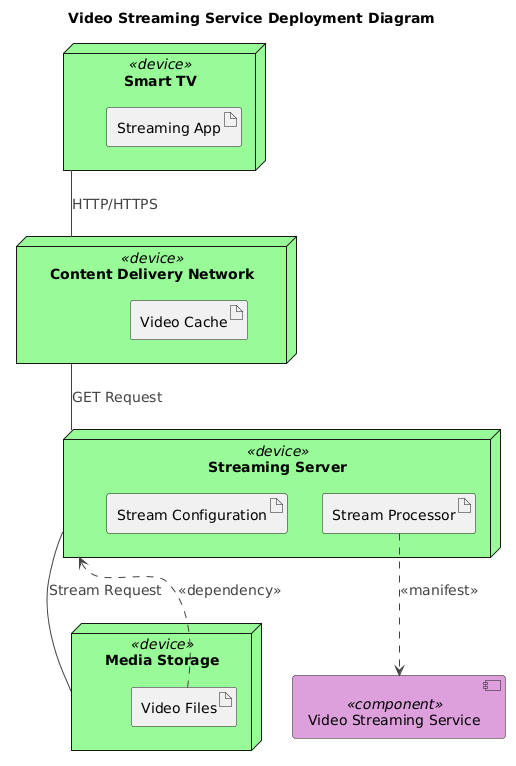
The final deployment diagram reflects a modern, scalable streaming architecture. At its core:
- Smart TV serves as the end-user device, running a streaming app that communicates with the CDN via HTTP/HTTPS.
- The Content Delivery Network (CDN) caches video segments to reduce latency and improve load times across geographies.
- The Streaming Server hosts the Stream Processor, which handles encoding and adaptive bitrate generation.
- Media Storage holds the original high-resolution video files, accessed only when new content is ingested.
Decoding the Logic: Why This Structure Works
Every element in the diagram follows established deployment modeling conventions:
- Nodes represent physical or logical hardware (e.g., smart TVs, servers, storage).
- Components are deployable software units—here, the Video Streaming Service as a logical container.
- Artifacts represent files or data units, such as Video Files or Stream Configuration.
- Dependencies and communications are shown using clear, semantic arrows:
- Smart TV → CDN: HTTP/HTTPS for request/response.
- CDN → Streaming Server: GET requests for video segments.
- Streaming Server → Media Storage: Stream request to retrieve source video.
- Stream Processor → Video Streaming Service: <
> dependency, indicating it provides the streaming manifest. - Video Files → Streaming Server: <
> to show source data access.
This structure enables scalability, fault tolerance, and performance optimization—key for services supporting millions of concurrent viewers.
Conversational Intelligence in Action
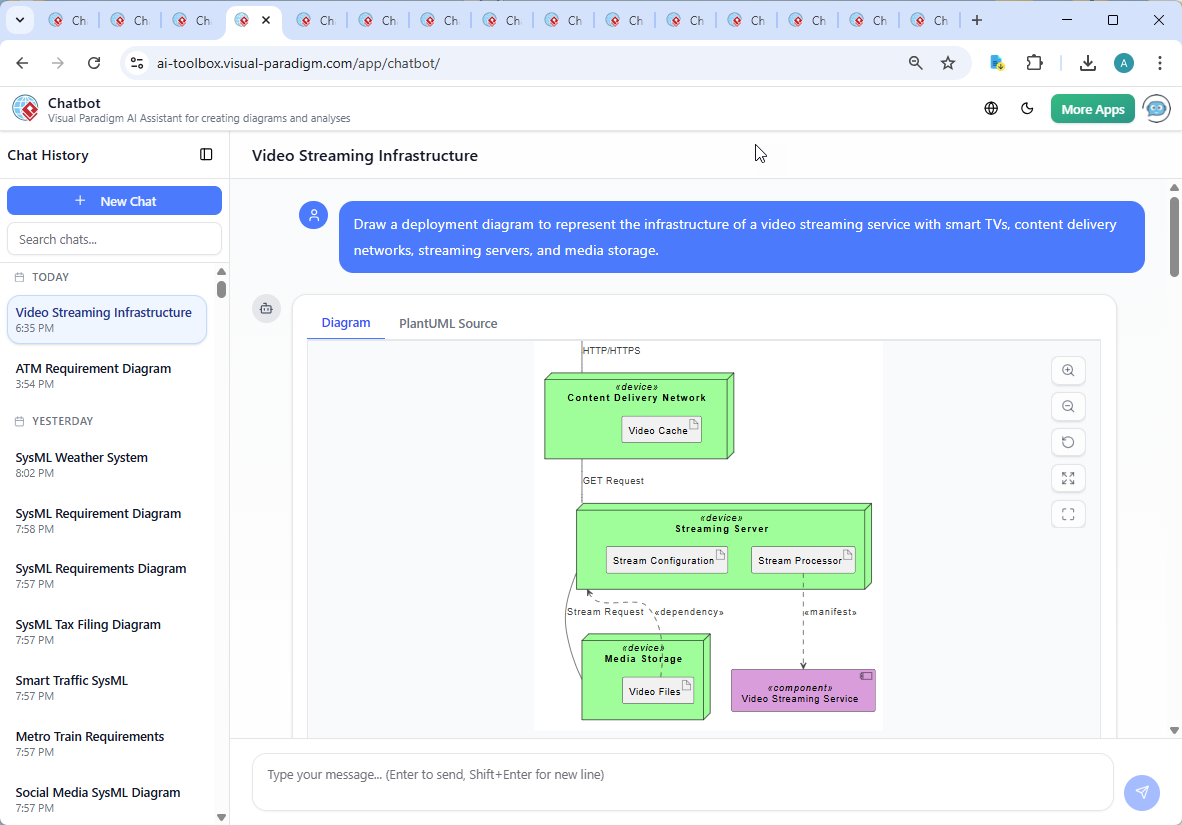
What sets Visual Paradigm apart is not just the diagram output, but the interactive intelligence behind it. The chat history reveals a true design partnership:
- After the initial diagram, the user requested clarification on the Stream Processor’s role.
- The AI responded with a detailed explanation of video encoding, adaptive bitrate streaming, and the technical workflow.
- Follow-up questions like “Explain this branch” or “Refine the logic” were handled with precision—showing the AI isn’t just a generator but a modeling expert.
This level of responsiveness turns the AI Chatbot into a collaborative modeling consultant, capable of guiding users through complex technical decisions in real time.
More Than Just Deployment: A Full Modeling Suite
While this example focused on a Deployment Diagram, the Visual Paradigm AI Chatbot is built to support a full range of modeling standards:
- UML: For software design and system behavior.
- ArchiMate: For enterprise architecture and business-IT alignment.
- SysML: For systems engineering and complex requirements modeling.
- C4 Model: For software architecture at multiple abstraction levels.
- SWOT, PEST, Org Charts, Mind Maps, PERT, and Charts: For strategic planning and data visualization.
Whether you’re designing a cloud-native system, mapping enterprise workflows, or visualizing market trends, the AI Chatbot adapts to your needs—making Visual Paradigm a true AI-powered visual modeling platform.
Conclusion: Build Smarter, Faster, Together
Creating a deployment diagram for a video streaming service isn’t just about drawing boxes and lines—it’s about understanding how systems interact under real-world constraints. With Visual Paradigm’s AI Chatbot, you’re not just generating diagrams; you’re engaging in a technical conversation that elevates your design from concept to production-ready model.
Experience the future of visual modeling. Explore the full interactive session and see how the AI Chatbot transforms your ideas into precise, intelligent models—crafted using the Visual Paradigm AI Chatbot.