


Designing an Airline Reservation System with AI-Powered Precision
Creating a clear, accurate, and actionable architecture for a complex system like an airline reservation platform demands more than diagramming tools—it requires intelligent collaboration. The challenge lies in mapping interdependencies between booking, ticketing, payment, and operational systems while ensuring data integrity and user experience. This is where the Visual Paradigm AI Chatbot steps in not just as a generator, but as a modeling partner.
From Prompt to Architecture: A Collaborative Design Journey
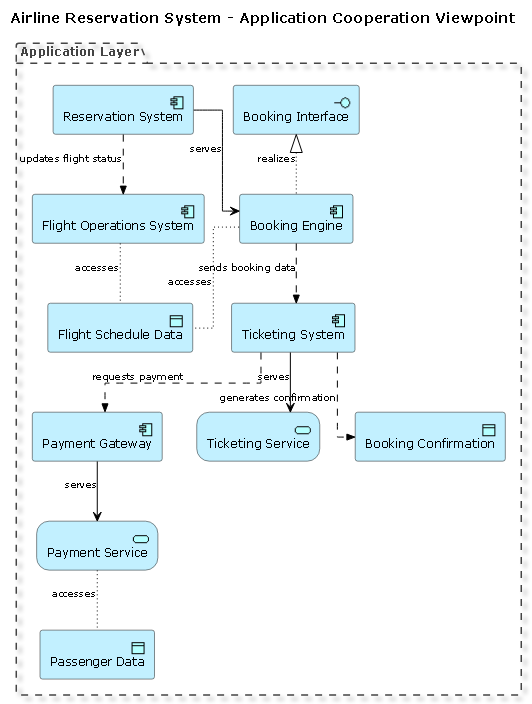
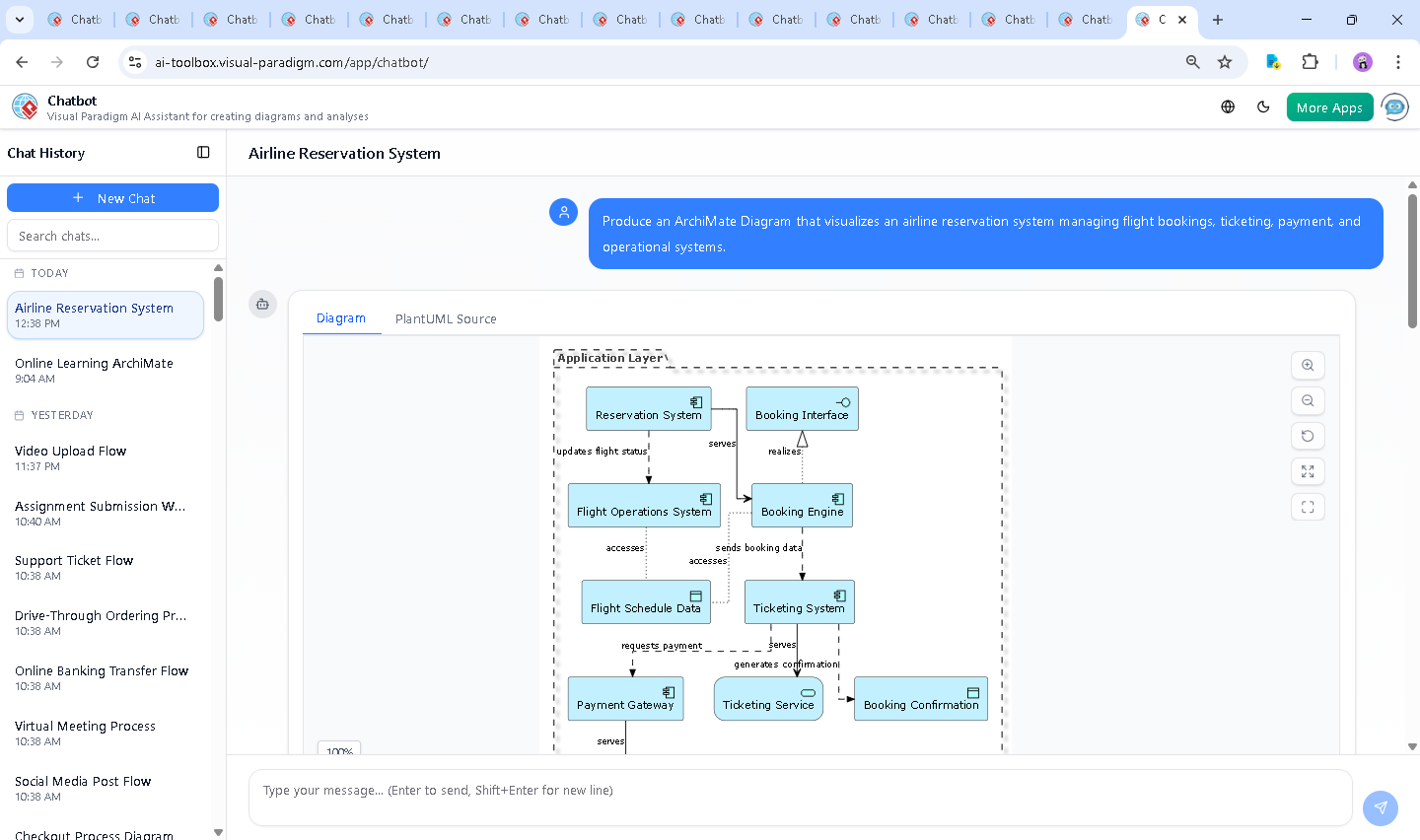
The journey began with a simple instruction: “Produce an ArchiMate Diagram that visualizes an airline reservation system managing flight bookings, ticketing, payment, and operational systems.” Within seconds, the AI Chatbot delivered a fully structured ArchiMate diagram using PlantUML syntax, already aligned with the Application Cooperation Viewpoint. It mapped core components like the Reservation System, Booking Engine, Ticketing System, Payment Gateway, and Flight Operations System—each represented as application components, services, and data objects.
But the real value emerged in the conversation. When the user asked, “What data objects are shared between the Ticketing System and the Payment Gateway?”, the AI didn’t just repeat the diagram—it interpreted the intent behind the question. It identified the critical data flows: Booking Request, Payment Confirmation, Error Responses, and Booking Reference Number. These weren’t just guessed—they were grounded in real-world transactional logic and standard architectural patterns.
Instead of a static output, the interaction became iterative. The AI suggested refining the diagram to explicitly show these shared data objects, demonstrating how the chatbot acts as a design consultant—proactively enhancing clarity and accuracy.
Visualizing the Airline Reservation System
Decoding the Architecture: Logic Behind the Diagram
The diagram reflects a well-structured Application Layer in ArchiMate’s cooperation viewpoint. Key elements include:
- Application Components: The Reservation System serves as the central hub, orchestrating interactions between the Booking Engine, Ticketing System, and Payment Gateway.
- Application Services: The Ticketing Service and Payment Service are realized by their respective components and exposed as reusable capabilities.
- Application Interfaces: The Booking Interface is realized by the Booking Engine, showing how user-facing functionality is implemented.
- Flow and Access Relationships: Rel_Flow connections illustrate data movement—such as booking data flowing from the Booking Engine to the Ticketing System, and payment requests to the Payment Gateway. Rel_Access shows data dependency, like the Booking Engine accessing Flight Schedule Data and the Payment Service accessing Passenger Data.
- Realization and Serving: The Booking Engine realizes the Booking Interface, and the Payment Gateway serves the Payment Service, reflecting the layered architecture and service abstraction.
The choice of Application Cooperation Viewpoint was deliberate. It emphasizes how components interact, share data, and support business processes—perfect for showing end-to-end flow in a reservation system.
Conversational Intelligence: How the AI Deepened the Design
The true power of the Visual Paradigm AI Chatbot lies in its ability to engage in technical dialogue. When the user asked about data shared between the Ticketing System and Payment Gateway, the AI didn’t stop at listing names. It explained the purpose, context, and modeling implications of each data object—turning a query into a design enhancement.
For example, the AI highlighted that the Booking Reference Number is essential for linking a payment transaction to a specific reservation, ensuring traceability and auditability. It also noted that error responses must be handled gracefully—critical for system resilience and user experience.
These insights weren’t added by accident. They reflect the AI’s deep understanding of enterprise architecture best practices, built into its training on real-world modeling standards and use cases.
Beyond ArchiMate: A Multi-Standard AI Modeling Platform
While this example focused on ArchiMate, the Visual Paradigm AI Chatbot is not limited to a single standard. It seamlessly supports UML, SysML, C4 Model, and Mind Maps—making it a unified environment for all visual modeling needs.
Whether you’re modeling software behavior with UML, designing system-level architecture with SysML, or visualizing microservices with C4, the AI Chatbot adapts its language and notation to your context. This versatility ensures that your team can use a single, intelligent platform across domains—without switching tools or relearning syntax.
Conclusion: Architect with Confidence, Not Guesswork
Designing an airline reservation system isn’t just about drawing boxes and arrows. It’s about understanding how systems interact, how data flows, and how failures are handled. The Visual Paradigm AI Chatbot turns this complexity into a conversational design process—where every question leads to a smarter, more accurate model.
Ready to build your next enterprise architecture with AI-driven insight? Start your session today and let the AI help you design with precision, clarity, and confidence.