


Designing a Digital Banking Ecosystem: From Concept to Collaborative Architecture
Creating a clear, accurate representation of a digital banking system requires more than just drawing boxes and lines. It demands a structured understanding of application layers, service interactions, and data dependencies—especially when aligning business goals with technical execution. The challenge lies in translating complex system behavior into a coherent visual model that stakeholders across IT, architecture, and product teams can interpret.
With Visual Paradigm’s AI Chatbot, this process transforms from a manual chore into a dynamic conversation. Instead of wrestling with syntax or diagramming conventions, users collaborate with an intelligent modeling partner that interprets intent, applies architectural best practices, and delivers a polished ArchiMate Diagram—crafted using the Visual Paradigm AI Chatbot.
From Prompt to Precision: The Collaborative Design Journey
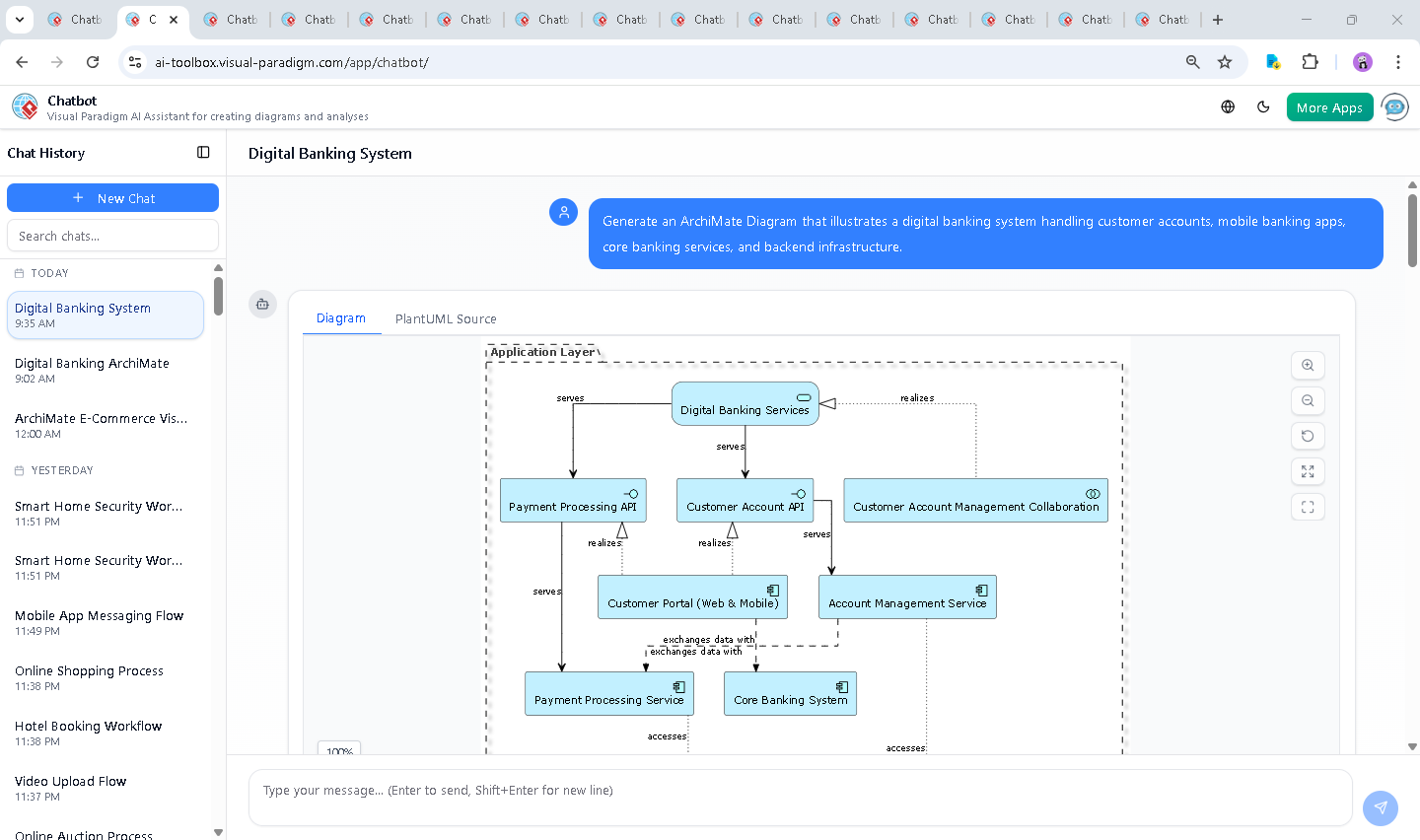
The journey began with a simple request: “Generate an ArchiMate Diagram that illustrates a digital banking system handling customer accounts, mobile banking apps, core banking services, and backend infrastructure.” Within seconds, the AI Chatbot responded with a fully rendered ArchiMate diagram in PlantUML syntax, already structured around the Application Cooperation Viewpoint.
But the real value emerged in the follow-up. When the user asked, “Explain this diagram,” the AI didn’t just list elements—it provided a narrative. It walked through the relationships: how the Customer Portal realizes the Account and Payment APIs, how those services serve the core banking functions, and how data is accessed and exchanged across components. This wasn’t a static output; it was an interactive design session where the AI acted as a modeling consultant.
Each clarification request—such as “Refine the logic around data access” or “Explain this branch”—was met with a precise update. The AI adjusted the diagram’s structure, clarified role responsibilities, and reinforced the use of ArchiMate’s standard notation for clarity and compliance.
Decoding the Architecture: A Deep Dive into the Logic
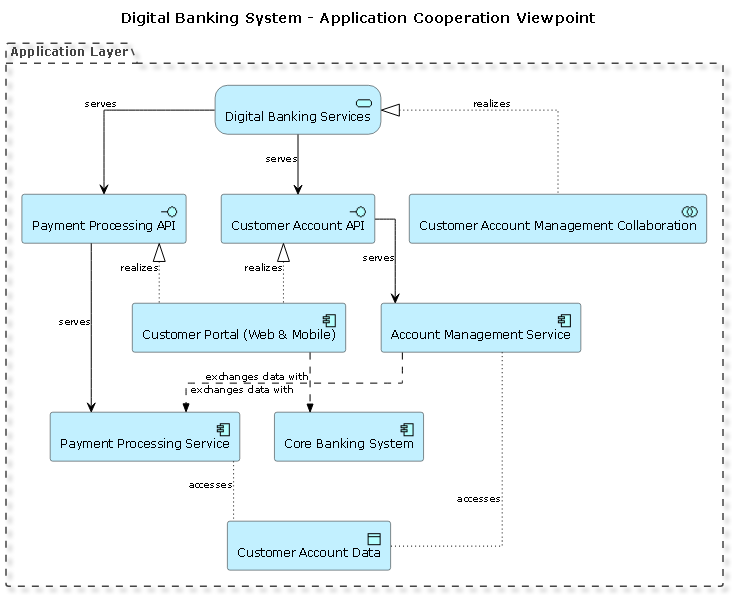
The final diagram captures a layered digital banking ecosystem, structured around the Application Layer in ArchiMate’s Cooperation Viewpoint. Here’s how each component contributes:
- Application Components: The Customer Portal (Web & Mobile) serves as the primary interface, realizing the Customer Account API and Payment Processing API. These interfaces are not standalone—they enable service delivery.
- Application Services: The Account Management Service and Payment Processing Service are the functional cores, serving the APIs and collaborating with the Core Banking System for transactional consistency.
- Data and Access: Customer Account Data is accessed by both services, emphasizing data integrity and shared access patterns. This reflects real-world practices where customer data is a shared asset across multiple services.
- Collaboration and Flow: The Customer Account Management Collaboration ties together the services and interfaces, illustrating how multiple components work in concert. The exchanges data with relationship between the Customer Portal and Core Banking System highlights integration points critical for real-time operations.
- Realization & Serving: The use of
realizesandservesrelationships follows ArchiMate’s standard semantics: a component realizes an interface, and a service serves an interface, ensuring traceability and design clarity.
The diagram’s layout—top-to-bottom, grouped into the Application Layer—aligns with best practices for readability and viewpoint focus. The PlantUML syntax is optimized for clarity, leveraging the Archimate-PlantUML library to ensure visual fidelity and compliance with ArchiMate 3.1 standards.
Conversational Intelligence: How the AI Enhances Design Thinking
What sets this interaction apart is the AI’s ability to respond to nuanced requests with architectural insight. When the user asked for an explanation, the AI didn’t just describe elements—it contextualized them. It clarified why certain relationships were used, how the design supports scalability, and how data access patterns reduce coupling.
For example, the AI explained that using accesses instead of flows between services and data objects reflects a data ownership model, where services consume data but don’t necessarily own it. This subtle distinction is critical in enterprise architecture and demonstrates the AI’s grasp of modeling semantics.
More Than ArchiMate: A Unified Modeling Platform
While this example showcases ArchiMate, the Visual Paradigm AI Chatbot is not limited to a single standard. It seamlessly supports UML for software design, SysML for systems engineering, C4 Model for software architecture, and even Mind Maps for ideation.
Whether you’re defining service boundaries in a microservices architecture, mapping enterprise capabilities in ArchiMate, or modeling system behavior with SysML, the AI Chatbot adapts to your needs. This versatility makes Visual Paradigm not just a diagramming tool—but an AI-powered visual modeling platform that evolves with your design journey.
Conclusion: A Smarter Way to Model
Designing a digital banking system isn’t just about technology—it’s about clarity, collaboration, and precision. With Visual Paradigm’s AI Chatbot, users gain a partner that understands architectural intent, applies industry standards, and refines designs through conversation.
Explore how your next system design can be shaped by intelligent collaboration. Try the AI Chatbot today and experience the future of visual modeling.