


Designing a Scalable E-Commerce Architecture with AI-Powered Precision
Building a robust e-commerce platform requires more than just coding—it demands a clear, layered understanding of how business goals translate into application logic and technology infrastructure. The challenge lies in visualizing how online ordering, payment processing, and order fulfillment interconnect across business, application, and technology layers—without losing clarity or consistency.
Enter the Visual Paradigm AI Chatbot: not just a diagram generator, but a conversational modeling expert that turns high-level intent into structured, standards-compliant architecture. By engaging in a natural dialogue, users guide the AI to build precise ArchiMate diagrams that reflect real-world system dynamics—ensuring alignment from strategy to deployment.
From Concept to Architecture: A Collaborative Design Journey
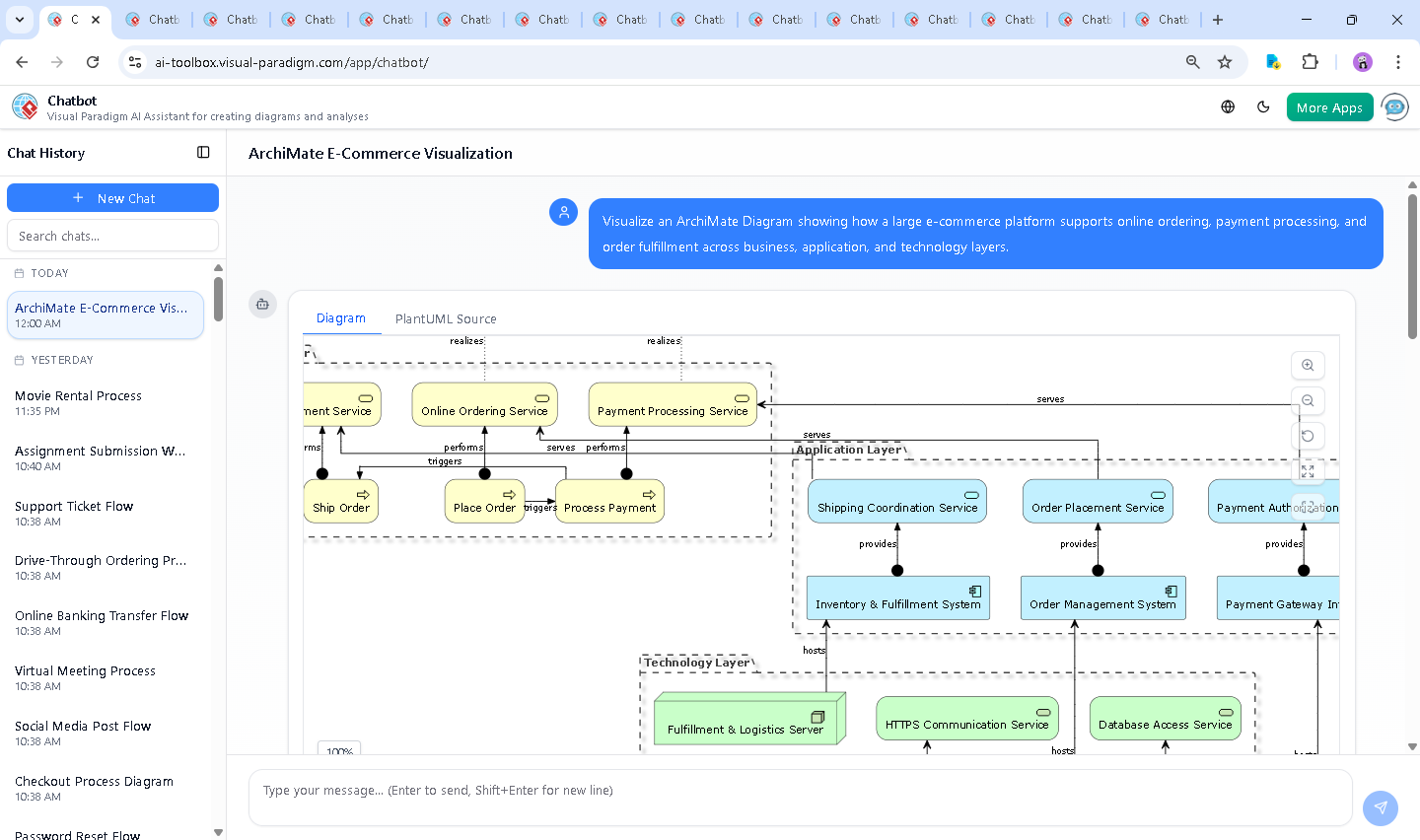
The journey began with a simple prompt: “Visualize an ArchiMate Diagram showing how a large e-commerce platform supports online ordering, payment processing, and order fulfillment across business, application, and technology layers.” Within seconds, the AI responded with a fully rendered ArchiMate diagram using PlantUML syntax, structured across the three core layers and enriched with motivation elements.
But the conversation didn’t stop there. The user asked, “What role does the inventory & fulfillment system play in order fulfillment?” Instead of a static answer, the AI delivered a detailed, role-specific breakdown—explaining how the system validates stock, manages real-time inventory, coordinates packing and shipping, and updates order status. This wasn’t just documentation; it was architectural insight.
With that context, the user requested refinements: “AI, refine the logic to highlight the trigger sequence between processes.” The AI immediately updated the diagram, strengthening the Rel_Triggering_Right relationships between Place Order → Process Payment → Ship Order, ensuring the causal flow was visually and semantically accurate.
Each interaction deepened the model’s fidelity. The AI didn’t just respond—it interpreted, contextualized, and evolved the design in real time, demonstrating its ability to act as a collaborative modeling partner.
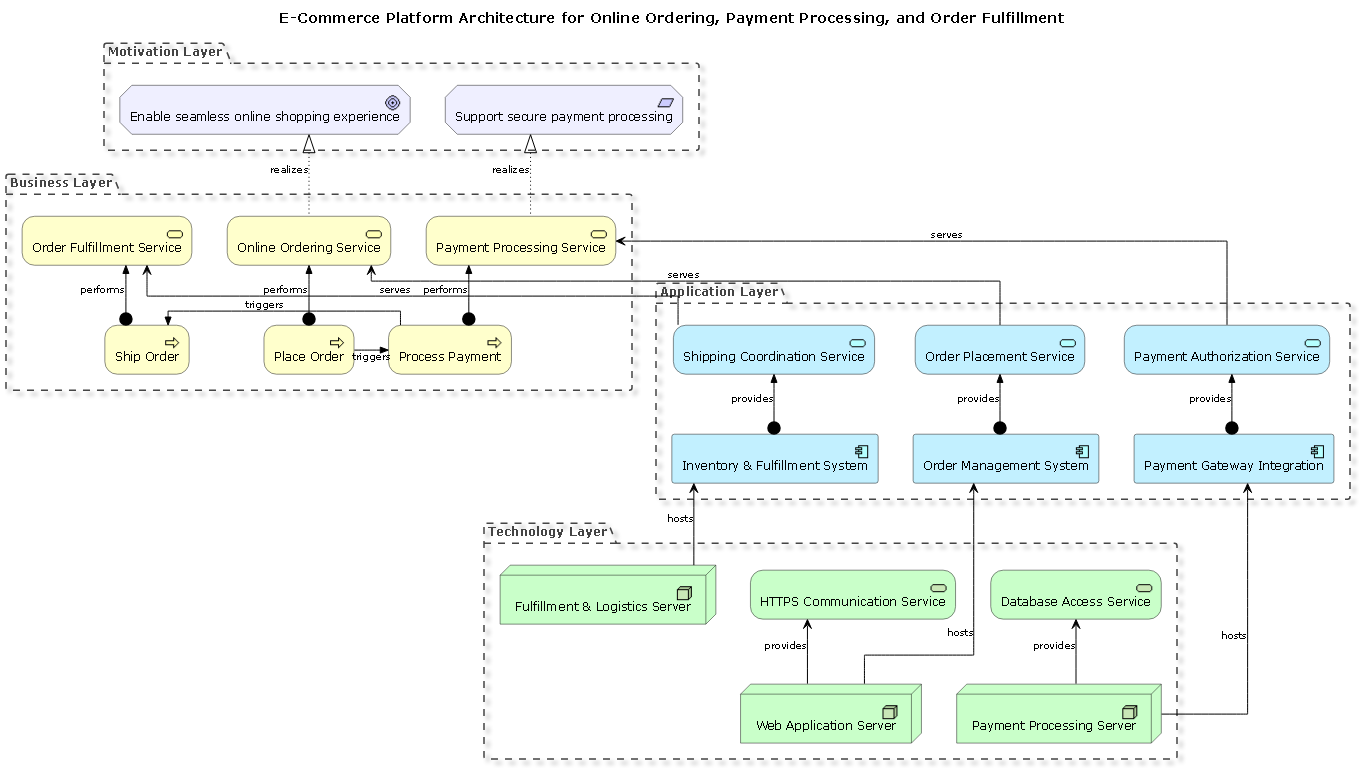
Decoding the ArchiMate Diagram: Logic and Layered Design
The final diagram captures the end-to-end flow of a modern e-commerce platform through a rigorous ArchiMate structure. Here’s how each layer contributes:
📍 Motivation Layer
At the top, the Enable seamless online shopping experience goal and Support secure payment processing requirement define the strategic drivers. These are not abstract concepts—they are the foundation for every technical decision below.
💼 Business Layer
The core business services—Online Ordering Service, Payment Processing Service, and Order Fulfillment Service—are the operational faces of the platform. Each is linked to a business process: Place Order, Process Payment, and Ship Order. The Rel_Assignment_Up relationships show that these processes are executed by their respective services.
💻 Application Layer
Underpinning the business layer are three key application components:
- Order Management System – orchestrates order creation and validation.
- Payment Gateway Integration – handles secure transaction authorization.
- Inventory & Fulfillment System – manages stock, packing, and logistics.
Each component provides one or more application services (e.g., Order Placement Service, Shipping Coordination Service), forming a clear vertical stack of responsibilities.
⚙️ Technology Layer
The infrastructure layer hosts the application components and provides foundational services:
- Web Application Server hosts the order and payment systems.
- Payment Processing Server secures transaction handling.
- Fulfillment & Logistics Server runs the inventory and shipping logic.
- HTTPS Communication Service and Database Access Service ensure secure, reliable data flow.
These are linked via Rel_Serving_Up relationships, showing that technology nodes provide the runtime environment for application components and services.
🔄 Flow and Triggers
The diagram’s strength lies in its causal logic. The Rel_Triggering_Right arrows create a clear sequence: Place Order triggers Process Payment, which in turn triggers Ship Order. This reflects the real-world dependency chain—no payment, no fulfillment.
🔍 Why ArchiMate?
ArchiMate was chosen because it explicitly models relationships between strategy, business, application, and technology—perfect for enterprise-grade systems. The use of Realization, Serving, Assignment, and Triggering relationships ensures semantic precision, making the diagram both visually intuitive and analyzable by architects, developers, and stakeholders alike.
AI-Powered Modeling: Beyond Diagrams, Into Insight
The true power of the Visual Paradigm AI Chatbot lies in its ability to function as a modeling consultant. Unlike traditional tools that require users to manually place elements and define relationships, the AI understands context, anticipates intent, and corrects assumptions.
For example, when the user asked about the inventory system’s role, the AI didn’t just list functions—it explained how it acts as a bridge between order and logistics, prevents stock-outs, and enables real-time updates. This level of contextual intelligence is built into the chatbot’s training, enabling it to deliver expert-level guidance during the design process.
Moreover, the AI’s support extends far beyond ArchiMate. Whether you’re modeling a microservices architecture in UML, designing system behavior with SysML, or visualizing software architecture with the C4 Model, the AI Chatbot adapts seamlessly. This versatility makes Visual Paradigm not just a diagramming tool—but a unified, intelligent platform for all visual modeling needs.
Conclusion: Design with Confidence, Build with Clarity
Creating a scalable e-commerce platform demands more than technical skill—it requires architectural clarity. With Visual Paradigm’s AI Chatbot, you’re not just generating diagrams; you’re co-designing systems with a smart, responsive partner that understands the ‘why’ behind every relationship.
Whether you’re a business architect, software designer, or technical lead, the ability to refine your model through natural conversation—asking for explanations, requesting refinements, and exploring implications—transforms architecture from a static artifact into a living, evolving blueprint.
Experience the future of visual modeling. Explore the full session and see how AI is redefining enterprise architecture.